We need to forget about formal terminology for a few moments- and just observe, observe, observe.
One of the mistakes many practitioners make is trying to match every trichoscopic image to a known list of “trichoscopic signs.”
Although this cataloguing is important, true trichoscopic skill starts somewhere much simpler:
State what you see!
The terminology comes later. The difficult part of trichoscopy (and in fact, all of hair loss diagnosis) is developing the power of simple observation.
The detective Sherlock Holmes once said
“You see, but you do not observe.”
Indeed, many people look at things without truly processing what they are seeing.
When I perform trichoscopy, I don’t begin with trying to find terms that fit with textbook terms. I begin with observing:
• shapes
• loops
• colors
• symmetry
Only afterwards do I attach terminology – and then seek to link what I observe with disease pathogenesis and ultimately a diagnosis.
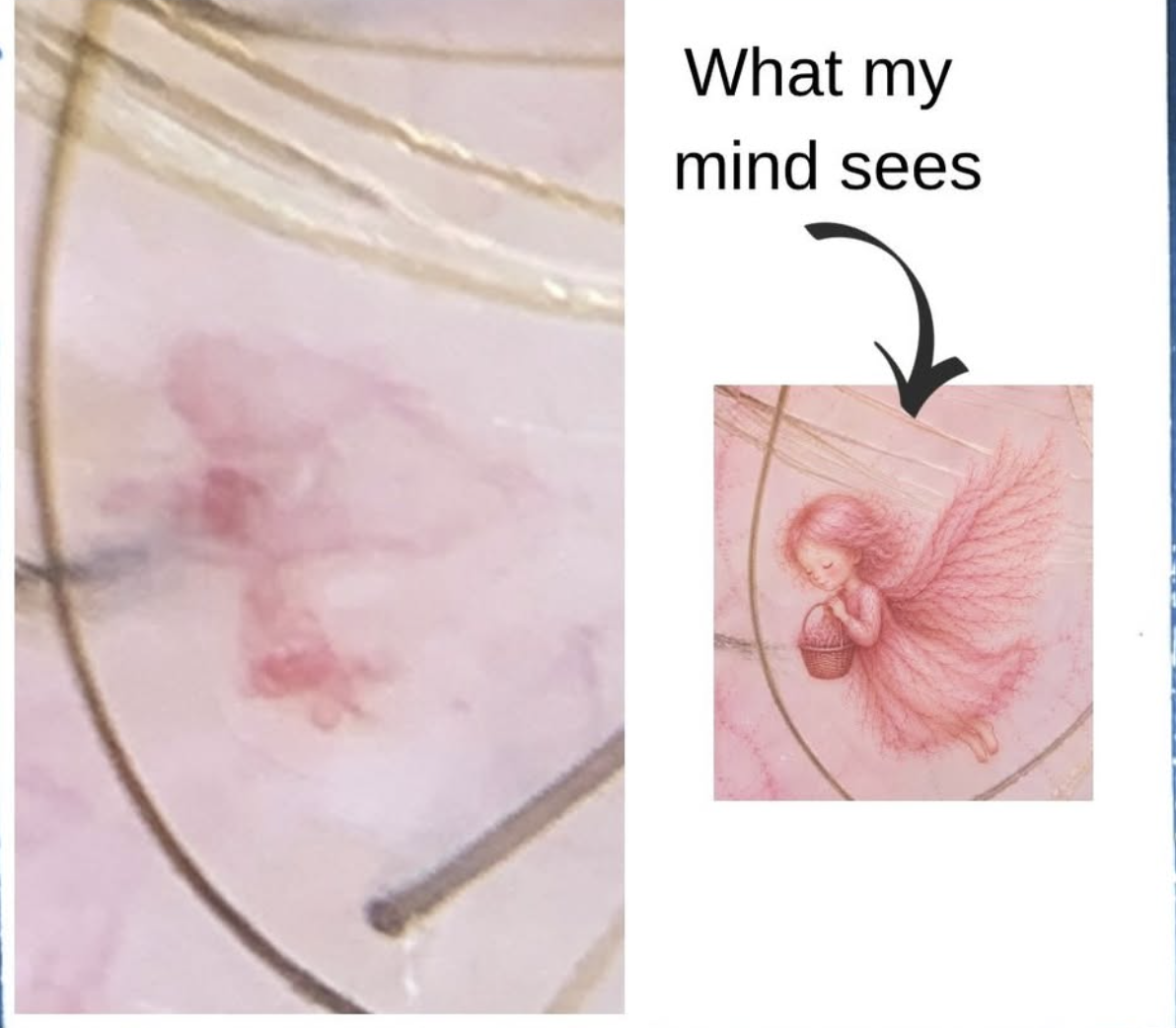
As an example, consider this image.
I ask practitioners…. What do you see?
In nearly all situations, I hear some wonderful answers about vascular patterns and bleeding.
After listening to a few answers, I let the audience know that to my eye, it looks like “a fairy holding a bucket.”
That may sound silly — but it’s actually incredibly useful.
By describing the image in a simple term, I am forcing myself to state what I see not what I think matches some textbook definition of vascular patterns.
Yes, these are likely thin loops (vascular structures) related to seborrheic dermatitis…but I allow my brain to reach that conclusion only later.
To me, trichoscopy is more than memorization. It is a wonderful form of biologic storytelling. We tell the best stories when we observe – rather than state what we think we are supposed to be seeing≠≠≠