Key takeaways:
- Thirteen states currently require alpha-gal syndrome reporting.
- Major news outlets and the American Gastroenterological Association have increased public and provider awareness of this allergic condition.
It has been nearly 9 months since the first documented alpha-gal syndrome fatality from mammalian meat consumption was reported in The Journal of Allergy and Clinical Immunology: In Practice.
Within the past year, tick populations have expanded, more states are requiring alpha-gal syndrome (AGS) reporting and research on onset to diagnosis timing has been published, according to Gary Falcetano, PA-C, AE-C, senior manager of global medical and scientific affairs for allergy/ImmunoDiagnostics at Thermo Fisher Scientific.

Healio spoke with Falcetano to learn more about these and other changes in AGS over the past year, as well as what clinicians should know about this allergic condition.
Healio: Have tick populations continued to expand over the past year? What should clinicians know about where they are now?
Falcetano: Yes, and the trend shows no indication of reversal. Both the lone star tick (Amblyomma americanum) and its primary mammalian hosts continue to expand their geographic ranges, driven in part by ecological shifts and changing land-use patterns. White-tailed deer populations in particular are increasingly present in peri-urban and suburban environments well beyond the tick’s historical stronghold in the American Southeast, facilitating the parallel spread of tick populations into new regions.
A notably recent development is the growing evidence that the lone star tick may not be the exclusive vector associated with sensitization to AGS. In 2025, CDC investigators described a case of AGS in Maine following a confirmed bite from the blacklegged tick (Ixodes scapularis), alongside statewide surveillance findings suggesting that AGS may occur outside the established lone star tick distribution.
In a separate report, a case from Washington State documented the onset of AGS following exposure to the western blacklegged tick (Ixodes pacificus), with a corresponding rise in alpha-gal-specific IgE after the reported bites. While these observations remain limited in number and the majority of confirmed U.S. cases continue to be associated with the lone star tick, they collectively raise the possibility that multiple tick species may be capable of triggering sensitization under certain conditions.
Taken together, these trends underscore an increasingly fluid epidemiologic landscape in which geographic assumptions are becoming less reliable. With greater population mobility, incidental exposure during travel and the ongoing northward and westward expansion of tick habitats driven by climate and ecological change, clinicians in all regions — not only historically endemic areas — should consider AGS in the differential diagnosis for patients presenting with delayed-onset, unexplained allergic reactions.
Healio: What new data from the past year have advanced our understanding of AGS?
Falcetano: Several meaningful developments have emerged over the past year, spanning surveillance infrastructure, diagnostic research and disease characterization.
Perhaps the most significant structural shift is the rapid expansion of mandatory state-level reporting requirements for AGS. Arkansas pioneered mandatory reporting on Sept. 11, 2023, becoming the first state in the country to require it. Since then, reported cases in Arkansas alone have climbed from 304 in 2023 to 3,781 in 2025 — a trajectory that underscores both the value of surveillance infrastructure and the scale of what has gone uncounted in states without it.
Since then, the list has grown to more than a dozen states, including Delaware, Iowa, Kentucky, Nebraska, North Dakota, Oregon, Rhode Island, South Carolina, Tennessee, Virginia, West Virginia and most recently Massachusetts (effective April 1, 2026). Additional states, including Missouri and Oklahoma, have active legislation under consideration. This represents a significant inflection point. Without consistent reporting, the CDC estimate of at least 450,000 affected Americans is almost certainly an undercount, and the new surveillance infrastructure will help close that gap.
The diagnostic picture is becoming clearer. In a 2024 publication examining 3,000 U.S. military recruits, researchers found alpha-gal IgE sensitization rates of 39% in Arkansas, 35% in Oklahoma and 29% in Missouri — far above the cohort-wide prevalence of 6%. The geographic distribution of sensitization closely mirrored the known range of the lone star tick, further supporting the link between tick exposure and alpha-gal sensitization. Research published in JAMA Network Open in 2025, co-authored by Scott P. Commins, MD, PhD, and CDC colleagues, examined time from onset to diagnosis among AGS patients, underscoring persistent delays that remain a barrier to timely care.
On the mechanistic side, a 2025 single-cell mRNA analysis of circulating immune cells from Commins’ lab at UNC Chapel Hill is advancing our understanding of the immunological profile of patients with AGS, which may ultimately inform future therapeutic targets. Collectively, this body of work confirms AGS as an underdiagnosed, increasingly geographically distributed condition with a surveillance system that is finally beginning to catch up to its true scope.
Healio: Are there any new data on potential treatments for AGS?
Falcetano: At present, avoidance of alpha-gal-containing foods and prevention of additional tick bites remain the primary management strategies for AGS. However, there has been growing interest in omalizumab (Xolair; Genentech/Novartis), which became the first FDA-approved medication to reduce allergic reactions associated with IgE-mediated food allergies in patients aged 1 year and older in 2024. Early evidence suggests it may help some patients with AGS who continue to experience symptoms despite dietary avoidance, particularly those who react to trace exposures.
Earlier clinical work showed that patients with AGS who continued to experience symptoms despite an avoidance diet responded well to 300 mg omalizumab every 4 weeks, with mean urticaria activity scores dropping substantially by 12 weeks of therapy. A more recent review of patient-reported outcomes from online support groups found that 84% of 57 patients with AGS who shared their experience with omalizumab described a positive response. Importantly, because omalizumab is manufactured in Chinese hamster ovary cells that may variably express alpha-gal, there is a theoretical risk for anaphylaxis in this population, and clinicians should weigh that consideration. Omalizumab is not a cure and is not intended to allow unrestricted red meat consumption, but it has proven particularly meaningful for patients who react to trace exposures or fumes from cooking.
A second area of early interest is metformin. It has been noted in published work that a small number of patients with AGS taking metformin in preparation for bariatric surgery were able to resume dairy consumption and, in some cases, return red meat to their diets. The mechanism is not yet established, but metformin’s known immunomodulatory properties make it a compelling candidate for further study. This remains early-stage, and a formal clinical trial has not yet been completed, but it represents one of the more intriguing signals in the AGS treatment pipeline.
Healio: How has the first documented AGS fatality impacted awareness and clinical practice?
Falcetano: The first documented and widely reported death from AGS, published in November 2025, was an eye-opening moment for the field. A previously healthy 47-year-old from New Jersey died in September 2024 after consuming a hamburger at a barbecue, approximately 4 hours after ingestion. The death was initially ruled unexplained. His wife’s persistence in seeking answers led to Thomas A.E. Platts-Mills, MD, PhD, who was instrumental in the initial identification of alpha-gal allergy. His investigation eventually confirmed fatal anaphylaxis consistent with AGS.
The national media coverage that followed was extensive and, from a public health standpoint, valuable. Major outlets including CNN, ABC News, CBS News and numerous regional publications covered the case, bringing AGS to a level of public awareness it had never previously reached. For clinicians, the case reinforced two critical points.
First, the delayed nature of AGS reactions does not predict severity. As Platts-Mills noted, even a fatal event can present with 4 hours of no symptoms before collapse. That delay remains one of the most dangerous features of this condition, because patients and clinicians alike may not connect the symptom to the meal.
Second, provider awareness remains dangerously low. A 2023 CDC survey found that 42% of health care providers were unaware of AGS, and 35% lacked confidence in their ability to diagnose or manage it. The fatality has elevated the urgency of that education gap and accelerated the legislative push for mandatory state reporting. The case is a reminder that AGS is not a nuisance condition. It can be fatal, mimic other diagnoses and requires a high index of suspicion in any patient presenting with delayed, unexplained allergic reactions.
Healio: Looking ahead, what aspects of AGS most need further research, and why is this research important for patients?
Falcetano: The research agenda for AGS is substantial, and several areas stand out as particularly consequential for patient outcomes.
The first priority is understanding what drives the dramatic variation in sensitization and symptom severity. Not everyone bitten by a lone star tick develops AGS, and among those who do, some react to trace amounts of alpha-gal while others tolerate modest exposures without symptoms. We do not yet fully understand the immunological or genetic factors that determine who becomes sensitized and why some patients experience anaphylaxis while others present with isolated gastrointestinal symptoms or even chronic urticaria. Single-cell immune profiling work is beginning to address this question, but it will take time to translate into clinical guidance.
The second priority is tick-level intervention. One of the most compelling long-term possibilities is the development of a vaccine or other approach that could prevent alpha-gal sensitization at the point of tick exposure, before the immune cascade begins. Research into tick saliva components and the mechanism of alpha-gal transfer is foundational to that goal.
Third, we need properly designed clinical trials for pharmacologic treatments. The signals around omalizumab and metformin are encouraging, but they are based on small observational series and patient-reported data. Prospective, controlled trials are needed to establish efficacy, optimal dosing and durability of effect.
Finally, the surveillance infrastructure now being built through state reporting requirements will enable the epidemiological research needed to understand true incidence, geographic distribution and demographic patterns. That foundation is essential for making the public health case for resources and for designing meaningful prevention programs as tick populations continue to expand.
Healio: What else should clinicians know about AGS?
Falcetano: One aspect that deserves more clinical attention is the gastrointestinal (GI)-dominant phenotype. A subset of patients with AGS develop GI symptoms, including abdominal pain, diarrhea, nausea and vomiting, without classic skin findings or anaphylaxis. These patients are frequently misdiagnosed with irritable bowel syndrome, food poisoning or other GI conditions, sometimes for years. The American Gastroenterological Association has issued a clinical practice update directing GI clinicians to be aware of AGS specifically because of this presentation pattern.
I also want to reiterate the critical role of proper diagnostic testing. Serologic laboratory testing using ImmunoCAP Specific IgE alpha-Gal assay (Thermo Fisher Scientific) is the appropriate tool, and it must always be interpreted alongside clinical history. A positive test alone does not confirm clinical allergy. Patients can carry alpha-gal-specific IgE without experiencing symptoms, a phenomenon known as irrelevant sensitization, which is why testing should be reserved for patients whose history and presentation are consistent with AGS rather than used as a broad screening tool.
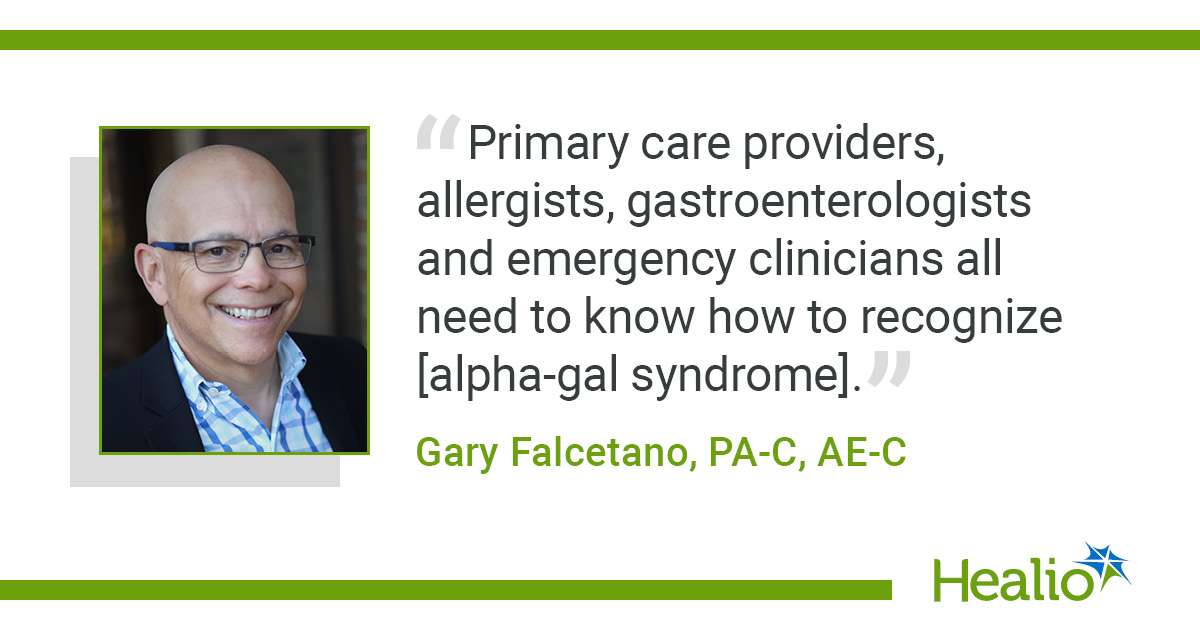
The bottom line is that AGS is no longer a regional curiosity. It is an expanding, potentially life-threatening condition that primary care providers, allergists, gastroenterologists and emergency clinicians all need to know how to recognize. The first documented fatality confirmed it, the expanding tick range reinforces it and the growing network of state reporting requirements is beginning to build the data foundation we need to respond to it at scale.
For more information:
Gary Falcetano, PA-C, AE-C, can be reached at gary.falcetano@thermofisher.com.
Sources/Disclosures
Source:
Healio Interviews
References:
- Ailsworth SM, et al. J Allergy Clin Immunol Pract. 2023;doi:10.1016/j.jaip.2023.10.046.
- Alpha-gal syndrome added to Oklahoma’s reportable disease list. https://www.newson6.com/health/alpha-gal-syndrome-added-to-oklahomas-reportable-disease-list. Published May 11, 2026. Accessed June 23, 2026.
- Alpha-gal syndrome cases rising in Arkansas. https://www.ktlo.com/2026/05/06/alpha-gal-syndrome-cases-rising-in-arkansas/. Published May 6, 2026. Accessed June 23, 2026.
- Altomari C, et al. J Allergy Clin Immunol. 2025;doi:10.1016/j.jaci.2024.12.327.
- Butler WK, et al. Emerg Infect Dis. 2025;doi:10.3201/eid3104.240577.
- Carpenter A, et al. MMWR Morb Mortal Wkly Rep. 2023;doi:10.15585/mmwr.mm7230a1.
- Choudhary SK, et al. Front Immunol. 2025;doi:10.3389/fimmu.2025.1629310.
- Commins SP. Expert Rev Clin Immunol. 2020;doi:10.1080/1744666X.2020.1782745.
- Commins S. J Allergy Clin Immunol. 2020;doi:10.1016/j.jaci.2019.12.468.
- Emerging tick-bite associated meat allergy potentially affects thousands. https://www.cdc.gov/media/releases/2023/p0727-emerging-tick-bites.html. Published July 27, 2023. Accessed June 23, 2026.
- Maki CK, et al. JAMA Netw Open. 2025;doi:10.1001/jamanetworkopen.2024.61729.
- McGill SK, et al. Clin Gastroenterol Hepatol. 2023;doi:10.1016/j.cgh.2022.12.035.
- Missouri alpha-gal patients push for bill to mandate reporting: ‘This is a systemic issue.’ https://www.kcur.org/health/2026-01-22/missouri-alpha-gal-patients-push-for-bill-to-mandate-reporting-this-is-a-systemic-issue. Published Jan. 22, 2026. Accessed June 23, 2026.
- Over 10 states now require mandatory reporting of syndrome marker tests. https://www.prismnews.com/news/over-10-states-now-require-mandatory-reporting-of-syndrome. Published April 2, 2026. Accessed June 23, 2026.
- Platts-Mills TAE, et al. J Allergy Clin Immunol Pract. 2025;doi:10.1016/j.jaip.2025.09.039.
- Saunders EF, et al. Emerg Infect Dis. 2025;doi:10.3201/eid3104.241265.
Disclosures:
Falcetano reports being employed with Thermo Fisher Scientific.

Ask a clinical question and tap into Healio AI’s knowledge base.
- PubMed, enrolling/recruiting trials, guidelines
- Clinical Guidance, Healio CME, FDA news
- Healio’s exclusive daily news coverage of clinical data