
Key takeaways:
- Comprehensive obesity care requires a multidisciplinary approach in which gastroenterologists play a key role.
- Endoscopic, bariatric and metabolic therapies fill a critical gap between medications and surgery.
AGA’s recent white paper provides a framework to navigate the latest innovations in obesity care, including GLP-1 receptor agonists, personalized treatment plans and endoscopic, bariatric and metabolic therapies.
The new commentary is a follow up to AGA’s 2017 publication, “POWER: Practice Guide on Obesity and Weight Management, Education, and Resources,” and encourages gastroenterologists to take initiative in treating the disease in their daily practice.

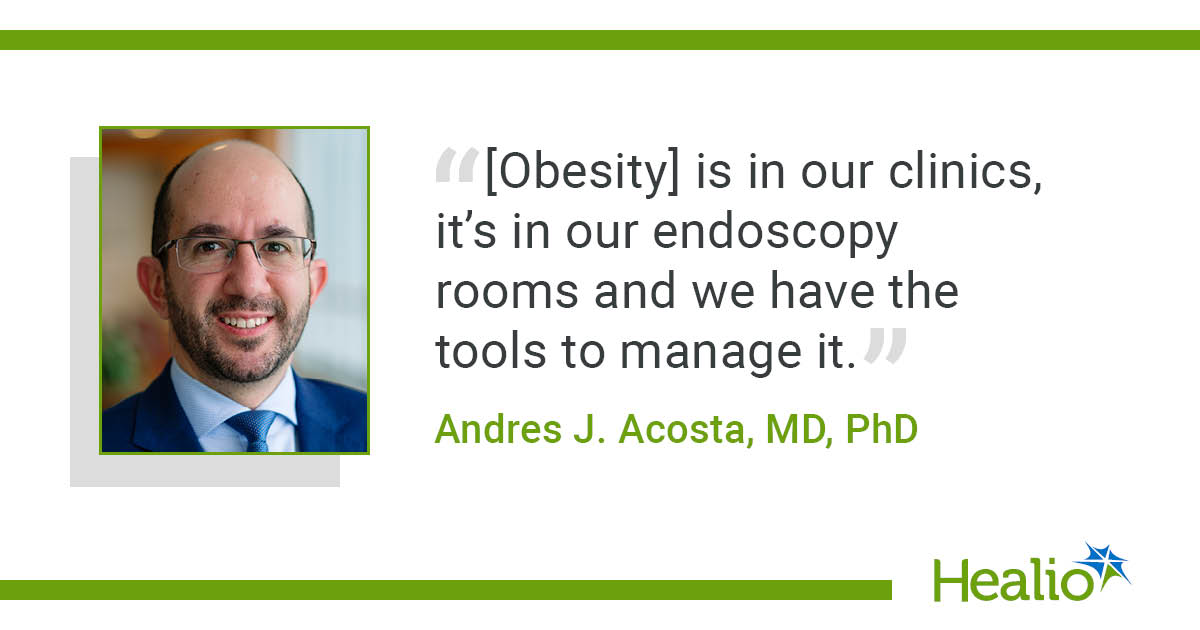
“Now more than ever, gastroenterologists need to embrace treating obesity,” lead author Andres J. Acosta, MD, PhD, professor of medicine and consultant in gastroenterology and hepatology at Mayo Clinic, told Healio. “[Obesity] is in our clinics, it’s in our endoscopy rooms and we have the tools to manage it.”
Healio spoke with Acosta about the changes from the 2017 paper after developments in the fields of obesity and cardiometabolic diseases, the role of endoscopic, bariatric and metabolic therapies (EMBTs) in a landscape dominated by GLP-1s and more.
Healio: What critical changes from the 2017 paper would you first like to highlight?
Acosta: We’re living in a completely different era of obesity care than we were in 2017. It seems like all anyone wants to talk about is GLP-1s, which are super exciting. In 2017, the only GLP-1 approved for obesity was liraglutide. Since then, we have had this boom in GLP-1s. It was essential to create this document to summarize how pharmacotherapy has changed now that we live in this GLP-1 era.
It’s also important to say there has been a lot of very important progress on endoscopic procedures, with pivotal trials for intragastric balloons, as well as endoscopic sleeve gastroplasty and other new techniques like duodenal resurfacing. They are changing the way that we can use our endoscopic tools to manage obesity.
There has also been a lot of progress in precision obesity and precision bariatrics that focus on how we should treat each individual.
Healio: How does the new recommendation to use tools other than BMI alone when classifying clinical obesity impact diagnostic decision-making?
Acosta: A group of experts supported by The Lancet Commission advised that clinicians talk more about preclinical obesity in those people who only have an excess of adiposity without an obesity-related comorbidity. What I think is most important to take away from that recommendation is that BMI is not a perfect tool to diagnose and classify obesity. We need to go back to the core of obesity, which is excess adiposity and how that excess fat mass contributes to comorbidities.
Healio: What impact does the shift toward reframing obesity as an aspect of broader cardiometabolic-based chronic disease have on treatment priorities and multidisciplinary collaboration?
Acosta: It’s essential to know that obesity doesn’t come by itself. We need to treat obesity, not for cosmetic reasons, but because obesity is an independent risk factor for overall mortality and cardiovascular disease. We know that the root cause of those cardiometabolic diseases is obesity, and we need to manage that root cause.
Healio: How does the updated paper position EBMTs relative to approved obesity medications and bariatric surgery?
Acosta: Endoscopic, bariatric and metabolic therapies play a key role in managing obesity. They fill the gap between medications and surgery. They are fewer invasive procedures with durable effects, and they’re not as expensive as the medications. We have seen the high level of evidence for EBMTs’ efficacy in different randomized, multicenter, placebo- controlled trials.
It’s important for gastroenterologists to know there are new [EBMT-specific Current Procedural Terminology] codes they can use to be reimbursed for doing these procedures. Not every patient responds to GLP-1, not every patient wants to try a GLP-1 and not every patient tolerates a GLP-1. We can tell our patients we have other tools that are quite safe and effective as well, such as bariatric procedures and endoscopic, bariatric and metabolic therapies.
Healio: How can gastroenterologists integrate new techniques discussed in the paper into their practices?
Acosta: Many GI practices have already adopted obesity as a key [risk factor] to manage. We can prescribe the medications and manage their side effects better than anyone else because they are GI-related. We can also offer the next level of care, like endoscopic and bariatric procedures, partnering with our surgeon colleagues.
At the end of the day, all these new obesity therapies are affecting the gut-brain axis. Our clinics are flooded with patients with obesity, because many obesity comorbidities are GI-related. GERD, fatty liver disease, diverticulitis, inflammatory bowel disease, even colon cancer — all these conditions are associated with obesity. If you have a patient with GERD and obesity, treat their GERD, of course, but also treat their obesity. That’s how we need to think about this.
For more information:
Andres J. Acosta, MD, can be reached at acosta.andres@mayo.edu.
Sources/Disclosures
Source:
Acosta A, et al. Gastroenterology. 2026;doi:10.1053/j.gastro.2026.04.016.
Disclosures:
Acosta reports consulting roles with Amgen, Boehringer Ingelheim, Busch Health, Currax Pharmaceuticals, General Mills, Gila Therapeutics, Nestlé, Novo Nordisk, Phenomix Sciences, RareDiseases, Regeneron, Rhythm Pharmaceuticals and Structure Therapeutics; funding support from Apollo Endosurgery, Boehringer Ingelheim, Dairy Management Institute, Delaney Foundation, NIH, Novo Nordisk, Regeneron, Rhythm Pharmaceuticals, Satiogen Pharmaceuticals, Spatz Medical and Vivus; and licensing from Gila Therapeutics and Phenomix Sciences for his research technologies at University of Florida and Mayo Clinic. Please see the paper for all other authors’ relevant financial disclosures.

Ask a clinical question and tap into Healio AI’s knowledge base.
- PubMed, enrolling/recruiting trials, guidelines
- Clinical Guidance, Healio CME, FDA news
- Healio’s exclusive daily news coverage of clinical data