
Key takeaways:
- Adults with perianal Crohn’s disease who are anti-TNF-naive and have shorter disease duration benefited most from upadacitinib.
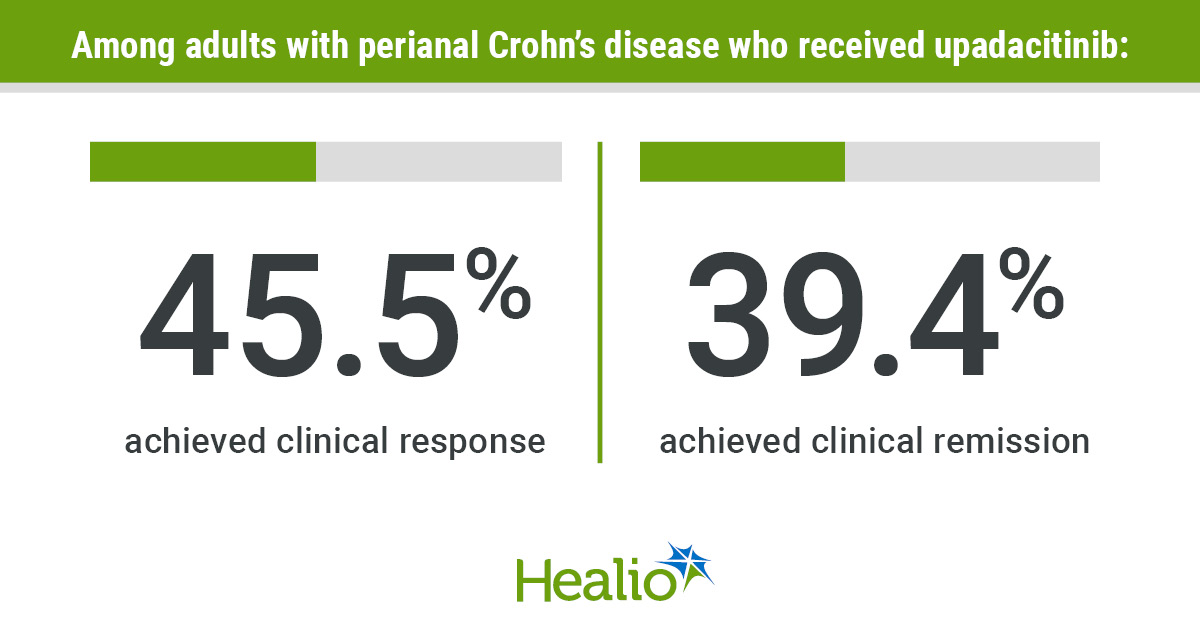
- Nearly half (45.5%) of patients achieved clinical response at 6 months.
Upadacitinib improved fistula outcomes in adults with perianal Crohn’s disease, with the strongest benefit reported among those who had no history of tumor necrosis factor inhibition use and those treated earlier in their disease course.
Retrospective cohort study data published in Clinical Gastroenterology and Hepatology showed that 45.5% of patients achieved clinical response and 39.4% achieved clinical remission.

Data derived from Devi J, et al. Clin Gastroenterol Hepatol.2026;doi:10.1016/j.cgh.2026.05.003.

Parakkal Deepak
“I don’t recall any prior studies that have shown a relationship between duration of perianal disease in response to this treatment,” Parakkal Deepak, MBBS, MS, co-director of the IBD Center and director of clinical and translational research in the division of gastroenterology at Washington University School of Medicine in St. Louis, told Healio.
“In Crohn’s disease, people have shown that longer disease duration tends to respond less well to any advanced therapy. Here we are showing this [result] with upadacitinib, but we are showing it specifically in the perianal Crohn’s disease cohort, which is novel.”
Post-hoc analysis of phase 3 trials have demonstrated efficacy of upadacitinib (Rinvoq, AbbVie) in perianal Crohn’s disease, but data are lacking on real-world effectiveness, according to study background. Efficacy data were also lacking in MRI endpoints.
For that reason, Deepak and colleagues conducted a multicenter, retrospective cohort study evaluating clinical and radiologic outcomes among patients with perianal Crohn’s disease who received upadacitinib.
“With Crohn’s disease, we often talk about a 40% to 50% therapeutic ceiling with most medications,” Deepak said. “That therapeutic ceiling is even lower in patients with refractory condition of perianal Crohn’s disease, broadly around 30% to 35%.
“Because it’s a smaller subset of patients with Crohn’s disease, you need strength in numbers across multiple sites to answer questions in this area,” he added.
The analysis included 125 adults (56% men; median age, 33 years; 50.4% white) with active perianal Crohn’s disease who received treatment with upadacitinib at 10 centers across North America. More than three-quarters (77.4%) had a history of anti-TNF use and 48% had complex fistulas.
Clinical response, defined as at least a 3-point reduction in Perianal Disease Activity Index (PDAI) score, served as the primary outcome. Secondary outcomes included clinical remission, defined as no greater than a 4-point reduction in PDAI score with either a 3-point decrease or no worsening from baseline; at least a 50% reduction in C-reactive protein; pelvic MRI outcomes; and rates of hospitalization, antibiotic use and perianal Crohn’s disease-related surgery.
The majority of patients received 45 mg upadacitinib at induction (98%), with some patients receiving 15 mg (1%) or 30 mg (1%). The induction phase lasted 12 weeks for most patients (93%), with others undergoing an 8-week induction. Nearly all patients (99%) transitioned to a 30 mg maintenance phase.
At first follow-up (median, 6 months), data showed 45.5% of patients achieved clinical response.
Researchers observed significantly higher clinical response in patients with no history of anti-TNF use (66.7% vs. 33.3%; HR = 0.38; 95% CI, 0.22-0.66) and those with shorter disease duration (54.7% vs. 33.3%), defined as less than 2 years.
Significant improvements also were observed across multiple PDAI domains, mostly discharge (59.6%), pain and restriction of activities (56.6%), degree of induration (44.4%) and restriction of sexual activity (36.4%), as well as type of perianal disease (16.2%).
A total of 39.4% of patients achieved clinical remission, 13.1% underwent perianal surgery and 5.1% were hospitalized. About a fifth (20.2%) achieved CRP reduction of more than 50%.
Of 78 patients with follow-up pelvic MRI data, 55.1% had radiologic improvement and 11.5% achieved complete healing.
The study had limitations, including its observational design, potential bias, limited long-term follow-up and availability of pelvic MRI data for slightly more than half of patients. Additionally, researchers noted that the lack of a control group did not allow for effectiveness comparisons.
“The data at the moment are still somewhat limited in terms of the duration of follow-up, but I’ll still say that we were somewhat surprised at seeing a 45% clinical response,” Deepak said. “On the MRI data, we actually showed that about 11.5% of patients were completely healed. Those are important data, we believe, which guides care moving forward.”
For more information:
Parakkal Deepak, MBBS, MS, professor of medicine, co-director of the IBD center and director of clinical and translational research in the division of gastroenterology at Washington University School of Medicine in St. Louis, can be reached at deepak.parakkal@wustl.edu.
Sources/Disclosures
Source:
Devi J, et al. Clin Gastroenterol Hepatol.2026;doi:10.1016/j.cgh.2026.05.003.
Disclosures:
Deepak reports research support from and/or consulting roles with AbbVie, Arena Pharmaceuticals, Boehringer Ingelheim, Bristol Myers Squibb, CorEvitas, Fresenius Kabi, Iterative scopes, Janssen, Landos Pharmaceuticals, Pfizer, Prometheus Biosciences, Roche/Genentech, Scipher Medicine, Takeda Pharmaceuticals and Teva Pharmaceuticals. Please see the study for all other authors’ relevant financial disclosures.

Ask a clinical question and tap into Healio AI’s knowledge base.
- PubMed, enrolling/recruiting trials, guidelines
- Clinical Guidance, Healio CME, FDA news
- Healio’s exclusive daily news coverage of clinical data