
Key takeaways:
- The American College of Rheumatology issued a letter in support of CMS’ proposed rule to streamline prior authorization processes.
- However, the group said the rule does not go far enough in increasing transparency and interoperability.
A new CMS proposed rule would reduce the burden of prior authorizations by further shortening payer decision timeframes and increasing transparency, but still does not go far enough, according to the American College of Rheumatology.
Following up on its 2024 proposed rule reforming prior authorizations, which introduced a 72-hour timeframe for expedited requests and 7 days for standard requests, CMS’ 2026 proposed rule would tighten those windows to 24 hours for expedited requests and 72 hours for most others. In addition, the new rule would apply to payers across CMS programs, including Qualified Health Plan (QHP) issuers. The 2024 rule excluded QHP issuers from the shortened timeframe requirements.

Amanda Myers, MD, clinical assistant professor at the University of Chicago Pritzker School of Medicine, rheumatologist at Endeavor Health, and the ACR’s Government Affairs Committee chair, told Healio that the 2026 proposed rule, issued by CMS on April 14, would also reduce administrative burdens by making it easier to transfer necessary documentation from electronic health records directly to the payer’s system. It would additionally require all impacted payers to detail specific reasons for denying prior authorization requests for any drug. This provision would extend a similar requirement for non-drug services from the 2024 proposed rule.
In a letter to CMS Administrator Mehmet Oz dated June 15, ACR President William F. Harvey, MD, MSc, FACR, commended these and other changes included in the new proposed rule. However, the letter also details several ways in which the ACR believes the rule could, and should, go further.
For example, regarding the proposed rule’s requirement that payers provide specific reasons for denials, the ACR letter states: “We urge CMS to provide further detail regarding what constitutes a ‘specific reason’ for a coverage denial. Vague denial reasons like ‘medical necessity not met’ or ‘does not meet plan criteria’ do not provide sufficient information.”
In addition, the letter notes that while the new rule would extend transparency and interoperability requirements to Medicare Advantage, Medicaid, CHIP and QHP plans on the federal marketplace, it leaves out QHP issuers on state-based exchanges.
Healio sat down with Myers to discuss the importance of streamlining the prior authorization process, the particulars of the CMS proposed rule changes, and how ACR can continue to advocate for their patients to receive medications in a timely fashion.
Healio: Why did the ACR feel the need to commend CMS on this document about prior authorizations?
Myers: Reducing the burden of prior authorization processes on rheumatology practices is one of the ACR’s core advocacy priorities. Prior authorization processes can cause major delays in patient access to care, sometimes leading patients to abandon treatment altogether. Prior authorization processes are also costly and time-consuming for physicians to navigate, especially for physicians working in private practice.
This proposed rule would reduce the burden of prior authorization by shortening the decision timeframes in which payers must make prior authorization decisions, and requiring greater transparency around denials of care.
Healio: What other parts of the CMS document prompted this letter?
Myers: Additionally, by requiring payers to adopt a standardized application programming interface for prior authorization requests, the rule will allow smoother transfer of necessary documentation from electronic health records directly to the payer’s system, minimizing administrative burden for the provider.
Healio: Why is it so important to compress timelines for prior authorizations for patients with rheumatic and autoimmune diseases?
Myers: Patients with rheumatic and autoimmune diseases require timely care in order to prevent severe inflammatory responses and permanent organ damage. Even brief delays in care can result in significant worsening of symptoms leading to decreased quality of life and disability. The delays imposed by prior authorization processes can result in life-threatening consequences for these patients.
Many studies have found that delays in prior authorization processes are associated with disease exacerbation, preventable hospitalizations and longer hospital stays. For time-sensitive conditions, even short interruptions in treatment can result in dire clinical consequences.
Healio: Why is it important to align prior authorization processes across payers?
Myers: Aligning prior authorization processes across payers is a helpful step in minimizing administrative burden for physicians and their practices. Our expert clinicians need to focus on taking care of patients rather than navigating multiple sets of documentation requirements, submission portals and interfaces.
Healio: What changes did CMS propose regarding denial of treatments, and what were the ACR’s comments on those changes?
Myers: The proposed rule requires payers to provide specific criteria for denials of care. The ACR supports this provision but requests that CMS provide further detail regarding what constitutes specific criteria.
Denials that provide no information beyond “medical necessity not met,” for example, do not provide sufficient information for physicians to determine what alternative treatment to pursue or how to appeal the denial. Denial criteria should be actionable and provide a clear path forward.
Healio: What has CMS proposed regarding appeals process for prior authorizations, and what is the ACR’s position?
Myers: The proposed rule requires that denials include information on the appeals process. The rule also requires plans to report information about the rate of prior authorization decisions that are appealed and the results of appeals. The ACR is in support of these provisions that would increase transparency around the appeal process and make appealing a denial easier.
Healio: How does the proposed rule address transparency in the prior authorization process? Is it enough?
Myers: The proposed rule requires public reporting of prior authorization metrics on the aggregate level. Required metrics include approval rates, denial rates, appeals outcomes and processing turnaround times.
The ACR is strongly in support of the increased transparency that public reporting of this data will engender, but we also urge CMS to require the reporting of information that would allow physicians, patients and advocates to compare payers’ prior authorization behavior with their stated approval criteria.
In our comment letter, we urge CMS to require payers to publish approval criteria and to require specialty-level disaggregation in reporting.
Healio: The ACR has also declared its support for extending the proposed rule’s interoperability and transparency requirements to plans on state-based exchanges and Medicare Part D. How could this be accomplished, and why is this important?
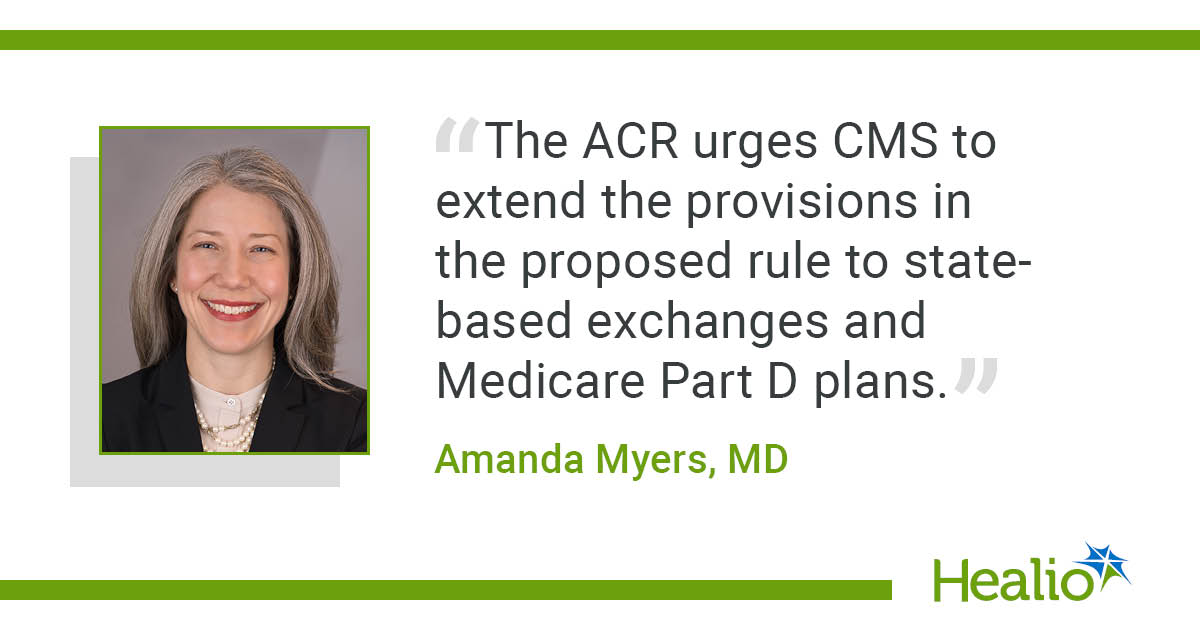
Healio: The ACR urges CMS to extend the provisions in the proposed rule to state-based exchanges and Medicare Part D plans. Though plans on state-based exchanges are not regulated by CMS in the same way as the other plans encompassed by the rule, a number of potential levers do exist to extend these regulations to these plans as well.
For example, for exchanges that use the HealthCare.gov platform for enrollment but handle their own QHP certification, CMS could condition continued access to the federal platform on meeting the new requirements.
The rule does not require Medicare Part D plans to adopt the same API as other payers. As a consequence, practices would have to continue to fax paperwork or manually document in a separate portal when requesting prior authorization for Part D drugs, thereby maintaining the administrative burden the rule intends to eliminate.
We urge CMS to incorporate Medicare Part D plans into the same API infrastructure as other plans.
For more information:
Amanda Myers, MD, can be reached at tarnold@rheumatology.org.
Sources/Disclosures
Source:
Healio interview
References:
American College of Rheumatology commends CMS for recognizing prior authorization burden. Emailed June 18, 2026. Accessed June 18, 2026.
Medicare and Medicaid programs; Patient Protection and Affordable Care Act; interoperability standards and prior authorization for drugs for Medicare Advantage organizations, Medicaid managed care plans, state Medicaid agencies, Children’s Health Insurance Program (CHIP) agencies and CHIP managed care entities, and issuers of qualified health plans on the federally-facilitated exchanges. https://www.federalregister.gov/documents/2026/04/14/2026-07205/medicare-and-medicaid-programs-patient-protection-and-affordable-care-act-interoperability-standards. Published April 14, 2026; accessed June 29, 2026.
ACR comment letter to CMS. https://assets.contentstack.io/v3/assets/bltee37abb6b278ab2c/blta1429eb8b8266422/advocacy-letter-cms-interoperability-prior-authorization.pdf. Published June 15, 2026. Accessed June 29, 2026.
Disclosures:
Myers reports no relevant financial disclosures.

Ask a clinical question and tap into Healio AI’s knowledge base.
- PubMed, enrolling/recruiting trials, guidelines
- Clinical Guidance, Healio CME, FDA news
- Healio’s exclusive daily news coverage of clinical data