
Key takeaways:
- Patients with IBD and the HLA-DRB1*01:03 allele may experience more severe outcomes, including surgery and perianal complications.
- Future testing for the allele could help individualize therapy.
The HLA-DRB1*01:03 allele was associated with severe outcomes across inflammatory bowel disease subtypes, including perianal complications, advanced therapy use and surgical interventions, according to study results.
“The prognosis and clinical course of IBD is highly variable and largely unpredictable,” study author James C. Lee, PhD, MRCP, professor of basic and translational gastroenterology at University College London’s Institute for Liver & Digestive Health and clinician scientist group leader at The Francis Crick Institute, told Healio.

“Being able to reliably predict future disease course would enable proactive management to ensure each patient is matched to the treatment or treatments most suitable for them,” Lee added.
Previous research has linked the allele to severe ulcerative colitis, as well as extraintestinal manifestations and an increased risk for colectomy in patients with UC.
“Beyond this, interest in this allele and its links to IBD have been rekindled with the recent discovery of a strong association between HLA-DRB1*01:03 and development of neutralizing autoantibodies against the immunomodulatory cytokine IL-10,” Lee said.
To investigate its ties across IBD subtypes, Lee and colleagues conducted a genotype-phenotype association study with data from 43,762 patients with IBD from two cohorts — the National Institute for Health and Care Research IBD BioResource and UK IBD Genetics Consortium — drawn from over 100 hospitals in the United Kingdom between 2005 and 2025. All were of European ancestry.
About half (n = 21, 839) of the participants had Crohn’s disease, and the remainder (n = 21,923) had UC or unclassified IBD.
Researchers adjusted analyses for sex, smoking, IBD diagnosis, follow-up, genetic principal components, coinherited HLA alleles and other factors.
A total of 4.6% participants carried HLA-DRB1*01:03, which was associated numerous severe disease phenotypes. In patients with CD, those adverse outcomes included colonic resection (OR = 1.35; 95% CI, 1.07-1.69), perianal disease (OR = 1.65; 95% CI, 1.42-1.92) and advanced therapy use (OR = 1.33; 95% CI, 1.12-1.58). Similar associations were observed in UC or unclassified IBD, including perianal disease (OR = 1.7; 95% CI, 1.27-2.28) and advanced therapy use (OR = 2.17; 95% CI, 1.86-2.52), as well as colectomy (OR = 1.99; 95% CI, 1.63-2.43) and hospitalization (OR = 1.96; 95% CI, 1.67-2.3).
Time-to-event analyses revealed associations between HLA-DRB1*01:03 and earlier development of perianal disease in CD (HR = 1.61; 95% CI, 1.24-2.07), as well as shorter time to colonic surgery (HR = 1.43; 95% CI, 1.13-1.82). The allele also was linked to earlier colectomy in UC or unclassified IBD (HR = 1.69; 95% CI, 1.33-2.14).
Carriers of HLA-DRB1*01:03 started their first advanced therapy sooner in both CD (HR = 1.82; 95% CI, 1.53-2.16) and UC and unclassified IBD (HR = 1.37; 95% CI, 1.18-1.59), and all phenotypes of IBD exhibited higher risk for therapy failure (HR = 1.23; 95% CI, 1.02-1.5).
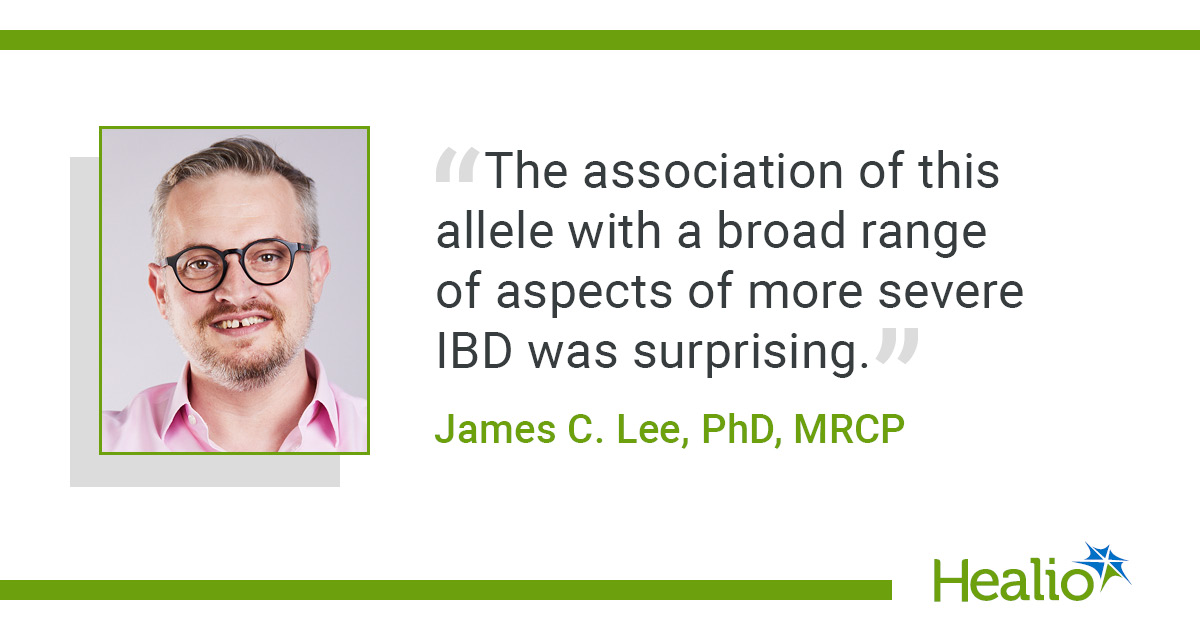
“The association of this allele with a broad range of aspects of more severe IBD was surprising,” Lee said.
Lee and colleagues noted that the association between HLA-DRB1*01:03 and perianal disease was a previously unreported finding. Earlier studies with smaller samples found a link between extraintestinal manifestations and HLA-DRB1*01:03, but the researchers found no significant association with this outcome in this study.
HLA-DRB1*01:03 also was linked to earlier-onset UC or unclassified IBD and later-onset CD.
While this study was restricted to patients with European ancestry, varying HLA-DRB1*01:03 frequency and IBD severities in other populations warrant further investigation of the allele’s association with IBD outcomes among non-Europeans, researchers noted.
Additionally, these findings could assist in developing a test to individualize IBD therapy, according to Lee.
“Although testing for HLA-DRB1*01:03 could have potential clinical utility, further validation work is required before pharmacogenetic testing for this allele can enter clinical practice, specifically relating to cost-effectiveness, predictive performance and modelling of the additional burden on genetic laboratories,” he said.
For more information:
James C. Lee, PhD, MRCP, is consultant gastroenterologist at Royal Free Hospital. He can be reached at gastroenterology@healio.com.
Sources/Disclosures
Source:
Zhang Q, et al. Lancet Gastroenterol Hepatol. 2026;doi:10.1016/S2468-1253(26)00113-5.
Disclosures:
Lee reports consulting roles with Enhanced Genomics, Isomorphic Labs, Johnson & Johnson and Pasithea Therapeutics; honoraria from AbbVie and Johnson & Johnson; grants or contracts from Kenneth Rainin Foundation, LifeArc and Medical Research Council and Merck Sharp & Dohme; and patents planned, issued or pending. Please see the study for all other authors’ relevant financial disclosures.

Ask a clinical question and tap into Healio AI’s knowledge base.
- PubMed, enrolling/recruiting trials, guidelines
- Clinical Guidance, Healio CME, FDA news
- Healio’s exclusive daily news coverage of clinical data