July 06, 2026
1 min watch

Key takeaways:
- Sexual orientation and gender identity minority individuals had lower adherence to guideline-recommended cancer screening.
- Targeted interventions are needed at the health system, policy and payer levels.
Persistent disparities in preventive cancer care exist among sexual orientation and gender identity minority individuals in the United States, according to results of a cross-sectional analysis.
The findings — which revealed particularly concerning gaps related to breast cancer and cervical cancer screening — highlight the need for targeted interventions at the health system, policy and payer levels to eliminate structural and systemic barriers and ensure equitable access, researchers concluded.

Data derived from Arena L, et al. Cancer. 2026;doi:10.1002/cncr.70462.

Timothy M. Pawlik
“Prior literature had suggested that health care access and utilization among this specific population is worse, so I wasn’t all that surprised by the results. That said, it is sobering when — even after adjustments for demographic and socioeconomic factors — we see sexual orientation and gender identity still had an independent effect on screening compliance,” senior author Timothy M. Pawlik, MD, MPH, PhD, chair of the department of surgery and Urban Meyer III and Shelley Meyer Chair for Cancer Research at The Ohio State University Wexner Medical Center, told Healio.
Distinct barriers
Sexual orientation and gender identity (SOGI) minority individuals — which include but are not limited to people who identify as lesbian, gay, bisexual or transgender — account for approximately 5.5% of U.S. adults.
Up to 16% of SOGI individuals have reported discrimination in health care settings, and a similar percentage report avoiding health care because they anticipate mistreatment, according to study background.
Prior research suggests SOGI individuals are at elevated risk for cancer due to multiple distinct but interconnected pathways. These include structural barriers in the health care system; psychosocial stressors such as homophobia or transphobia; increased risk for exposure to HIV or HPV infections; and behaviors such as smoking or alcohol use that may be triggered by psychological stress.
As Healio previously reported, disparities in access to and quality of care for LGBTQ+ individuals with cancer are more pervasive than previously understood. In addition, cancer survivors who identify as LGBTQ+ are at greater risk for several chronic health issues, such as myocardial infarction, diabetes or asthma.
However, most cancer registries do not collect SOGI data, so evidence about national trends in cancer prevalence and screening adherence in this population is limited.
Pawlik and colleagues sought to assess associations between SOGI status and adherence to U.S. Preventive Services Task Force recommendations for three cancer screenings.
“We know these individuals encounter distinct barriers than other traditionally marginalized groups,” Pawlik said. “Barriers that prevent more universal adoption of screening recommendations could result in differential outcomes in cancer management due to late detection, so we specifically wanted to look at utilization and compliance with screening recommendations in this population.”
The investigators used 2018-2022 data from the Behavioral Risk Factor Surveillance System — an annual telephone survey of U.S. adults — to identify those who met USPSTF guideline criteria to be screened for breast cancer, cervical cancer or colorectal cancer.
Researchers categorized respondents as heterosexual or sexual orientation minority individuals, and as cisgender or gender identity minority individuals.
The analysis included data from 663,924 screening-eligible respondents, 8,108 (1.2%) of whom identified as sexual orientation minorities and 2,315 (0.4%) of whom identified as gender identity minorities. Two-thirds (67.9%) identified as white and one-third (33.5%) had been assigned male at birth.
A higher percentage of sexual orientation minority individuals than heterosexual respondents reported being uninsured (11.8% vs. 7.2%) and having no personal physician (18% vs. 12.9%). A higher percentage of gender identity minority individuals than cisgender respondents reported having no personal physician (17.9% vs. 2.2%), but insurance coverage did not differ significantly.
‘Potentially more advanced cancers’
Researchers analyzed data using multivariable models that adjusted for race, ethnicity, education, income, marital status, insurance type, employment status and area of residence (urban vs. rural).
Results showed sexual orientation minority women had 16% lower adherence to breast cancer screening (adjusted prevalence ratio [aPR] = 0.84; 95% CI, 0.77-0.92) and 8% lower adherence to cervical cancer screening (aPR = 0.92; 95% CI, 0.87-0.97) than heterosexual women.
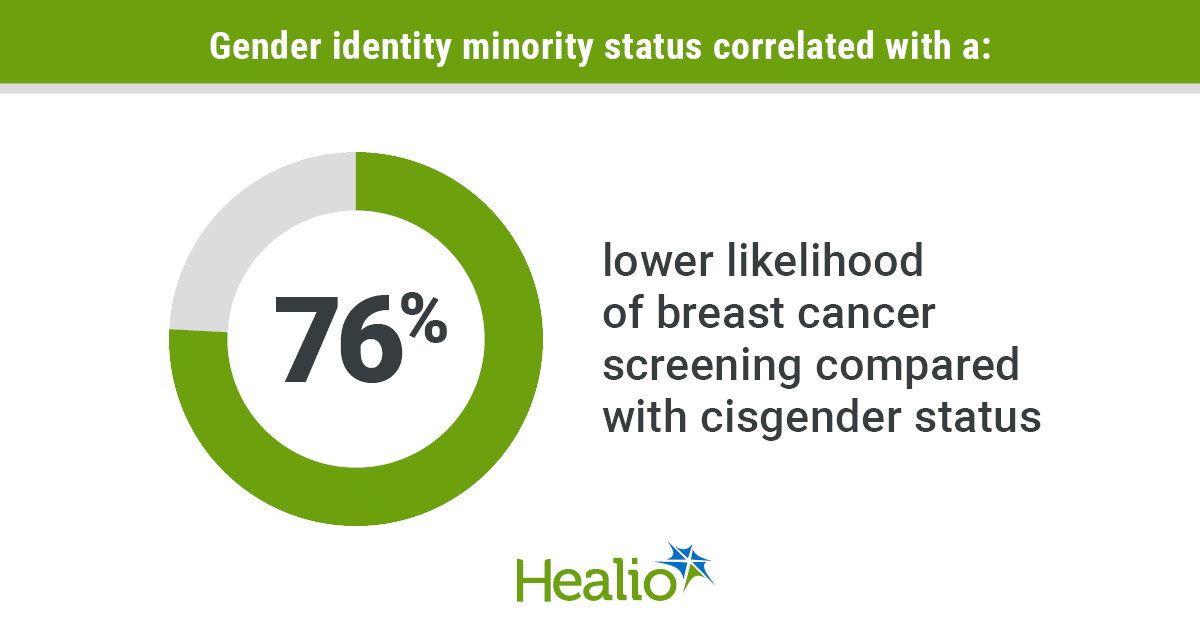
Gender identity minority individuals had a 76% lower likelihood of adhering to screening for breast cancer (aPR = 0.24; 95% CI, 0.08-0.74) and a 42% lower likelihood of adhering to screening for cervical cancer (adjusted PR = 0.58; 95% CI, 0.37-0.9) than cisgender individuals.
Colorectal cancer screening adherence appeared slightly higher among sexual orientation minority men (aPR = 1.1; 95% CI, 1-1.21) but did not differ based on gender identity.
Despite differences in screening adherence, SOGI status did not appear associated with meaningful differences in cancer prevalence. However, due to the study design and inherent limitations of retrospectively analyzing administrative data, researchers are more confident in the findings related to screening, Pawlik said.
“The findings have important clinical and public health implications,” he said. “Even though we are glad we didn’t see differences in cancer prevalence, we have to acknowledge that lower screening rates will place individuals at higher risk for being diagnosed with potentially more advanced cancers.”
Eliminating barriers
The findings underscore the importance of multipronged efforts to eliminate barriers and increase screening uptake, according to researchers.
Pawlik and colleagues outlined several strategies:
- Health care systems should promote gender-affirming environments through the use of nonheteronormative language and inclusive intake forms, and by offering alternative screening approaches such as self-collected HPV testing.
- Additional training should be offered to enhance clinician-patient communication about the importance of screening for SOGI individuals.
- Insurers’ coverage policies should ensure screening recommendations are based on anatomy rather than administrative gender records, and payers also can expand coverage of gender-affirming and culturally competent preventive services.
Policy-level solutions also can help.
Researchers called on state and federal agencies to mandate inclusion of SOGI questions in cancer registries and national surveys, ensuring their processes capture current gender identity and sex assigned at birth. Addendums to national guidelines should explicitly address SOGI populations and ensure clinical messaging and public health campaigns de-gender screening recommendations, they added.
“Hopefully the data presented in this study highlight the importance of this,” Pawlik said. “Only by reporting and analyzing these data and raising social awareness of these specific disparities can we begin to formulate effective interventions.”
Future research should emphasize collection of prospective longitudinal data that can more firmly establish causal pathways between SOGI minority status and screening behavior, Pawlik said. This will allow for development of care models and navigation programs that can improve cancer screening and surveillance, he said.
Clinicians also play a vital role.
“All health care professionals should be asking their patients if they have been screened,” Pawlik said. “I’m always shocked by how frequently we don’t ask the basic questions like, ‘When did you last have a mammogram?’ or ‘When was your last colonoscopy?’ For clinicians who have patients who are part of the sexual orientation or gender identity minority subgroup, a more detailed conversation is necessary about what organs need to be screened based on their sex assigned at birth and their current self-identified gender.”
The conversation must also elucidate barriers that could be impeding uptake.
“I might ask a patient, ‘You’re 60 and you’ve never had a colonoscopy. Why not?’” Pawlik said. “The patient might say they live in rural Ohio and they don’t have transportation. If you ask the questions that identify barriers, you can work with other members of the clinical team to remove them so we can get greater compliance with cancer screening for all of our patients — especially those who may be at higher risk.”
For more information:
Timothy M. Pawlik, MD, MPH, PhD, can be reached at tim.pawlik@osumc.edu.

Ask a clinical question and tap into Healio AI’s knowledge base.
- PubMed, enrolling/recruiting trials, guidelines
- Clinical Guidance, Healio CME, FDA news
- Healio’s exclusive daily news coverage of clinical data