
Key takeaways:
- Nearly 69% of U.S. counties, home to 51 million people, have no radiation oncology clinic.
- Closures since 2018 disproportionately occurred in rural areas with existing economic and health care access challenges.
An analysis of the radiation oncology landscape across the United States revealed multiple concerning trends that are leaving millions of Americans with little or no access to local care.
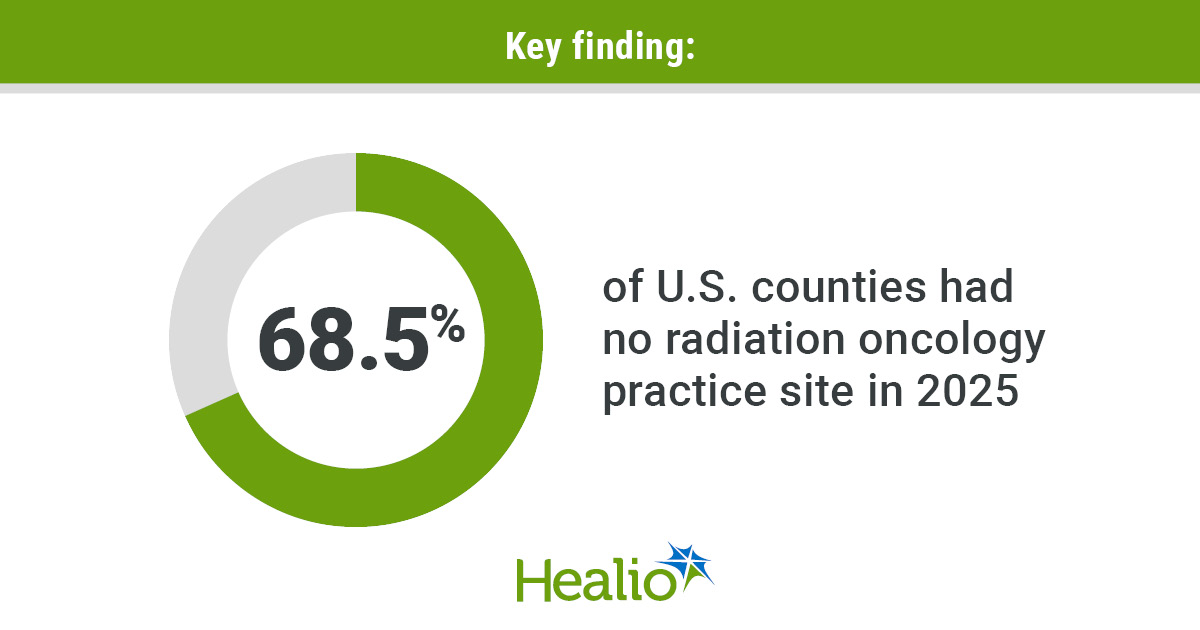
More than two-thirds of U.S. counties — home to nearly 15% of the country’s population — did not have a radiation oncology practice site as of 2025, results showed.

Data derived from Yu C, et al. Int J Radiat Oncol Biol Phys. 2026;doi:10.1016/j.ijrobp.2026.06.3090.
The overall number of radiation oncology clinics across the nation remained stable over the past 8 years; however, several new treatment centers replaced others that ceased operations during that time.
The closures disproportionately affected rural areas, suggesting regions that already face challenges related to health care access and economics will bear the brunt of the impact.

Kunal Sindhu
“These are counties that are more socioeconomically disadvantaged and harbor less robust health care infrastructure, so they can least afford a further erosion of services,” senior author Kunal Sindhu, MD, assistant professor in the department of radiation oncology at the Icahn School of Medicine at Mount Sinai, told Healio. “This is a real wake-up call for policymakers, and hopefully they take it seriously.”
Filling an evidence gap
More than half of people diagnosed with cancer undergo radiation therapy.
Concerns have emerged over the past 15 years about the stability of radiation oncology delivery across the United States.
A prior study by Sindhu and colleagues showed considerable practice consolidation between 2015 and 2023, with the number of large practices increasing by 51% and the number of solo practices declining by 27%.
Anecdotally, Sindhu and colleagues had heard that centers in rural or nonmetropolitan areas had been closing at faster rates due to greater financial pressure.
“To my knowledge, there had been no rigorous analysis to explore this,” Sindhu said. “Because of increasing conversations about access and rural viability, we felt it was important to further examine what was happening at individual practice sites.”
Investigators used CMS data from 2018 through 2025 to identify all U.S. radiation oncology practice sites. They analyzed whether factors such as rurality or lack of hospital affiliation correlated with higher odds for practice site disappearance.
They also performed county-level analyses to evaluate the geographic concentration of site closures. This yielded net changes in local radiation oncology site counts and allowed them to quantify remaining treatment capacity after closures.
‘Radiation deserts’
The number of radiation sites nationwide remained relatively stable during the 7-year study period, ranging between 3,214 and 3,338 from 2018 to 2023 and then declining to 3,145 by 2025.
The distribution of sites by urban county vs. rural county also held fairly steady, as did the proportion of sites that were affiliated with hospitals.
However, the consistencies in these broader categories “masked substantial turnover” that became apparent after more granular analyses, researchers wrote.
Multivariable analysis showed higher odds for disappearance among freestanding and community-based sites vs. hospital-affiliated sites (OR = 1.56; 95% CI, 1.24-1.95), and among sites in rural vs. urban counties (OR = 1.44; 95% CI, 1.23-1.69).
More than two-thirds (68.5%) of U.S. counties — home to about 50.8 million people — did not have a radiation oncology practice site in 2025. These counties, on average, had fewer primary care physicians, lower incomes, higher poverty and higher uninsurance rates than counties with radiation oncology access.
“We’re talking about one-seventh of the U.S. population having to travel outside of their county — which, especially in rural areas, can be a long distance and limit a person’s ability to receive life-saving cancer care,” Sindhu said.
The results also showed that 13.6% of counties evaluated (n = 427 of 3,144) had a net loss of radiation oncology sites during the study period. Although the losses were geographically dispersed, more than 70% of net-loss counties were in the Midwest or South.
Among net-loss counties, the mean number of radiation oncology practice sites that remained as of 2025 appeared significantly higher in urban counties (3.66) than rural-adjacent counties (0.43) or rural-non-adjacent counties (0.28; P < .01 for comparison).
“If you live in Manhattan, for example, and a center on the Upper East Side closes, you still have the option to go to the Upper West Side,” Sindhu said. “In rural counties that lost practices, there is very little capacity left. All of a sudden, the people who live there are dealing with the potential of living in a radiation desert. If you or a loved one needs radiation therapy but you have to drive two hours each way to get treatment every day, that very well could be prohibitive.”
A ‘reimbursement story’
The findings highlight the need for policymakers and health systems to develop strategies to preserve access to radiation oncology care before gaps become wider, researchers concluded.
They also demonstrate the need to improve reimbursement models to ensure long-term practice stability, Sindhu said.
“This is fundamentally a reimbursement story,” he said.
Although the cost of delivering radiation care has increased, Medicare reimbursement for radiation therapy has declined by more than 25% over the past decade, according to American Society for Radiation Oncology (ASTRO). Private insurers often follow Medicare’s lead when making reimbursement decisions.
“These cuts are making the delivery system more fragile,” Sindhu said. “Practices in urban counties typically are larger and affiliated with hospitals. These organizations presumably have greater ability to absorb financial shocks. Freestanding centers often have less flexibility and less of a cushion than larger organizations, so reimbursement cuts can have a real impact on viability.”
Many patients who undergo radiation therapy travel to treatment centers 5 days a week for several weeks. Prior research has linked greater travel distances to a radiation therapy clinic to higher cancer mortality, presumably due to patients skipping or delaying treatments.
Adoption of shorter radiation courses for some cancer indications have improved patient convenience, but they also altered the economics of radiation delivery, Sindhu said.
Earlier this year, CMS introduced additional billing changes that have placed further financial pressure on practices, he said.
“A reassessment of those cuts is, I think, a necessary first step to stop further bleeding,” Sindhu said. “[CMS] recently released a proposal for undoing or at least adjusting some of them, which would help. Longer term, reimbursement as a whole needs to be reevaluated.”
Sindhu said he would like to see “more conversation” about whether creation of new centers in regions with no radiation sites can be incentivized.
He also encouraged radiation oncologists to think about moving “out of their comfort zone” by considering practicing in underserved regions.
A study by Yu and colleagues published last year showed only 4.3% of radiation oncology graduates from 2015 to 2022 accepted jobs in rural counties.
“Some of that is probably related to the fact that there aren’t as many practices in rural counties,” Sindhu said. “However, incentivizing residents to practice in these communities — perhaps by waiving some of their student debt — could go a long way.”
ASTRO also is supporting the Radiation Oncology Case Rate Act, a bill introduced in the House of Representatives designed to move Medicare toward a more patient-centered payment model based on each patient’s episode of care rather than the number of radiation therapy treatments delivered.
Sindhu urged radiation oncologists to advocate for this legislation or other reforms.
“Policy is a big part of this, but policymakers only listen when you talk to them. Every voice counts,” Sindhu said. “We all should be willing to engage with our governor, senators and local members of Congress to ensure our voices are heard.
“We need to do something,” he added. “If nothing gets done, these trends are going to continue.”
For more information:
Kunal K. Sindhu, MD, can be reached at kunal.sindhu@mountsinai.org.

Ask a clinical question and tap into Healio AI’s knowledge base.
- PubMed, enrolling/recruiting trials, guidelines
- Clinical Guidance, Healio CME, FDA news
- Healio’s exclusive daily news coverage of clinical data