

Key takeaways:
- A novel marker based on routine lab values can identify transplant recipients at high risk for organ rejection due to medication nonadherence.
- Clinicians could then target interventions for those patients.
Use of an electronic health record-based marker could help clinicians identify liver transplant recipients who are at risk for organ rejection due to medication nonadherence.
Study findings published in American Journal of Transplantation showed adolescents and young adults assigned to a 2-year remote behavioral intervention after transplantation experienced half as many primary events — a combination of rejection, retransplantation and consent withdrawal — as those assigned standard of care.

The study did not reach statistical significance for its primary endpoint, but demonstrated that use of an objective marker — derived from routine lab values already found in the EHR —could help reduce rejection rates.
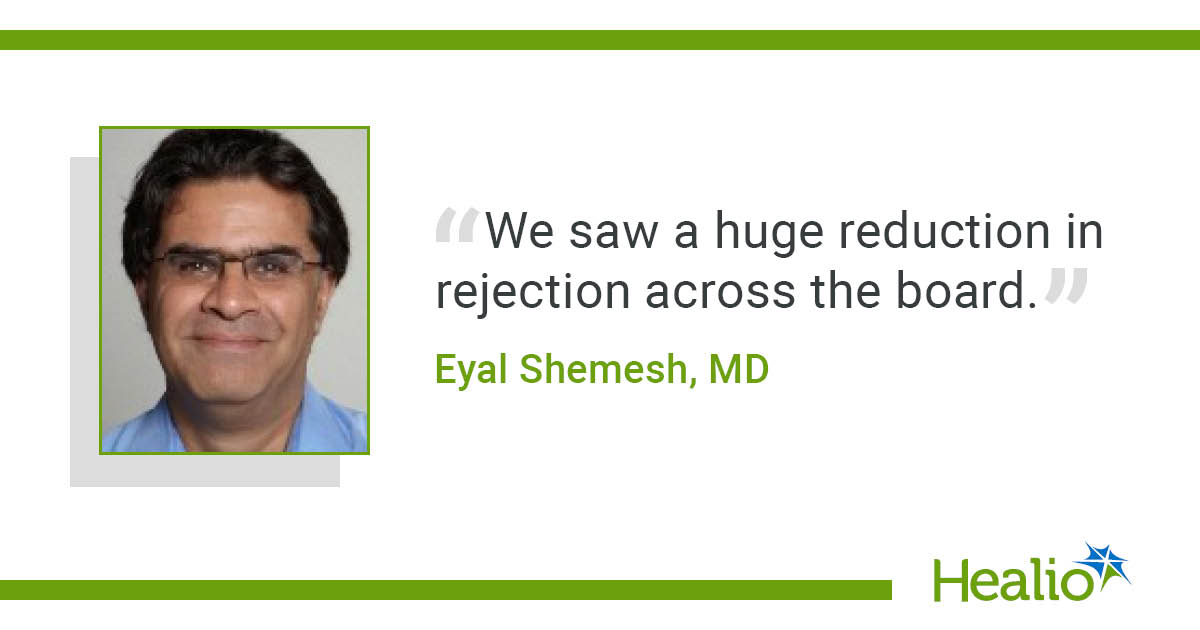
“I can’t say the effect of the intervention was significant, but oh boy, can I say that the marker works — and that’s way more important,” Eyal Shemesh, MD, principal investigator and chief of the division of behavioral and developmental health at Mount Sinai Kravis Children’s Hospital, told Healio. “We saw a huge reduction in rejection across the board. I think that is the most important and really amazing result from the research.”
Shemesh and colleagues developed the medication level variability index (MLVI), which uses fluctuations in routine immunosuppressive blood levels to identify inconsistencies in medication adherence. Clinicians can then intervene before adverse events occur.
The researchers investigated whether MLVI scores could affect transplant outcomes by conducting a prospective, single-blind study at 13 pediatric liver transplant centers in the United States and Canada. Shemesh and colleagues reviewed the electronic health records of several thousand transplant recipients at those participating centers, using the MLVI marker to identify patients at high risk for imminent organ rejection.
From the few hundred patients classified as high risk, they randomly assigned 148 adolescent and young adult liver transplant recipients (mean age, 15.5 years) to either the behavioral intervention (n = 72) or standard care (n = 76).
Results showed 8.3% of participants in the intervention group experienced rejection compared with 15.8% in the standard of care group (RR = 0.57; 95% CI, 0.24-1.35).
Healio spoke with Shemesh about the study’s inception, the creation of the MLVI marker and its potential generalizability in other settings to identify patients at risk for adverse outcomes.
Healio: What clinical observations led you and your team to pursue this research??
Shemesh: I’ve been interested in the idea that patients don’t take their medicines for a long time. It actually came from another interest I had in psychiatric disorders where my team showed that patients with PTSD are less likely to take their medicines because they are a reminder of the stressor. We then wondered how we can know whether patients are not taking their medication. What would be a way to figure that out?
We know already that asking patients is not good enough. They’re not always going to tell us the truth. We know the problem is more prominent in adolescents, and while it has different implications depending on the disease process, it is incredibly important in transplant medicine that patients take their immunosuppressants.
In transplant medicine, we check blood levels of the immunosuppressant routinely to figure out how much we should prescribe. If patients are not taking their medication consistently, those levels will either be low or high, because they’re either not taking enough of the medicine or they may take a double dose when they know a blood test is coming if they didn’t take it the day before. They can ‘fool’ one test to show a high level, but they cannot ‘fool’ a series of tests to show a stable level over time. My research team and I came up with the idea to calculate the degrees of variability between the medication blood levels, rather than looking at just one level.
Healio: How does the MLVI work and how did you incorporate it into this study design?
Shemesh: It does two things. First, it gives you an idea of inconsistent medication-taking, but it also gives you an idea over time of patients who you know are chronically not taking it, not just those who sometimes forget — and those are the patients we want to pick up.
Those who occasionally miss a single dose are generally doing well and not who we want to target with these interventions. We want to target those patients who have been consistently missing their medications over an extended period and are therefore at truly increased medical risk, and the MLVI marker only flags these chronically nonadherent patients.
We concentrated on adolescents and young adults who were seen in 13 pediatric transplant centers in the United States and Canada over a period of several years. We calculated this metric and whenever somebody met the threshold, we would try to get them into research. We were actually quite successful in recruiting those patients because we were able to tell them they are at-risk due to the metric we already had.
Since our intervention was remote, we were also able to engage them. This is important because many adherence interventions require patients to come to the clinic weekly. If a patient is already struggling to take medication as prescribed, it is unlikely they will be able to keep weekly clinic visits. But with this remote intervention, we came to them.
Healio: The study did not meet its primary endpoint but still showed encouraging data. What is your interpretation of the results?
Shemesh: We had 18 primary endpoints events occur in the entire study: 12 of them in the control group and six in the intervention group. That’s much less, but it wasn’t statistically significant. We think that’s because the rate of rejection in the entire study was much lower than what we and others have observed before.
The reason for that was the metric itself. Transplant centers started using the MLVI and incorporating it into their care. If they saw someone with a high level of the marker, they intervened. We couldn’t stop them and we shouldn’t stop them. So even controls fared better because of use of the marker.
Healio: How generalizable and/or scalable is the MLVI?
Shemesh: Other groups have published about it. It’s a known thing. Changing practice is a big deal, and I am still stunned that centers now use MLVI as part of standard care. We and other groups have tested it in adults, so it’s definitely applicable across the age spectrum in transplant centers.
This is also not just limited to transplant centers. If you think about the idea of variability in a test or a biological metric as a behavioral metric, it’s generalizable. We did another study where we used variability in blood pressure as a marker of risk. We thought the changes were behavioral—that they didn’t take their blood pressure medication and that’s why there was variability. We did a pilot study that showed we can improve that variability with a behavioral intervention.
The nice thing is the MLVI hinges on electronic health record information. It doesn’t ask the patient to do anything extra apart from what they already do for their health care. It’s a manipulation of existing data. The fact that transplant centers are using it shows that it is easy to do, because if it wasn’t easy, they wouldn’t already be making it a part of their practice.
Healio: What are the next steps in terms of future research or building on this existing framework?
Shemesh: I’ll tell you what I’m not going to do: I am not going to repeat this study in a larger population to get to the statistical significance. To show such a difference, we would need a control group in which the marker is not used, and I don’t want to stop the good work that people already do. I think the results are pretty much OK in that they show us that using the marker is likely to improve patient outcomes.
My next step is to see if the marker works in other populations, which could be adult transplant recipients or those with other diseases, and also to try to make the intervention as accessible as possible. That means cheap and available; the way to do that is to either create a kind of interventionist hub or automate the intervention itself through an AI agent or something similar.
The more you streamline this, the less it will cost and maybe the more compelling it is. We already invest so much in transplant — from getting the donor to the amazing surgeons who do it. At the end of the day, if we do all that and patients don’t take their medication, it’s not the right answer.
I’m going to make it as easy as possible for clinicians to implement it, so that is my next step.
For more information:
Eyal Shemesh, MD, can be reached at eyal.shemesh@mssm.edu.

Ask a clinical question and tap into Healio AI’s knowledge base.
- PubMed, enrolling/recruiting trials, guidelines
- Clinical Guidance, Healio CME, FDA news
- Healio’s exclusive daily news coverage of clinical data