Key takeaways:
- Patients with chronic migraine were more likely to develop 14 of 15 gastrointestinal comorbidities.
- Clinicians should consider screening patients with chronic migraine for GI symptoms.
Adults with chronic migraine had greater odds for gastrointestinal comorbidities than those with no migraine, according to an abstract presented at the American Headache Society 68th Annual Scientific Meeting.
“Previous work has shown that migraine is associated with several GI disorders, but the full scope has been underexplored,” Leon S. Moskatel, MD, clinical assistant professor of adult neurology at Stanford Medicine, told Healio. “We thought it was important to examine a full spectrum of GI disorders in patients with chronic migraine.”

Data derived from Patlolla R, et al. Gastrointestinal comorbidities associated with chronic migraine: A retrospective, observational analysis. Presented at: American Headache Society 68th Annual Scientific Meeting; June 4-7, 2026; Orlando.
The retrospective observational cohort study included 9,903 adults (average age, 49 years; 79.4% women; 57.1% white) with chronic migraine assessed at the Stanford Headache Clinic or Comprehensive Neurology Clinic between 2017 and 2024.
Patients were matched with 9,903 controls (average age, 48.7 years; 79.2% women; 55.4% white) with no migraine.

Leon S. Moskatel
“The burden of GI disorders in chronic migraine is broader than what has been previously known,” Moskatel said. “We found that patients with chronic migraine had significantly higher odds of nearly every GI disorder we evaluated.”
Fourteen of 15 gastrointestinal comorbidities were more prevalent among the group with chronic migraine. The most common included gastroesophageal reflux disease (29.4% vs. 16.8%), constipation (21.4% vs. 14.2%) and diarrhea (16.3% vs. 9.6%), with P values less than .001 for all differences.
Prevalences also included 11.2% vs. 4.4% for irritable bowel syndrome; 1.5% vs. 0.7% for peptic ulcer; and 3% vs. 1.3% for small intestinal bowel overgrown (P < .001 for all differences).
Other differences included 7.6% vs. 4.1% for noninfective gastroenteritis and colitis; 1.4% vs. 0.9% for ulcerative colitis; 3% vs. 1.5% for functional dyspepsia; 3.5% vs. 1.9% for gastroparesis; and 1.1% vs. 0.6% for Helicobacter pylori infection (P < .001 for all differences).
The remaining comorbidities with statistically significant differences in prevalence included disease of digestive system unspecified, Crohn’s disease and celiac disease. There was no statistically significant difference in non-celiac gluten sensitivity.
After adjustment for residual demographic differences, depression and anxiety, 13 of the gastrointestinal comorbidities remained more prevalent among the group with chronic migraine, with Crohn’s disease joining non-celiac gluten sensitivity with no statistically significant difference in prevalence.

Niushen Zhang
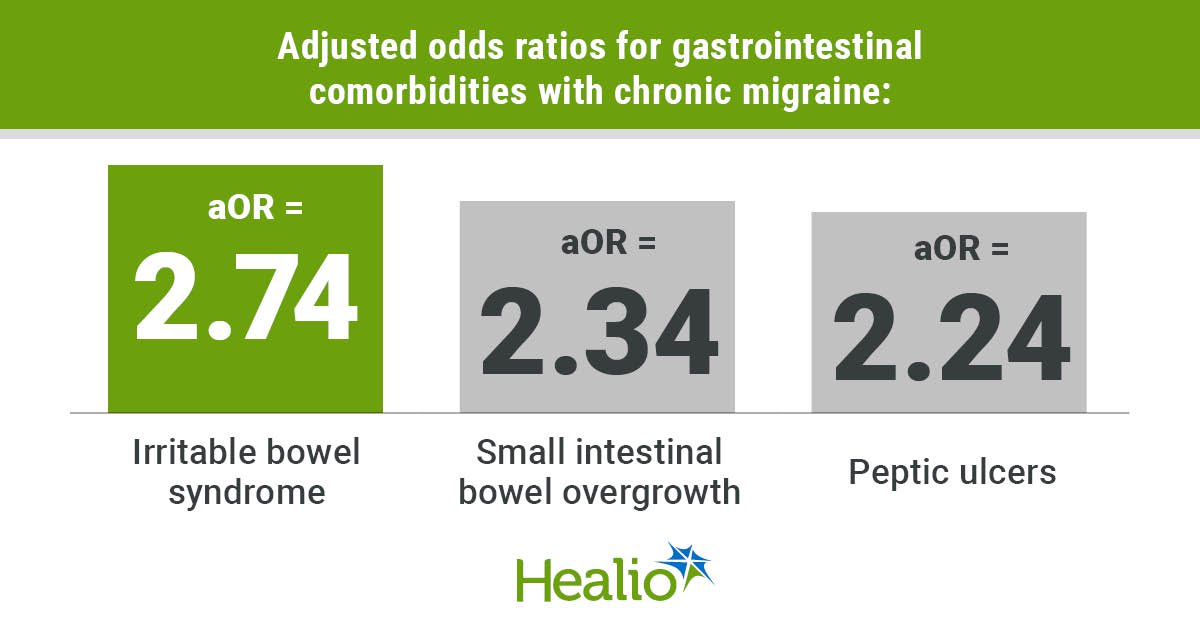
The comorbidities with the greatest adjusted odds ratios included irritable bowel syndrome (aOR = 2.74; 95% CI, 2.44-3.07), small intestinal bowel overgrowth (aOR = 2.34; 95% CI, 1.9-2.89) and peptic ulcers (aOR = 2.24; 95% CI, 1.68-3).
Based on these findings, the researchers encouraged clinicians who treat patients with chronic migraine to screen them for these comorbidities, which would inform individualized treatment plans.
“When treating migraine, it is essential to screen for other underlying health conditions that could be contributing to ongoing migraine symptoms,” Niushen Zhang, MD, clinical associate professor of adult neurology at Stanford Medicine, told Healio.
“Given the broad association of GI disorders and migraine, clinicians should consider screening patients with chronic migraine for GI symptoms and provide referral to GI specialists when it is appropriate,” she said.
For more information:
Leon S. Moskatel, MD, and Niushen Zhang, MD, can be reached at neurology@healio.com.
Sources/Disclosures
Source:
Patlolla R, et al. Gastrointestinal comorbidities associated with chronic migraine: A retrospective, observational analysis. Presented at: American Headache Society 68th Annual Scientific Meeting; June 4-7, 2026; Orlando.
Disclosures:
Moskatel reports receiving royalties from CRC Press and serving as a sub-investigator for Ipsen Pharmaceuticals and as an advisory board member for Amneal Pharmaceuticals. Zhang reports no relevant financial disclosures.

Ask a clinical question and tap into Healio AI’s knowledge base.
- PubMed, enrolling/recruiting trials, guidelines
- Clinical Guidance, Healio CME, FDA news
- Healio’s exclusive daily news coverage of clinical data