
Key takeaways:
- Patient-authored portal messages have increased substantially since 2020.
- Office visits also have risen during that time.
Patient portal messaging is not replacing in-person care. It is adding to it.
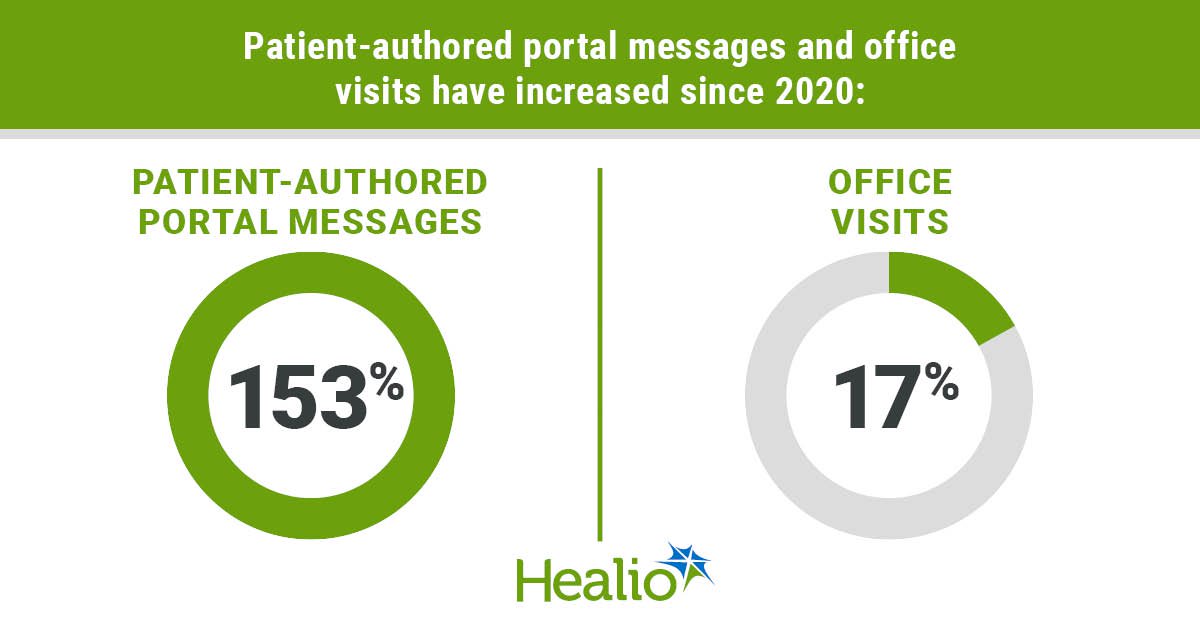
An evaluation of 2,000 hospitals and 40,000 clinics showed patient-authored messages have increased more than 150% since the start of 2020. Office visits increased 17% during the same time.

Data derived from Long JJ, et al. JAMA. 2026;doi:10.1001/jama.2026.8690.

Michal A. Mankowski, PhD
“Physicians and health care systems have to be ready for the increasing volume of patient messaging,” Michal A. Mankowski, PhD, assistant professor of surgery at NYU Grossman School of Medicine, told Healio. “It’s not something we can ignore. It has to be incorporated in workflows. It’s a burden.”
‘Quite a bit of work’
Healio has previously reported how increases in patient messaging have added to clinician workloads.
“Messages can feel deceptively simple,” Jane J. Long, MD, general surgery resident at Mayo Clinic, told Healio. “From a patient perspective, it’s very convenient to be able to message instead of calling or scheduling a visit. It might seem like this is an easy way to get a quick response, but from our perspective, a simple question can be more work than people realize.
“We have to review their chart. What medications are they on? Oftentimes, we have to coordinate with the rest of the team or talk to the attending. It might seem like a minute or two to write that message, but there’s quite a bit of work that goes into it.”
Patient-initiated messages to oncologists increased 34% between 2019 and 2022, according to data published in Journal of the National Cancer Institute.
Mankowski and colleagues wanted to determine how increases in messaging across health care impacted other communication modalities.
They conducted a cross-sectional analysis of electronic health record data from 2,067 hospitals and 47,100 clinics to investigate.
National trends in patient portal messaging, office visits, and telehealth and telephone encounters served as the primary endpoint.
No plateau
The number of active patients increased approximately 50% from the first quarter of 2020 (94.3 million) to the final quarter of 2025 (140.5 million).
During that time, researchers identified 1.34 billion patient-authored messages, 3.25 billion clinician/staff-authored messages, 1.77 billion office visits, 1.59 billion telephone interactions and 146 million telehealth encounters.
Annual patient-authored messages increased 153% between 2020 (0.99 per patient) and 2025 (2.5 per patient), and clinician/staff-authored messages rose 24% (4.59 to 5.7 per patient), with a peak of 6.86 per patient in 2021 during the COVID-19 pandemic.
Among patients who sent at least one message, intensity increased 146% during the study period — from 2.2 to 5.4 messages per sender per year.
“We didn’t see any plateau yet,” Mankowski said.
The increase in messaging coincided with a slight decline in telephone encounters (2.33 to 2.2), but an increase in office visits (2.37 to 2.77).
“Patient portal messages are an extra modality, not a replacement of other modalities,” Mankowski said.
“What we’re finding is it’s just another means to ask more questions and continue to receive care in addition to office visits,” Long added. “There is a concern that there is just going to be more and more.”
Of 139.4 million active patients in the first quarter of 2025, researchers identified 41.8 million message senders. Messaging varied significantly based on age and rurality (P < .001).
Women had a significantly higher likelihood of being senders (33% vs. 26.1%; P < .001), as did those living in the lowest quartile of social vulnerability index quartile vs. those in the highest (36.7% vs. 25.2%; P < .001).
As of 2025, telehealth visits made up just 0.19 visits per patient annually.
“We were surprised with the telehealth,” Mankowski said. “We were expecting it to keep growing and it’s stayed at the same level for years.”
Researchers acknowledged study limitations, including patient network changes potentially impacting trends.
‘I expect them to grow’
Mankowski expects messaging trends to continue upward in the future.
“Most of messages are uncompensated and free to send by patients,” he said. “Unless there is a push to charge patients for those messages, I expect them to grow.”
Long noted health care systems should investigate which communication modalities their patients use most often to optimize their workflows.
This research also could include how communication changes based on specialty.
“My hope is that we’re going to be able to better understand who is best served by each modality,” Long said. “Who is getting the best care from messaging? Who might need a phone call more? Who may need more frequent office visits? I can only hope that in the future, communication modality is tailored to patient preference and needs, because I don’t see anything going away. Having options is convenient. It’s nice to be able to reach your teams in so many different ways.
“Health care systems are going to need to adapt and figure out what workflow is best for how their teams are set up and how they work. How can they better support clinicians and staff?”
For more information:
Jane J. Long, MD, can be reached at jane.long@nyulangone.org.
Michal A. Mankowski, PhD, can be reached at michal.mankowski@nyulangone.org.

Ask a clinical question and tap into Healio AI’s knowledge base.
- PubMed, enrolling/recruiting trials, guidelines
- Clinical Guidance, Healio CME, FDA news
- Healio’s exclusive daily news coverage of clinical data