
Key takeaways:
- Cyclosporiasis and cryptosporidiosis share many similarities.
- An ID expert called one of them the “lesser of two evils.”
As the cyclosporiasis outbreak in the U.S. continues to grow, we were reminded of another, similar sounding intestinal pathogen that frequently causes outbreaks of diarrhea in the summer.
It is called cryptosporidiosis — often shortened to crypto. Just like cyclosporiasis, crypto is caused by a microscopic parasite that leaves its sufferer with brutal bouts of diarrhea.

Data derived from CDC.
“It can be very confusing for sure,” Thomas A. Moore, MD, FACP, FIDSA, said of the two illnesses with similar names, culprits and symptoms.
But as comparable as the two may be, Moore also noted that there are distinct differences, starting with the respective parasites: Cyclospora and Cryptosporidium.
“The parasites look almost identical,” Moore, a clinical professor at the University of Kansas School of Medicine-Wichita, told Healio. However, “Cyclospora is larger than Cryptosporidium. Cyclospora typically just inhabits the intestines while Cryptosporidium invades the intestinal lining.”
How are they transmitted?
Another difference is the time it takes for each to be infectious. According to a study of Peruvian children published in the CDC’s Emerging Infectious Diseases journal in 2002, Cryptosporidium is much more easily transmitted from person to person because it is infectious as soon as it is excreted, whereas Cyclospora requires a period of time to become infectious, which means people are far more likely to get it from food or water than another person.
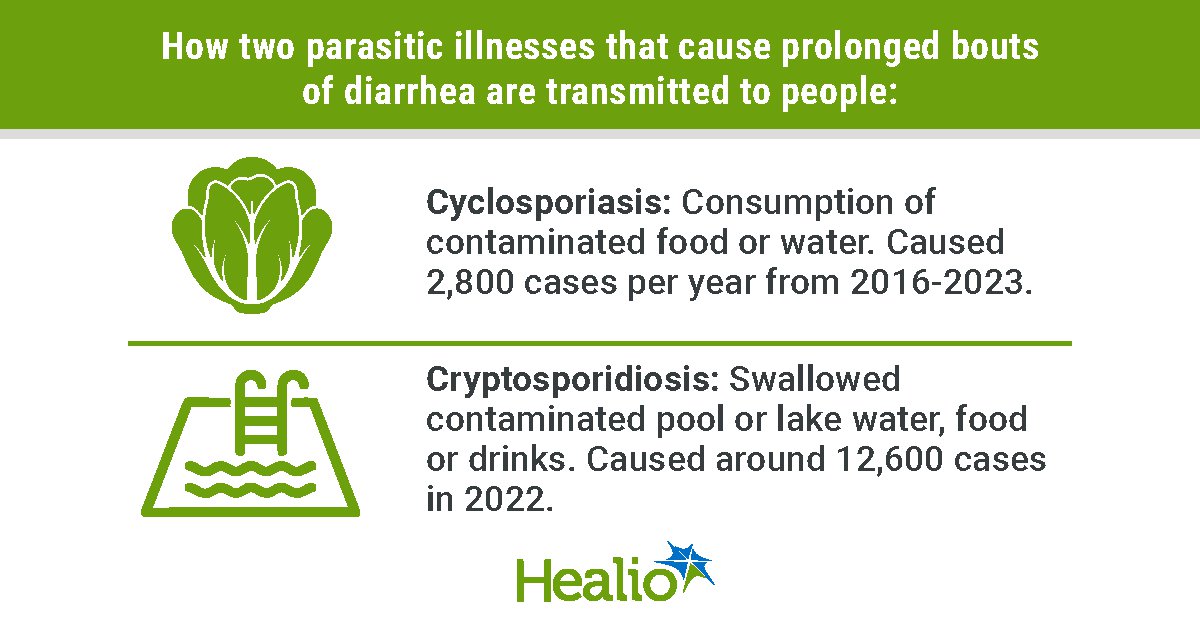
Indeed, cyclosporiasis is usually transmitted when a person eats food or drinks water contaminated with human feces containing Cyclospora, according to the CDC. In the current outbreak, federal health officials traced cases to iceberg lettuce sourced from a central Mexico facility where the lettuce was sprayed with tainted water.
People usually get crypto through swallowing fecal-contaminated water, often from recreational venues such as swimming pools, water parks and splash pads where another swimmer with infectious diarrhea has been in the water.
“You are not supposed to put your kids who have diarrhea in swimming pools. They have some anal leakage. There’s probably no way to politely say that. It does happen, and it happens every summer,” Moore said.
Which is more common?
The current cyclosporiasis outbreak includes 1,947 lab-confirmed cases in nine states with 98 hospitalizations and zero deaths, according to the CDC, but thousands more cases are suspected. (The CDC said it has confirmed more than 6,700 cases of cyclosporiasis overall in the U.S. since May 1.)
There were approximately 2,800 cyclosporiasis cases reported annually in the U.S. between 2016 and 2023, per CDC surveillance data.
Cryptosporidiosis is much more common, with an estimated 823,000 cases occurring in the U.S. each year, according to the CDC. However, only a small percentage are confirmed — around 12,600 in 2022, for example — because most people are not tested or diagnosed.
Moore noted that there was an outbreak of crypto that infected 400,000 people in the Milwaukee metro area in 1993, ultimately leading to improved water treatment and monitoring.
“I’ll say this about outbreaks,” Moore said, “they are never good, but we do learn from them.”
How are they treated?
The CDC recommends trimethoprim-sulfamethoxazole, a combination antibiotic used to treat and prevent bacterial infections, as the preferred medication for cyclosporiasis. The agency notes that most healthy people will recover without medical intervention.
According to the CDC, crypto treatment largely focuses on hydration and symptom management. Although the antiprotozoal medication nitazoxanide is routinely prescribed for healthy individuals with crypto, its effectiveness in treating immunocompromised patients remains unclear, the CDC says.
Moore said there are “significantly less” treatment options for crypto and that cyclosporiasis is “curable with oral antibiotics that are readily available and cheap.”
Which one is worse?
Both cyclosporiasis and cryptosporidiosis cause prolonged bouts of watery diarrhea and gastrointestinal distress, but cyclosporiasis is uniquely known for relapse, whereas crypto often features more prominent vomiting and dehydration, the CDC reports.
Moore called cyclosporiasis “the lesser of two evils” due to available treatments.
For more information:
Thomas A. Moore, MD, FACP, FIDSA, can be reached at infectiousdisease@healio.com.
Sources/Disclosures
Source:
Healio Interviews
References:
- Bern C, et al. Emerg Infect Dis. 2001;doi:10.3201/eid0806.010331.
- Clinical care of crypto. https://www.cdc.gov/cryptosporidium/hcp/clinical-care/index.html. Published June 25, 2025. Accessed July 29, 2026.
- Cryptosporidiosis NNDSS summary report for 2022. https://www.cdc.gov/healthy-water-data/documentation/cryptosporidiosis-nndss-summary-report-for-2022.html. Published Sept. 11, 2025. Accessed July 26, 2026.
- CDC. MMWR Morb Mortal Wkly Rep. 1994;43(31):561-3.
- CDC. NNDSS Annual Summary Data 2016-2023 Results. https://wonder.cdc.gov/controller/saved/D130/D513F661. Accessed July 29, 2026.
- Surveillance of cyclosporiasis. https://www.cdc.gov/cyclosporiasis/php/surveillance/index.html. Updated July 28, 2026. Accessed July 29, 2026.
- Treating crypto. https://www.cdc.gov/cryptosporidium/treatment/index.html. Published June 4, 2025. Accessed July 29, 2026.
- Widodo WT, et al. Open Vet J. 2025;doi:10.5455/OVJ.2025.v15.i10.3.
- Wikipedia. 1993 Milwaukee cryptosporidiosis outbreak. https://en.wikipedia.org/wiki/1993_Milwaukee_cryptosporidiosis_outbreak. Accessed July 29, 2026.
Disclosures:
Moore reports no relevant financial disclosures.

Ask a clinical question and tap into Healio AI’s knowledge base.
- PubMed, enrolling/recruiting trials, guidelines
- Clinical Guidance, Healio CME, FDA news
- Healio’s exclusive daily news coverage of clinical data