
August 06, 2026
6 min read

Key takeaways:
- Patients view AI-written portal messages as mutually beneficial to them and clinicians.
- Oversight and transparency are key to that comfort.
Many patients report high comfort with health systems using AI-written portal messages, noting it gets them information quickly and reduces clinician workload.
Their comfort comes with caveats, though. Patients want both clinician oversight and transparency that AI is being used.

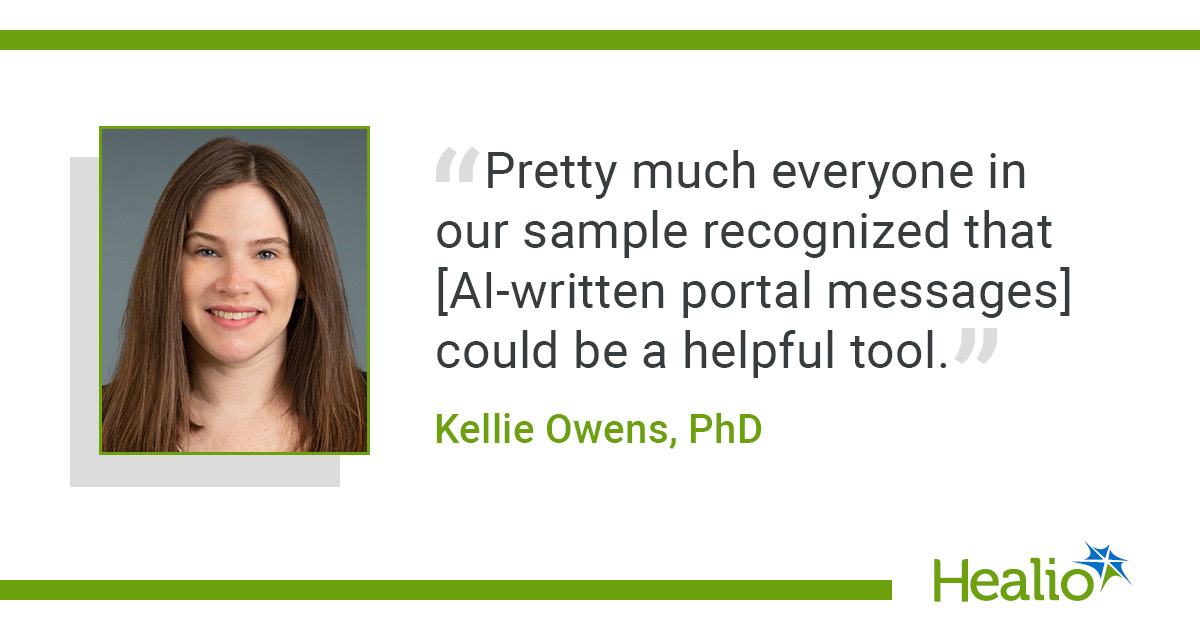
“Pretty much everyone in our sample recognized that this could be a helpful tool,” Kellie Owens, PhD, assistant professor in the department of population health at NYU Grossman School of Medicine, told Healio.
“[However], patients were very clear that they see AI not as something they wanted to replace human judgment or involvement, but something they wanted to work hand-in-hand, to make clinicians’ work easier, to automate the things that can be automated, but still very much seeing the ultimate responsibility lying on the clinician to provide good care.”
Portal messaging increasing
Healio previously reported that annual patient-authored portal messages across 2,000 hospitals and 40,000 clinics increased 153% between 2020 and 2025.
Clinicians and staff authored 3.25 billion messages during that time.
Prior research has shown that the increase in portal communication has contributed to both clinician burnout and dissatisfaction, according to study background.
Many health care practices and institutions have started using AI to compose messages to patients to reduce clinician workload.
Healio previously reported on a survey of nearly 1,500 participants that showed significantly higher satisfaction with AI-generated responses than human-written ones. However, patients also had significantly higher satisfaction if they found out messages came from clinicians instead of AI.
Participants viewed vignettes of low-, medium- and high-risk messages, ranging from prescription refills to medication side effects to seeing lab results that could provoke concerns.
“We wanted to do a follow-up to that survey, to chat with patients to try to understand why we saw these results,” Owens said. “One of the benefits of qualitative research is being able to dive more deeply into why patients feel the way they do about AI integration, what it might mean for patient-provider relationships, what it might mean for their trust levels with their health care institutions, and ways that AI can help them in their health care journey.”
The study included 40 participants from the previous survey (75% women; 35% Black; 32.5% white; 25% aged 55-64 years).
Perspectives on portal messaging preferences, comfort with AI responses, message content and tone, and disclosure expectations served as primary endpoints.
‘I was surprised’
Most interviewees reported portal messaging served a “transactional” purpose, researchers described.
The portal provides patients a pathway to get information, have questions answered or finish administrative tasks.
They expect to use the portal to manage their clinical needs in a quick, concise way.
“It doesn’t really need to be very personal. It just needs to be quick and to the point. … You see that I’m having issues, and how do I address them?” one participant said.
“I came in with a naive assumption that the purpose of these chats with your clinician online is that you want to have some sort of human-to-human connection about something meaningful in your health care,” Owens said. “What we found is that’s not really how folks use these online tools.”
Even patients who expressed lower comfort with AI overall had minimal issues with AI in this context.
One participant noted AI reduces “personal touch” and they expressed concern over “losing” contact with their clinician. The interviewee did not have a problem with the transactional approach in the portal, though.
“I’m only looking for [a personal touch] in person, not online. … that’s online … it’s a machine, so I don’t expect the interpersonal,” they said.
Participants reported high comfort with AI-drafted communication across message types.
“I was surprised,” Owens said. “Even in our higher medical severity examples, like, ‘I’m worried about this mass found on imaging, what can you tell me about it?’ Folks still were mostly OK with AI being used in the drafting of those messages. The AI-drafted message didn’t say, ‘We think you have cancer.’ It said something like, ‘Here’s a little bit more detail about what this might mean. Let’s have a conversation in person or please call our office, here’s how you can schedule an appointment.’”
However, most interviewees described their comfort as conditional on clinician oversight.
“I feel like if AI can generate a message that the doctors feel comfortable with, and it answers all the questions that the patients have, it’s a win for both the doctors and for the patients, because we’re going to get responded to quicker because they’re not having to sit there and generate a message from scratch and AI is going to help them to keep things moving and flowing quicker,” one participant said.
“I think as long as there’s an indication … that somebody reviewed it before they sent it, that alleviates any fears,” added another.
Viewpoints on message content and empathy varied considerably. Some participants preferred short responses with no personal touch. Others preferred empathy and a “customer service” tone, researchers wrote.
“I usually just want to get an answer. I don’t need all of the extra stuff. I’m not expecting [empathy] that I might expect if I were in the office with my doctor directly, but from just messaging … I don’t need the empathy. I don’t need ‘I’m sorry that you’re feeling this way’ or anything like that. I just want the answers at that point,” one participant said.
“I really liked kindness and leading with kindness,” another said.
In general, interviewees preferred shorter responses to low-risk messages and longer responses to higher-risk queries.
All participants agreed that transparency was important. However, the way in which systems disclosed use of AI did not matter.
“Patients are very clear that transparency is helpful,” Owens said.
Researchers acknowledged study limitations, including the small sample size.
Stakeholder engagement ‘important’
Owens noted several areas of future research regarding AI use in the portal and overall, beginning with how to disclose AI use “appropriately.”
Owens also wants to see additional research on how much time clinicians are saving when using AI tools.
“If you are ultimately responsible for assessing the quality and content of an AI-generated summary in an electronic health record, is that saving time for you, or are you spending just as much time with the editing and review than you might if you were just taking your own notes?” Owens asked. “We’ve seen some minor time savings, and maybe as the tech gets better and folks become more comfortable with it, we’ll see greater efficiency there.
“I also want to track whether they’re actually going in and editing. Are they spotting when there is a problem? If they’re not, then it’s a little bit more disingenuous to say that these are truly clinician-reviewed messages.”
Owens described herself as “nervous” when discussing whether future AI iterations could tailor messages based on individual patient preference.
“I’m certainly interested in studies where people try to mimic the tone that a patient wants to see how that works, but I would be nervous about whether the tools are good enough, whether patient preferences are stable enough to get that right,” she said. “Instead, we could potentially change tone and content based on the question that the patient asks. It would still be stable across individuals, but if you’re asking about a quick medication refill, you can have a different tone than for some of these higher medical severity questions.”
Owens also highlighted the importance of continued monitoring and maintenance of AI systems.
Teva Brender, MD, resident physician at UCSF, and Elizabeth Dzeng, MD, PhD, MPH, associate professor of medicine at UCSF, agreed in an accompanying editorial in JAMA Network Open.
“Patients’ perspectives — informed by their experiences with AI in health care and in their personal and professional lives — will continue to evolve as social norms adapt to rapid technological change,” they wrote. “One can imagine a not-too-distant future where disclosing AI’s role in portal messaging will feel as superfluous as disclosing the use of spell check. All studies exploring patients’ views on AI in medicine should therefore be understood as key snapshots in time: provisional, not permanent.”
For more information:
Kellie Owens, PhD, can be reached at kellie.owens@nyulangone.org.

Ask a clinical question and tap into Healio AI’s knowledge base.
- PubMed, enrolling/recruiting trials, guidelines
- Clinical Guidance, Healio CME, FDA news
- Healio’s exclusive daily news coverage of clinical data