August 17, 2026
8 min read

The prevalence of extensively drug-resistant Shigella is surging in the U.S., with isolates jumping from 0% in 2011 to 8.5% in 2023, according to a CDC report analyzing trends and epidemiologic characteristics for these bacterial strains.
In another stark shift, more than 96% of patients who contracted extensively drug-resistant (XDR) Shigella during this period were adults. Historically, Shigella infection burden has been concentrated in pediatric populations and most often caused by drug-susceptible strains.

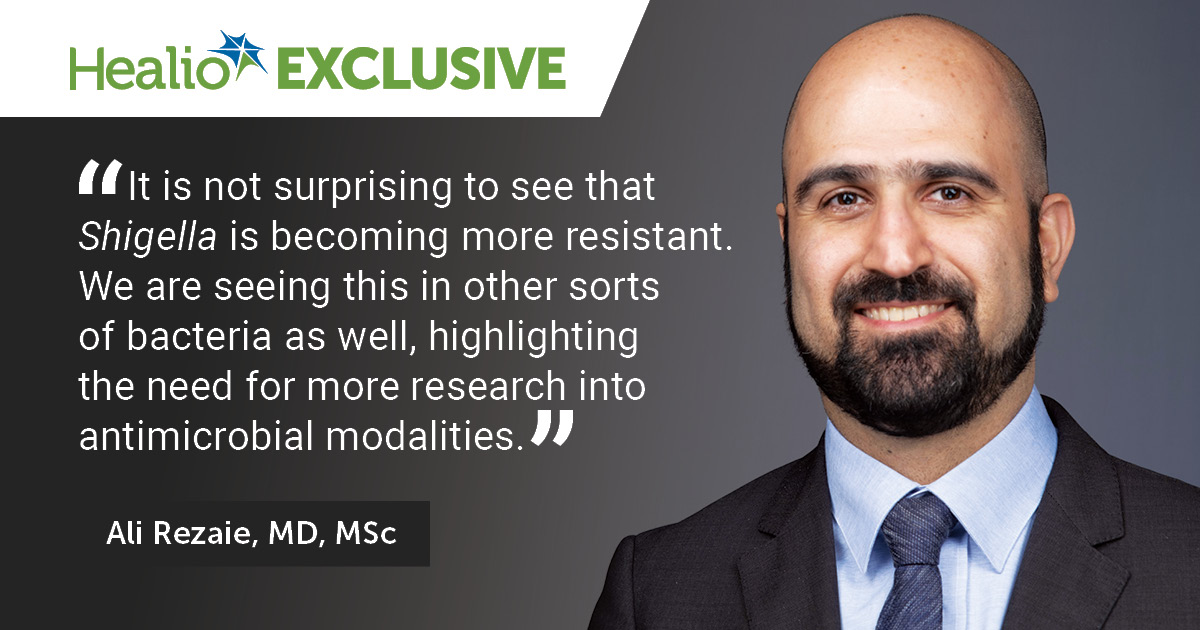
Image: Ali Rezaie, MD. Reprinted with permission.
“Shigellosis is one of those intestinal infections that responds well to antibiotics, by and large,” William Schaffner, MD, professor of preventive medicine and infectious diseases at Vanderbilt University Medical Center, told Healio. “But now we have strains of Shigella that are labeled extensively drug resistant, which means we don’t have an FDA-approved antimicrobial that can be used against them.”
Shigella is highly infectious and can be contracted through as few as 10 bacterial cells. Species of Shigella with XDR designation are resistant to ampicillin, azithromycin, ceftriaxone, ciprofloxacin and trimethoprim-sulfamethoxazole.
“For the majority of patients with shigellosis, it is a self-limited disease that goes away after roughly 7 days with supportive care,” Ali Rezaie, MD, MSc, medical director of the GI motility program and associate professor at Cedars-Sinai, told Healio. “But for patients who do need treatment and have a resistant [strain], oral antibiotics won’t work.”
Typically, patients require treatment if they are immunocompromised, develop severe shigellosis or are hospitalized for another serious condition.
The rise in XDR shigellosis incidence is aligned with broader trends in drug-resistant bacterial infections.
“It is not surprising to see that Shigella is becoming more resistant,” Rezaie said. “We are seeing this in other sorts of bacteria as well, highlighting the need for more research into antimicrobial modalities.”
Among pathogen-antibiotic pairings monitored by WHO between 2018 and 2023, resistance rose more than 40%. Limiting antibiotic use is one strategy to minimize bacterial drug resistance.

Jason E. Zucker
“When we think about Shigella clinically, we want to be judicious with our use of antibiotics, and we want to make sure that we’re offering antibiotics to those people who really will benefit from them,” Jason E. Zucker, MD, assistant professor of medicine at Columbia University Medical Center and medical director of the New York City STD Prevention Training Center, said.
Who is at risk?
Shigella is commonly spread via fecal-oral transmission, sexual contact or contaminated food or water sources.
In particular, sexual contact among men who have sex with men is a notable pathway for Shigella transmission, according to research cited in the CDC report.
“Although anyone can get Shigella, we see higher rates among gay, bisexual and other men who have sex with men, in part because it can be passed through sexual contact,” Zucker said.
The CDC was unable to gather data on sexual behavior for its report, but did note that 86.2% of individuals with XDR shigellosis were men. Seasonal transition can also be an issue.

William Schaffner
“In summertime, people go out, vacation and may develop new relationships or partners,” Schaffner, also a Healio | Infectious Disease News Editorial Board Member, said. “They should exercise caution, because not only are we concerned about HIV and other sexually transmitted infections, but now we have to add XDR shigellosis to the list.”
Of the 116 individuals with XDR shigellosis for whom HIV status was known, 46.6% were HIV-positive.
“With Shigella, there is always the stated concern about anyone who is immunocompromised,” Schaffner said. “People with HIV infection, particularly if they are not well treated, would fall into that category.”
The median age of individuals who contracted XDR Shigella was 41 years, according to the CDC. Only around 4% of cases occurred in children or adolescents.
“Traditionally we think of shigellosis involving mostly children, and then their mothers, who are often the caregivers at home,” Schaffner said.
Schaffner highlighted that addressing XDR Shigella may require a shift away from this line of thought, with a focus on at-risk adult populations.
“We have also seen multiple Shigella outbreaks among people experiencing homelessness over the past few years, often driven by limited access to handwashing and sanitation,” Zucker said.

Donald Dumford
Donald Dumford, MD, an infectious disease specialist at Cleveland Clinic Akron General, also weighed in on individuals who may be more susceptible to infection as drug-resistant strains become more common.
“People who may live in crowded conditions, such as prisons or nursing homes, might be at higher risk,” Dumford said. “Although we haven’t seen outbreaks of XDR Shigella in nursing homes, that might be a population to be concerned for in the future.”
Stopping the spread
Dumford advised clinicians to counsel at-risk patients on harm reduction strategies, including talking to their partners about whether they have had recent diarrheal illness.
“Once patients are symptom-free, they should wait 2 weeks before any sexual contact,” he said. “There are also recommendations for bathing before and after sex, to reduce the bacterial burden as much as possible.”
Dumford also emphasized the importance of reminding patients about hand hygiene.
“Whenever we’re talking about gastrointestinal infections and that fecal-oral route, we have to remind people about the common-sense stuff,” Dumford said. “The big common-sense advice is to wash your hands.
“Whether it’s Shigella, some other bacteria like C. diff or a virus like norovirus, that is the best way to get it off of yourself and your hands before you bring your hands to your mouth,” he added.
Dumford also outlined other reminders clinicians should share with their patients.
“When a patient has a mild strain, we need to manage not only them, but their contacts as well,” he said. “People should stay home from school or work until they are symptom-free for 24 to 48 hours, refrain from preparing food for others during that time, and if they have soiled clothes or linens, they should be washed separately from anything used by the rest of the family or household.”
People can further reduce the risk of spreading the infection within households by assigning the individual with shigellosis a separate sink to wash their hands for the duration of their illness.
Shigella is often foodborne, which makes it difficult to prevent, according to Zucker.
“Ensuring employees who are handling food are washing their hands is really important,” he said.
Clinicians can also curb transmission by providing antibiotic treatment to patients who may need to return to work in industries at high risk for outbreaks.
“Those who work in health care, child care or food handling may benefit from treatment to shorten how long they shed the bacteria, so they can safely return to work,” Zucker said.
Another population clinicians can consider treating to prevent outbreaks —even if they do not have severe illness — is children.
“In the pediatric setting, you might treat children in daycare to limit spread before they pass it to others, though that gets weighed against our goal of using antibiotics judiciously,” Zucker said.
Rezaie encouraged clinicians to advise patients with the infection to stay home from work and avoid contact with immunocompromised friends and family.
Given the higher prevalence of XDR Shigella among individuals with HIV, he also recommends targeted counseling for those patients.
“If a patient is HIV positive, it is important for them to be compliant with anti-HIV medications to keep their immunity up, so the risk for severe disease lessens,” Rezaie said.
Clinicians should also work with laboratories to run culture and sensitivity tests when they encounter a patient with Shigella, Zucker advised. Running these tests will ensure they are prepared to treat the patient, if necessary, but also benefit public health by helping to surveil drug-resistant bacteria.
Supportive care
Clinically, XDR Shigella is indistinguishable from drug-susceptible Shigella. Both strains can cause abdominal pain, diarrhea and sometimes bloody bowel movements or signs of dehydration.
“They present exactly the same,” Rezaie said. “If you are treating a patient with antibiotics and they are not responding after a couple days, or maybe they are worsening, that is the time when you may suspect you are dealing with a drug-resistant strain.”
Clinicians can address the growing threat of XDR Shigella by knowing how to detect it and identify its associated risk factors.
“They also need to know how to treat it, when to reach for antibiotics — and which type to use — and when not to reach for antibiotics,” Rezaie said.
Rezaie has encountered XDR Shigella in his inpatient practice and has treated it in individuals with bloody diarrhea. He encourages clinicians to request an antibiotic sensitivity analysis whenever a patient’s stool tests positive for Shigella.
“Granted, the majority of patients with Shigella don’t need antibiotics, but if they do, you need to be ready with the IV antibiotic, because oral antibiotics are not going to work,” he said.
Zucker also emphasized the importance of a sensitivity analysis.
“These days, many people make the diagnosis of Shigella using multiplex [polymerase chain reaction],” he said. “This test looks for a lot of different types of bacteria in stool, but it doesn’t tell you anything about the bacteria’s susceptibility to antimicrobials.
“The other reason culture can be valuable is that Shigella can hang around for a really long time, and these multiplex PCRs are incredibly sensitive,” Zucker continued. “It is not always clear whether they are picking up active infection or old infection, and so if you are doing a culture and it does not grow, it is possible you are looking at a prior infection that would not benefit from additional antibiotics.”
Whether or not patients need antibiotics, supportive care is critical and remains the cornerstone of treatment.
“Ensure patients are keeping up with fluids, so they do not become dehydrated,” Schaffner said. “The very young, the very old, those who are frail because they have a chronic underlying illness, immunocompromised people and persons who are pregnant are all much more vulnerable to dehydration and its metabolic consequences.”
Outpatients can avoid dehydration with oral resuscitation solutions that can be made at home or purchased over the counter.
“You don’t want to suggest patients take antimotility agents like Imodium, because that might actually prolong the length of shedding and the length of illness,” Dumford said.
Treating outpatients with severe cases of XDR shigellosis, whose symptoms are worsening with time rather than improving, can be difficult.
“Starting IV antibiotics as an outpatient is not feasible,” Rezaie said. “Patients would need to be hospitalized.”
Schaffner emphasized the importance of collaboration and communication between clinicians and infectious disease specialists when treating shigellosis.
“If you encounter [XDR Shigella], please contact your infectious disease colleagues,” Schaffner said. “They will work closely with the microbiology laboratory, trying to find an antibiotic that might be available to help.”
Threat to enteric bacteria
Dumford offered a theory about how XDR Shigella may have evolved.
“It seems like treatment or prophylaxis for other sexually transmitted infections may have driven some of this resistance,” he said. “Ciprofloxacin and azithromycin are common for some other infections, and that may have driven some of the resistance to those drugs within the Shigella population.”
The CDC noted that resistance genes from XDR Shigella can be transmitted to other enteric bacteria, further demonstrating its potential as a public health threat.
“If you have XDR Shigella, or another antibiotic-resistant bacteria that you are carrying in your GI tract, there is always the chance that it’s going to share its genes with some other more benign bacteria, which might cause colonization of drug-resistant strains of bacteria,” Dumford said.
With more than 1,000 different microbial species in the gut, including Escherichia coli, the potential for bacterial conjugation is strong.
“These resistance genes are on a plasmid, and plasmids are transferable,” Schaffner said. “As these Shigella come in contact with other enteric bacteria, such as E. coli, there may be opportunity for this plasmid to be transmitted, thereby initiating the XDR phenomenon in E. coli. This is a potential public health problem not limited to some strains of Shigella, but one that could spread more widely.”
For more information:
Donald Dumford, MD, can be reached at gastroenterology@healio.com.
Ali Rezaie, MD, MSc, can be reached at gastroenterology@healio.com.
William Schaffner, MD, can be reached at william.schaffner@vumc.org.
Jason Zucker, MD, can be reached at jz2700@cumc.columbia.edu.
Sources/Disclosures
Source:
Healio Interviews
References:
Disclosures:
Dumford, Rezaie, Schaffner and Zucker report no relevant financial disclosures.

Ask a clinical question and tap into Healio AI’s knowledge base.
- PubMed, enrolling/recruiting trials, guidelines
- Clinical Guidance, Healio CME, FDA news
- Healio’s exclusive daily news coverage of clinical data