
August 17, 2026
4 min read

Key takeaways:
- Researchers reported better outcomes with focused ultrasound and FOLFIRINOX than had been observed in a historical cohort of patients who received chemotherapy alone.
- A randomized phase 3 trial is planned.
The addition of a novel form of focused ultrasound to standard FOLFIRINOX chemotherapy may improve outcomes for certain patients with pancreatic cancer, according to results of an exploratory phase 2 trial.
The combination appeared associated with a higher response rate, longer survival and greater eligibility for surgery among patients with borderline resectable or locally advanced disease than had been observed in a matched historical cohort of patients who received chemotherapy alone.

Data derived from Lee DH, et al. Eur J Cancer. 2026;doi:10.1016/j.ejca.2026.116903.

Jae Young Lee
“We are encouraged by these [results], which suggest that nonthermal focused ultrasound may help improve the effectiveness of FOLFIRINOX without adding toxicity or side effects,” Jae Young Lee, MD, PhD, professor in the department of radiology at Seoul National University College of Medicine and Seoul National University Hospital in South Korea, said in a press release. “For patients with borderline resectable or locally advanced pancreatic cancer, improving tumor response and creating more opportunities for curative-intent surgery can be clinically important. These findings are an important step, and we are now focused on confirming the benefit in a randomized phase 3 clinical trial.”
A novel approach
Focused ultrasound delivers concentrated sound waves to heat and destroy tissues deep in the body. The noninvasive, radiation-free technology is used to treat prostate tumors, uterine fibroids, Parkinson’s disease and other conditions.
Data in pancreatic cancer have been limited to single-institution series, according to Hyun Kim, MD, associate professor of radiation oncology and director of GI radiation oncology at City of Hope.

Hyun Kim
“The investigators should be commended for successfully completing a prospective clinical trial for this novel technology. The data so far are early so, while promising, we really do not know how efficacious and safe it is without further follow-up and evaluation,” Kim, who was not involved with exploratory phase 2 study, told Healio.
Mechanical effect-dominant nonthermal focused ultrasound uses acoustic radiation force and cavitation, which create microbubbles that break up targets but do not induce tissue heating. This mitigates the risk for thermal damage, particularly to the nearby duodenum and bowel, Kim said.
Lee and colleagues assessed the efficacy and safety of using this novel form of focused ultrasound in conjunction with FOLFIRINOX, which is standard for borderline resectable or locally advanced pancreatic cancer but often results in suboptimal response rates.
The researchers enrolled 60 patients, 56 of whom completed four cycles of focused ultrasound plus FOLFIRINOX, followed by additional cycles of FOLFIRINOX alone. Thirty-six patients (64.3%) had borderline resectable disease and 20 patients (35.7%) had locally advanced disease.
Investigators compared outcomes in this group with a propensity score-matched historical cohort of patients who received FOLFIRINOX alone.
Objective response rate served as the primary endpoint. OS, PFS and treatment-related toxicity served as secondary endpoints.
Focused ultrasound-chemotherapy favored
Researchers reported median follow-up of 24 months (range, 4-38).
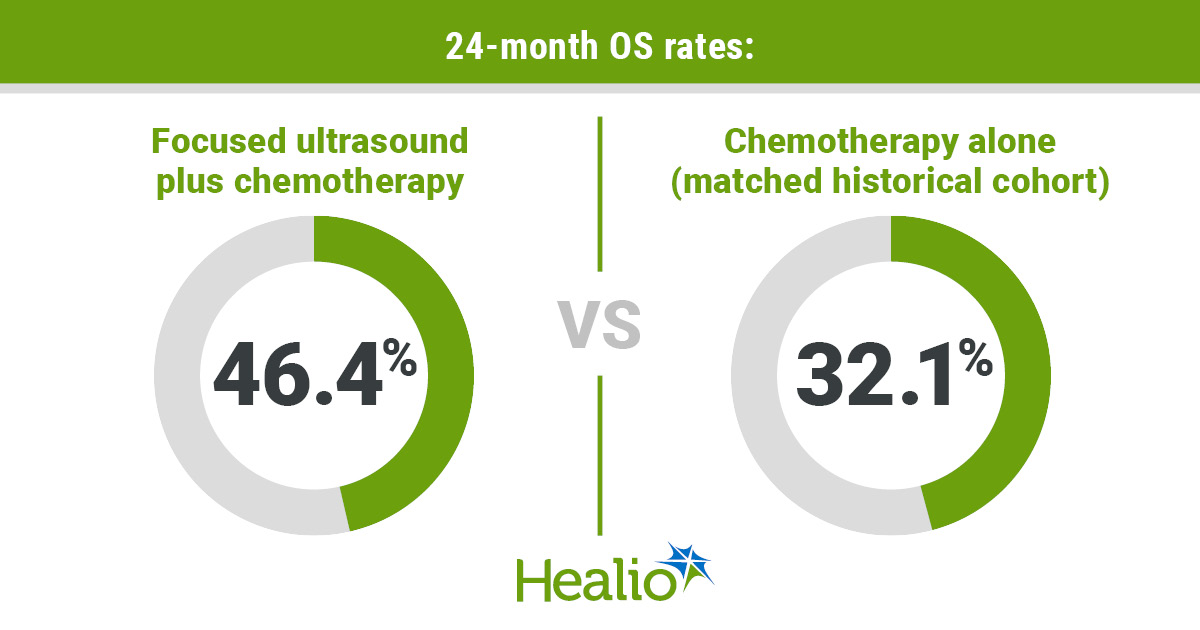
Results showed a higher objective response rate (64.3% vs. 35.7%; P = .003), longer OS (median, 24 months vs. 17 months; HR = 0.63; 95% CI, 0.41-0.97) and a higher 24-month OS rate (46.4% vs. 32.1%) with the combination than those in the historical cohort who received chemotherapy alone.
The difference in median survival reached statistical significance among patients with borderline resectable disease (median, 26 months vs. 20 months) but not those with locally advanced disease (median, 19 months vs. 13 months).
Other outcomes — including PFS (median, 16 months vs. 11 months; HR = 0.65; 95% CI, 0.43-0.99) and percentage of patients who became eligible for surgery (51.8% vs. 30.4%) — favored the focused ultrasound-chemotherapy combination.
Grade 3 or higher toxicities occurred among comparable percentages of patients treated with the combination or FOLFIRINOX alone (55.4% vs. 57.1%).
Investigators reported no adverse events related to focused ultrasound during posttreatment monitoring, and no collateral organ injuries occurred during follow-up.
‘Important’ questions
The outcomes are encouraging but there are multiple caveats, Kim said.
Radiographic response in pancreatic cancer is challenging to assess, he said, so ORR outcomes are more difficult to interpret than biochemical PFS or OS.
The PFS results compare favorably to prior multi-institution randomized phase 3 trials. However, the study’s single-arm design is a limitation, and the comparison with historical controls creates potential for bias, he said.
Some patients had short follow-up and the study did not offer detailed explanations for why certain patients had been excluded, Kim said.
The surgery eligibility data also raise “a really important question,” he added.
“Given 64% of patients had borderline resectable disease, I find it odd that only 30% of patients in the matched historical cohort who received chemotherapy alone proceeded to surgery,” Kim said.
In contrast, a prior prospective, multi-institution phase 2/phase 3 study led by investigators from Seoul National University showed that in their experience, 78% of patients with borderline resectable pancreatic cancer who received chemotherapy alone proceeded to surgery.
“That makes me a little concerned that maybe the study population was not as balanced as one would think,” Kim said.
Lee and colleagues are planning a randomized phase 3 trial.
The results should provide valuable insights to better understand the potential benefit of focused ultrasound in this setting, Kim said. Even if they are positive, however, some hurdles may remain.
A billing code is an “elephant in the room” that would need to be addressed prior to broad adoption, Kim said.
“We have seen important technologies come and go because we as societies, cooperative groups and policymakers have not been willing or able to give it a designated billing code so it can be financially incentivized or just financially viable enough to survive,” Kim said.
The scientific community also has begun moving toward use of elective nodal irradiation to treat high-risk lesions — particularly around the celiac axis and superior mesenteric artery — to account for perineural and elective nodal spread, he added.
“Would focused ultrasound make it so that we can account for potential microscopic spread the way that elective nodal radiation can?” Kim said. “Perhaps we can give elective nodal radiation in combination with this ultrasound technology and be able to combine the best of both worlds.”
For more information:
Hyun Kim, MD, can be reached at hxkim@coh.org.
Sources/Disclosures
Source:
Lee DH, et al. Eur J Cancer. 2026;doi:10.1016/j.ejca.2026.116903.
Reference:
Disclosures:
The authors report no relevant financial disclosures. Focused Ultrasound Foundation, as well as Korea Ministry of Science and ICT, supported this study. Kim reports consulting/speaking fees from Elekta and Varian Medical Systems, as well as research funding from Varian Medical Systems.

Ask a clinical question and tap into Healio AI’s knowledge base.
- PubMed, enrolling/recruiting trials, guidelines
- Clinical Guidance, Healio CME, FDA news
- Healio’s exclusive daily news coverage of clinical data