
August 24, 2026
3 min read

Key takeaways:
- CRC mortality fell 50% among individuals aged 50 to 69 years.
- The most significant decline occurred 3 years after the program began.
- Around 70% of cancers were detected at stage I or II.
A fecal immunochemical testing-based screening program in Spain was linked to durable decline in colorectal cancer mortality over a 21-year period, according to study results published in JAMA Network Open.
“Our research was motivated by a key clinical challenge: the need to generate long-term, population-level evidence on the real impact of organized FIT-based colorectal cancer screening programs on mortality,” Luis Bujanda, MDPhD, professor of medicine at Donostia University Hospital in San Sebastián, Spain, told Healio. “Although FIT screening is widely implemented, robust data describing how CRC mortality evolves across all phases of program maturation — prescreening, rollout, consolidation and external disruptions such as COVID19 — have been limited.”

The Basque Country region of Spain initiated a FIT-based screening program in 2009, inviting individuals aged 50 to 69 years at average risk for CRC to participate and sending tests to their homes every 2 years. Outreach expanded in 2014 to the full population of approximately 2.2 million residents.
Bujanda and colleagues investigated CRC mortality before, during and after the program’s implementation using electronic health record data from 2004 to 2024.
Primary outcomes included age-standardized CRC mortality rates per 100,000 people and annual mortality trends. Secondary outcomes assessed screening uptake, FIT positivity, colonoscopy adherence and cancer stage distribution.
The median population of Basque Country over the 2-decade period was 2,174,033 (51.3% women). During this time, there were 438,134 total deaths, 3.7% of which were attributable to CRC.
Age-standardized CRC mortality dropped from 32.8 to 23.1 deaths per 100,000 from 2004 to 2024, equating to a reduction of 29.6%. By age, mortality declined 50.1% among individuals aged 50 to 69 years — a relative reduction of 46.2% compared with projected rates — and 19.6% among individuals aged 70 years or older.
More than two-thirds (70.8%) of CRC detected via screening was diagnosed at stage I or II.
“Screening benefits extend beyond the directly screened cohort, likely due to earlier detection before aging into the 70 [years and older] group, removal of precancerous lesions during screening years and improved diagnostic pathways triggered by screening infrastructure,” Bujanda said.
Researchers observed the most significant decline in CRC mortality in 2012.
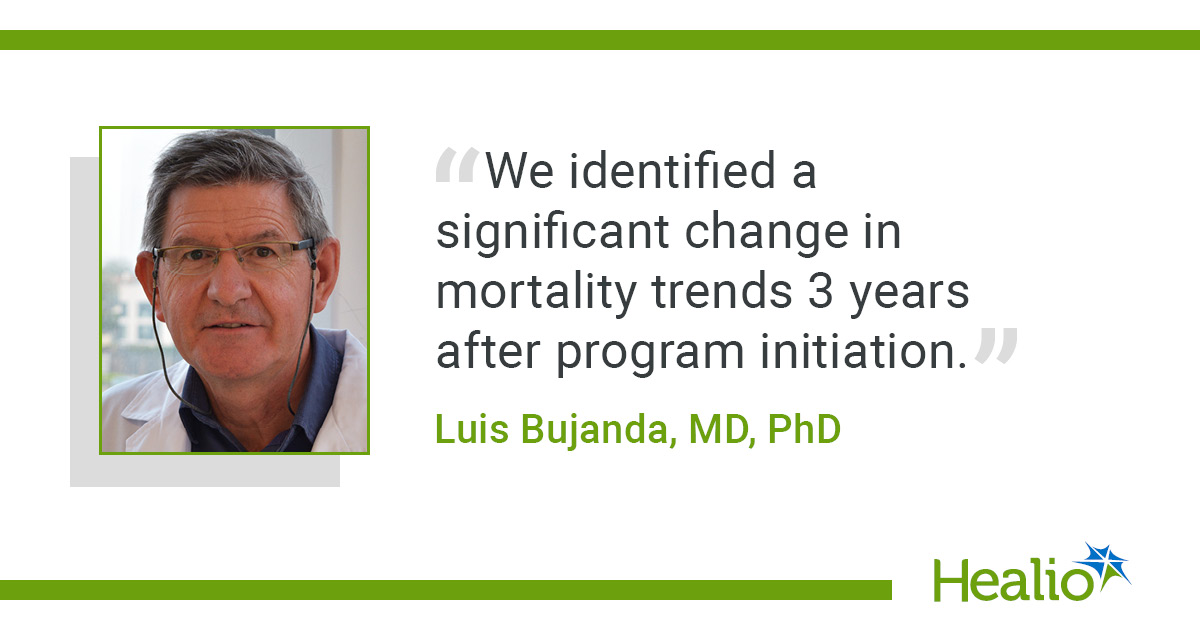
“We identified a significant change in mortality trends 3 years after program initiation, highlighting the time required for screening benefits to manifest at the population level,” Bujanda said.
Mean participation in the program reached 70.1% and median adherence to colonoscopy after positive FIT results exceeded 91%.
The FIT positivity rate during early implementation of the program was 6.5% (interquartile range [IQR], 5.7%-6.9%), which fell to 4.9% (IQR, 4.6%-5.2%) after the program was established. It declined again to 4.3% (IQR, 4.2%-4.3%) in the period after the COVID-19 pandemic.
FIT positivity remained higher among men than women for the duration of the study, as did CRC mortality, although mortality rates did decline by 18.3% among men from 2004 to 2024.
“Sex- and age-specific differences in positivity and mortality suggest that tailored FIT cutoffs may improve performance,” Bujanda said.
The study has several limitations, including lack of individual-level data on screening participation and outcomes, and use of a prescreening historical comparator that did not account for advances in healthcare.
Bujanda and colleagues suggested several avenues for further research, including evaluating CRC screening programs enhanced with risk-stratification tools and assessing the value of extending screening to older adults.
“More than 15 years of screening and five rounds of invitation with fecal occult blood and participation have prevented more than 3,000 deaths per million inhabitants from colon cancer and avoided surgeries, hospital admissions and associated chemotherapy treatments,” Bujanda said.
For more information:
Luis Bujanda, MD, PhD, is professor of medicine at Donostia University Hospital and University of the Basque Country and coordinator of the liver and gastrointestinal diseases department at Biogipuzkoa Health Research Institute. He can be reached at gastroenterology@healio.com.

Ask a clinical question and tap into Healio AI’s knowledge base.
- PubMed, enrolling/recruiting trials, guidelines
- Clinical Guidance, Healio CME, FDA news
- Healio’s exclusive daily news coverage of clinical data