
September 01, 2026
3 min read

Key takeaways:
- Treatment response rates were significantly higher with singing therapy vs. diaphragmatic breathing at 1 week and 1 month.
- Older age and higher baseline belching scores were predictors of treatment response.
Patients with supragastric belching reported greater symptom relief and improvements in health-related quality of life with singing therapy than diaphragmatic breathing, study results showed.
Findings also suggested that singing therapy could be particularly beneficial for older patients with severe symptoms.

Data derived from Shang H, et al. Clin Gastroenterol Hepatol. 2026:doi:10.1016/j.cgh.2026.03.047.
“Supragastric belching significantly impairs quality of life,” Haitao Shang, PhD, of the department of gastroenterology at Qingdao Hospital in China, and colleagues wrote. “Although diaphragmatic breathing is recommended as a first-line intervention in clinical guidelines, some patients perceive it as monotonous.”
Supragastric belching — characterized by involuntary contractions of the diaphragm that cause rapid intake and expulsion of air at the esophagus — can cause substantial patient discomfort, as well as compromise quality of life.
Pharmacological therapy often is associated with central nervous system-related adverse events, according to the researchers. Behavioral therapies like speech and cognitive therapy have shown promise but can be limited by intensive time requirements and specialist availability.
Given these barriers — and some patients’ perception of and poor adherence to diaphragmatic breathing exercises — Shang and colleagues investigated structured singing therapy as a possible treatment.
“Singing requires precisely coordinated respiratory muscle activity involving the diaphragm, intercostal and abdominal muscles, which may help correct the dysfunctional diaphragmatic contractions,” they wrote.
Study design
Shang and colleagues recruited 72 adults with supragastric belching from two gastroenterology outpatient centers in China between October 2024 and April 2025.
They randomly assigned patients 1:1 to singing therapy (mean age, 46.1 years; 66.7% women) or diaphragmatic breathing (mean age, 43 years; 63.9% women). Thirty participants in each group adhered to treatment for the duration of the study.
The cohorts were balanced in symptom severity, Gastrointestinal Symptom Rating Scale scores, psychiatric comorbidities and quality-of-life measurements.
Participants assigned singing therapy engaged in three 5-minute singing sessions per day, with additional 5-minute sessions when belching episodes occurred.
During these sessions, patients were required to maintain open mouth phonation to activate their diaphragm and to reach a target vocal intensity of 80 decibels. They could sing one of four Chinese folk songs, which were selected for their simplicity and broad familiarity.
Those assigned diaphragmatic breathing participated in 30-minute sessions focused on controlled breathing, positional progression and home practice techniques.
Both interventions were guided by gastroenterologists over a 1-week period.
Participants completed questionnaires assessing symptom severity, impairment of daily activities, perceived controllability and function interference in social settings, among other factors.
Treatment response, defined as at least a 50% reduction in belching visual analogue scale (VAS) scores, served as the primary outcome. Quality of life, anxiety, depression and gastrointestinal symptom severity served as secondary outcomes.
Researchers conducted assessments at baseline, 1 week and 1 month.
‘Sustained therapeutic advantage’
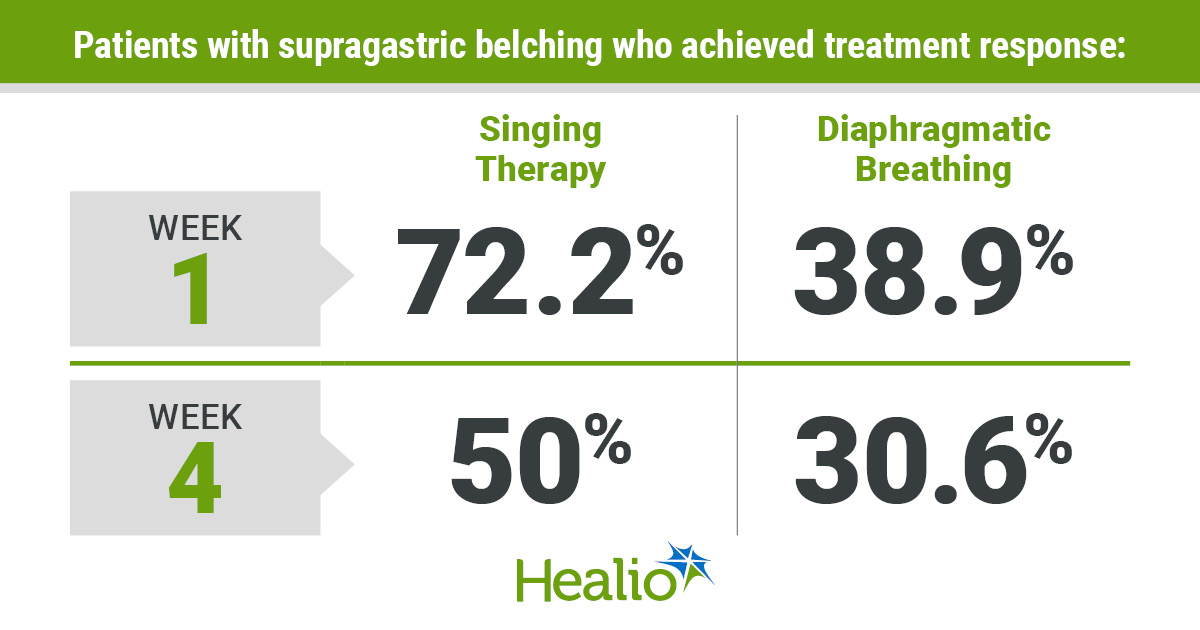
Singing therapy significantly outperformed diaphragmatic breathing in response rates at 1 week (72.2% vs. 38.9%; P = 0.004) and 1 month (50% vs. 30.6%; P = 0.032).
“The sustained therapeutic advantage observed with singing therapy may be attributable, at least in part, to enhanced treatment acceptability, as evidenced by the significant positive correlation between treatment acceptability and VAS improvement,” Shang and colleagues wrote.
Participants assigned singing therapy also demonstrated significantly greater improvements in health-related quality-of-life scores, assessed via EuroQol VAS, at 1 week. Scores from both intervention groups dropped at 1 month but were still significantly higher than baseline.
Assessments of GI symptom severity, anxiety and depression also improved, but were not significantly different between groups.
Three factors predicted treatment response: singing therapy (OR = 6.7; 95% CI, 1.71-26.21), older age (OR = 1.1; 95% CI, 1.03-1.18) and higher baseline belching VAS scores (OR = 1.02; 95% CI, 1.01-1.04).
The researchers acknowledged study limitations, including lack of validation of the belching VAS scale, generalizability, short-term follow-up and reliance on self-reported data.
“Although long-term outcomes require further investigation, these findings strongly support the use of singing therapy as an effective adjunctive treatment, particularly for older patients with severe [supragastric belching] symptoms,” they wrote.
Perspective

The current treatment options for the management of excessive supragastric belching include pharmacological management with baclofen monotherapy, which is limited by its unclear benefit and neurological side effects, and the more beneficial behavioral interventions. Two examples are speech therapy, including differing forms of speech therapist-led biofeedback and diaphragmatic breathing exercises, and cognitive behavioral therapy, which is limited by specialist availability and knowledge.
To have a potentially new — and fun — alternative like singing therapy would be an extremely welcome and desired therapeutic option. Singing therapy offers a likely more engaging and effective alternative to standard diaphragmatic breathing, particularly for older patients with severe symptoms.
Singing requires precisely coordinated respiratory muscle activity involving the diaphragm, intercostal and abdominal muscles. This comprehensive muscle engagement may help correct the dysfunctional diaphragmatic contractions that underlie supragastric belching, providing a more targeted therapeutic intervention and potentially less monotonous therapy than diaphragmatic breathing alone. Both interventions reduce belching through distraction-based attentional modulation, but singing’s superiority may stem from greater treatment acceptability.
It should be noted that all participants in this study were from a Chinese cohort with culturally validated music selections, so whether this intervention would be acceptable to a local population would require further study. In addition, breathing exercises can be discreetly done at the first warning signal and in triggering environments for supragastric belching. It might be hard to imagine a patient breaking out into song at a work meeting or in a restaurant.
Disclosures: Gluckman reports no relevant financial disclosures.

Ask a clinical question and tap into Healio AI’s knowledge base.
- PubMed, enrolling/recruiting trials, guidelines
- Clinical Guidance, Healio CME, FDA news
- Healio’s exclusive daily news coverage of clinical data