
 Column
Lindstrom’s Perspective
September 01, 2026
3 min read
Lindstrom’s Perspective
Click here to read the Healio Exclusive, “Experience builds confidence when it comes to speaking at meetings.”
I am often asked by residents, fellows and younger ophthalmologists to share the pathway to becoming a key opinion leader in ophthalmology and a regular invited speaker at educational meetings.

In the following paragraphs, I will share a few thoughts gained from my personal journey as a lecturer and a frequent organizer of educational programs today.
Remember, there is no elevator to success or excellence as a key opinion leader (KOL) or speaker — you must take the stairs. The first stair is quality training including, for most, one or more years of post-residency fellowship. I personally completed three fellowships after residency, the first in cornea and external disease at the University of Minnesota, the second in advanced microsurgery at a busy surgical academic private practice in Dallas, and the third in glaucoma at the University of Utah supported by the Heed Ophthalmic Foundation. These fellowships provided extremely valuable clinical training and a strong knowledge base as well as a solid set of credentials supporting expertise.
Next, it is important to build a busy clinical practice. You cannot be a credible educator of other clinicians unless you have strong clinical experience. As you grow your clinical experience, you will become passionate about one or more areas of clinical practice. Focus on these areas of interest and study global literature to become a true expert in your chosen topics. Then, compile and evaluate your own clinical outcomes and compare them with world literature. Collaborating with an industry partner and performing an investigator-initiated clinical trial in your area of interest is a good way to strengthen this process. Once complete, you will have a unique set of personal data and clinical insights useful to others, including your colleagues and industry.
The next step is to get invited to share your thoughts and insights at a meeting. Here, a residency or fellowship mentor, senior partner or industry representative can help.
Finally, when invited to present to your colleagues at an educational event, it is critical to take the time and effort required to deliver an outstanding presentation. It is important to know that once you are at the podium, you will have a critical audience. Your presentation with be critiqued by the meeting organizer, in many cases a panel of expert colleagues, meeting attendees and any industry representatives present.
The lecture you give must end on time, be delivered smoothly with support from high-quality audiovisual PowerPoints and/or video, and be free from commercial bias. If you fail in any of these regards, you are much less likely to be invited to present again. If you succeed, you will find yourself a regular speaker as your reputation as an excellent and honest educator expands by word of mouth among those who have the responsibility to organize quality educational programs for their colleagues. Always present information that is evidence based with references, clinically useful and unbiased, while being presented in the time allotted with a high-quality delivery style.
Once positioned as a quality speaker with useful information to share, you will find yourself in demand to participate in industry-sponsored clinical trials, join medical advisory boards, participate in leadership positions at ophthalmology societies and over time become a meeting organizer yourself. You will be a KOL!
Now, a few thoughts on how to prepare and present a quality medical lecture. An excellent lecture has a central idea and provides information that can be used immediately to improve a colleague’s clinical or business performance when returning to their practice. It is important to know your audience, know your subject matter, prepare your presentation well in advance and practice the talk repeatedly at home.
Every lecture has an architecture. Dress appropriately for the setting. Adjust the microphone before you begin to speak. Speak in an audible, purposeful, paced fashion and make eye contact with the audience right, left, center, front and back. Pause and direct the audience view to the PowerPoint presentation when appropriate to emphasize key points. Start by telling the audience what you are going to teach them, teach with your verbal and audiovisual presentation, and then, when closing, tell them again what you taught them. Case presentations are a powerful and memorable way to illustrate diagnostic reasoning and therapeutic choices and keep listeners engaged by making them think during the presentation.
Just like no one is born a great surgeon, no one is born a great orator. It helps to critically observe other speakers. One can learn from good and bad speaker examples. Adopt a style you find attractive and emulate it through practice. Training courses such as Dale Carnegie and Toastmasters are available as are personal coaches. Many universities, colleges, societies and some companies offer speaker training programs. Ask a few friendly colleagues and mentors to critique your presentations and offer constructive advice. If your presentation is recorded or on video, watch it and learn, just like you would review a video of your surgical procedures.
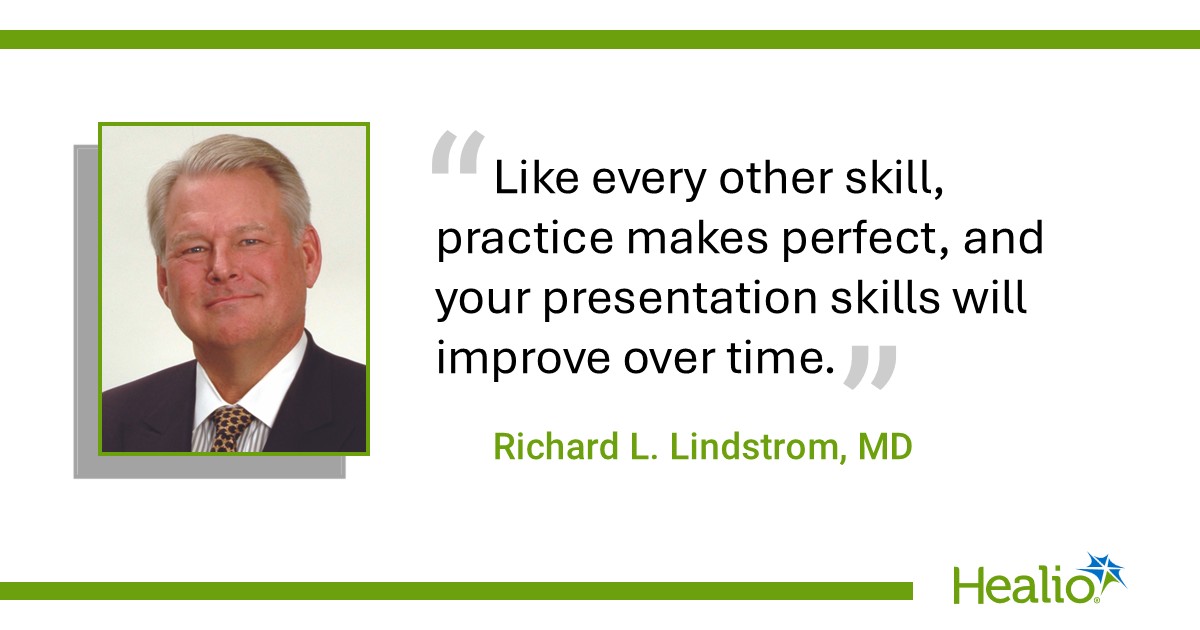
Like every other skill, practice makes perfect, and your presentation skills will improve over time. Be patient with yourself and do not expect to be perfect at first. Remember that while it is an honor and gratifying to be chosen to teach your colleagues, it is also a significant responsibility. Never forget that what you teach has the potential to impact many patients’ vision, positively or negatively. Integrity and honesty in your presentation are critical to earn the long-term trust of your colleagues and those who put you on the podium.
For more information:
Richard L. Lindstrom, MD, can be reached at rllindstrom@mneye.com.
Lindstrom’s Perspective

Sources/Disclosures
Source:
Expert Submission
Disclosures:
Lindstrom reports having disclosures for the American Academy of Ophthalmology, the American Society of Cataract and Refractive Surgery, Healio, Healio LIVE, SLACK Incorporated, Vindico Medical Education and the Wyanoke Group and having gratitude for my many mentors and those who gave me the opportunity to share my thoughts with my colleagues. Literature search enhanced by Elicit AI, Google and Healio AI.

Ask a clinical question and tap into Healio AI’s knowledge base.
- PubMed, enrolling/recruiting trials, guidelines
- Clinical Guidance, Healio CME, FDA news
- Healio’s exclusive daily news coverage of clinical data