
September 01, 2026
9 min read
Key takeaways:
- Direct primary care offers more personalized care and potential savings on medications and lab tests.
- However, it does not replace health insurance, and the membership fees may be a barrier for some.
Membership-based primary healthcare is becoming commonplace, offering longer visits, more individualized care and lower out-of-pocket costs for certain tests and medications, according to experts.
The American Academy of Family Physicians defines direct primary care (DPC) as an alternative to the traditional fee-for-service insurance billing model, where patients are charged a fee monthly, annually or biannually.

These costs can vary, with monthly fees ranging from $50 to $150 for adults, $20 to $49 for youth and $100 or more for families. This fee covers most or all primary care services, “including clinical and laboratory services, consultative services, care coordination, and comprehensive care management,” according to AAFP.
Similarly, concierge care also operates under a membership-based structure.
Concierge care and DPC “are viewed interchangeably, but they are distinct,” Ann Greiner, MCP, president and CEO of the Primary Care Collaborative, told Healio.
While concierge care offers monthly and annual — although typically higher — fees like DPC, this model also may accept insurance plans and government programs.
In comparison, DPC “is no insurance coverage and a subscription fee, which is either paid by an individual or sometimes employers,” Greiner said.
For physicians who are interested in the DPC model but still want to offer traditional fee-for-service care to their patients, Greiner said hybrid models are an option. But such hybrid models can be complicated, “and many practices just make that full on switch to DPC,” she added.
DPC on the rise
According to an analysis published last year in Health Affairs, the number of concierge and DPC practices in the United States grew by 83.1% from 2018 to 2023 and the number of clinicians participating in them rose by 78.4%.
There are currently around 3,163 DPCs in the U.S., according to the tracking group DPC Frontier Mapper.
“The rise of concierge and direct primary care reflects, in many ways, dissatisfaction with the traditional primary care system,” Jane M. Zhu, MD, MPP, MSHP, the study’s lead author and an associate professor of medicine at the Oregon Health & Science University School of Medicine, told Healio.
As a primary care physician, Zhu said she sees “the pressures facing clinicians and patients in today’s primary care landscape.”
“Many physicians are struggling with administrative burden, time constraints and burnout, while patients face growing difficulty accessing timely care,” she said. “DPC and concierge models have emerged as one way clinicians can try to regain clinical autonomy and spend more time with patients. So, against this backdrop, it’s important to understand how these models are evolving nationally.”
While the Health Affairs analysis “wasn’t a census and likely underestimates concierge and DPC practices nationally,” Zhu said they “observed an impressive speed of growth over a 5-year period. This growth mirrors what we’ve been seeing on the ground, with significant interest from clinicians and patients alike on these models.”
Greiner said there are a few possible explanations contributing to this rise, one of which is a new provision under H.R. 1, or the “One Big Beautiful Bill” Act, that now allows eligible individuals enrolled in DPC arrangements to contribute to a health savings account (HSA). These individuals can then “use their HSA funds tax-free to pay periodic DPC fees,” according to the IRS website.
According to AMA, patients with an HSA can use the funds to pay for DPC if fees are under $150 monthly for an individual and under $300 monthly for a family, though “the funds must be used for primary care services provided by a primary care physician or other allowed health professional.”
Greiner also noted that more employers are beginning to offer DPC, “and they’re using platforms that allow them to make these offerings available across the country.”
According to a 2025 report from Health Compiler, 58% of all DPC memberships in 2024 were employer-sponsored, an increase of 28% from 2022.
One trend that Zhu said is “worth watching over time” is an increase in corporate ownership of concierge and DPC models, which rose in the Health Affairs analysis by 576% from 2018 to 2023, while independent ownership decreased from 84% to 59.7%.
“Concierge and DPC models are often framed as a response to corporatization and declining clinical autonomy,” she explained. “Seeing increasing corporate involvement suggests these models are evolving in ways that may diverge from their original vision.”
Benefits of DPC
DPC practices “offer clear benefits to clinicians, like smaller patient panels, reduced administrative burden and greater autonomy,” all of which “may improve access and satisfaction for enrolled patients,” Zhu said.
“These models also respond to a real demand for accessible care, and many patients are willing to pay for more access and personalized care,” she said.
For Josh Umbehr, MD, a family physician and cofounder of Atlas.md, a software and DPC clinic, this model represents a way of making healthcare “less than free.”
“What that means to me is that you have all the care you need and money left over,” Umbehr told Healio. “If you’re spending $2,500 a month on healthcare and not getting $2,500 a month in value out of that, then we are limiting your life’s potential.”
Out-of-pocket maximums with health insurance can cost thousands of dollars, Umbehr said.
“I think that, combined with HSA allowability and price transparency, we are going to see a lot more people question the cash price of their care,” he said. “Now insurance is so expensive, I might as well not have it for the first $5,000 or $6,000 in out-of-pocket costs.”
DPC can also help reduce drug costs for patients. For example, “your migraine medicine is $100 with a GoodRx coupon at the pharmacy. It’s $5 with us,” Umbehr said.
“If you have a $50 a month membership, you’re saving $45 a month, and you have your migraine medicine,” he said. “Name-brand Lexapro for depression is $12 a pill. Generic Lexapro in my office is $0.04 a pill.”
The reason that medications are cheaper in DPC models, Umbehr explained, is because practices purchase them at wholesale prices.
“Pharmacy benefit managers aren’t involved because they’re between the pharmacy and insurance, not necessarily between the pharmacy and patient,” he said. “A lot of times, they make the pharmacies sign contracts to affect the patient’s cash price.”
Joshua Liao, MD, MSc, FACP, a professor of medicine at the University of Texas Southwestern Medical Center, said during a presentation at ACP’s Internal Medicine Meeting that DPC is often thought of as “boutique care for the wealthy, but in reality, some of these services are priced in a way that are comparable to other fees you might pay in your life. There is skew for concierge medicine, but it does vary nonetheless.”
Brian R. Forrest, MD, CEO of Access Healthcare Direct, told Healio that “by not having to pay copays, and by not having to pay for labs or meet their deductibles, most people save more than the cost of their membership.”
While current literature on DPC is not “the strongest” because of how new the model is, “most research suggests that there’s a 65% cost reduction of taking care of patients,” Norman M. Dy, MD, MBA, FACP, an internal medicine physician and DPC provider at Johns Hopkins Community Physicians, told Healio. This is because specialty care and emergency care are often avoided “a great deal by timely advice and intervention” thanks to DPC, he said.
According to Philip Eskew, DO, JD, MBA, a physician and founder of Direct Primary Care Frontier, “most conditions are not isolated acute issues but rather are acute-on-chronic in origin until proven otherwise. By addressing a chronic issue, we decrease the chance of repeat acute exacerbations that would require emergency and specialist intervention,” he told Healio, adding that patients with complex or chronic conditions “are more likely to join DPC practices than healthy patients without any concerns.
“By sorting out and appropriately identifying and treating their chronic conditions the patient can spend more time living their life and the physician gradually spends less time with the patient as chronic conditions are identified and better managed,” he said.
A big reason why DPC allows for higher quality and more individualized care is due to the smaller patient panel sizes. According to AAFP, the typical panel size for a DPC practice is about 413 patients vs. about 1,700 patients in a typical family medicine practice.
Higher panel sizes typically limit visits to 15 minutes, “and it allows even the best clinicians to just basically spot weld problems,” Dy said.
“It’s impossible to do a comprehensive visit in 15 minutes,” he added.
In contrast, the smaller panel sizes in DPC practices allow clinicians “to spend more time with the patient and give comprehensive, convenient care that’s much more fulfilling to both the providers and the patient,” Dy said.
Carolyn L. Engelhard, MPA, associate professor emerita at the University of Virginia School of Medicine, told Healio that DPC “is fine as … an adjunct to real insurance. This is the best of both worlds: guaranteed access to primary care with a safety net of insurance if there is a serious and/or costly condition.”
The drawbacks
According to AMA, the downsides of DPC for physicians may include fewer patients overall, less income at the beginning of a practice, and “complications related to operating outside of traditional payment models.”
Another important consideration is how affordable it is for lower-income populations, or if it is “really only for folks who have more disposable income and can afford to pay this monthly subscription cost,” Greiner said.
Dy noted that an $80 to $150 monthly fee “is considerable for many patients.”
“That’s the same cost as utilities or paying for gas to get to work,” he said.
Also, if more physicians transition to DPC “without a corresponding expansion of the primary care workforce,” this could limit primary care access to patients who choose a traditional fee-for-service model, Zhu said.
If the census of traditional primary care is decreased, “you’ll need more providers, and we don’t even have enough providers now,” Dy said.
While DPC “does reduce certain aspects” of administrative burden, Liao said it can create “other types of burden.” For example, physicians may feel obligated to conduct a lab or test, even when not indicated, and patient relationships are “24/7,” Roger Khetan, MD, FACP, a physician at North Texas Preferred Health Partners, said during the ACP presentation.
“You are checking your email constantly,” he said.
In addition, DPC physicians are limited in “what they can offer if medical problems get chronic and expensive,” Engelhard said.
“They have to be able to refer to specialists for cancer care and other kinds of specialty treatment,” she said. “Some DPC PCPs have those relationships, but specialty doctors will not do ‘contract’ or ‘membership’ medicine like DPC, so patients need to know that up front.”
Assessing DPC ‘will be important’
The rise of DPC may reflect “a failure on the part of policy — that we’re not adequately supporting primary care — and so people are finding these arrangements outside of the insurance system,” Greiner said.
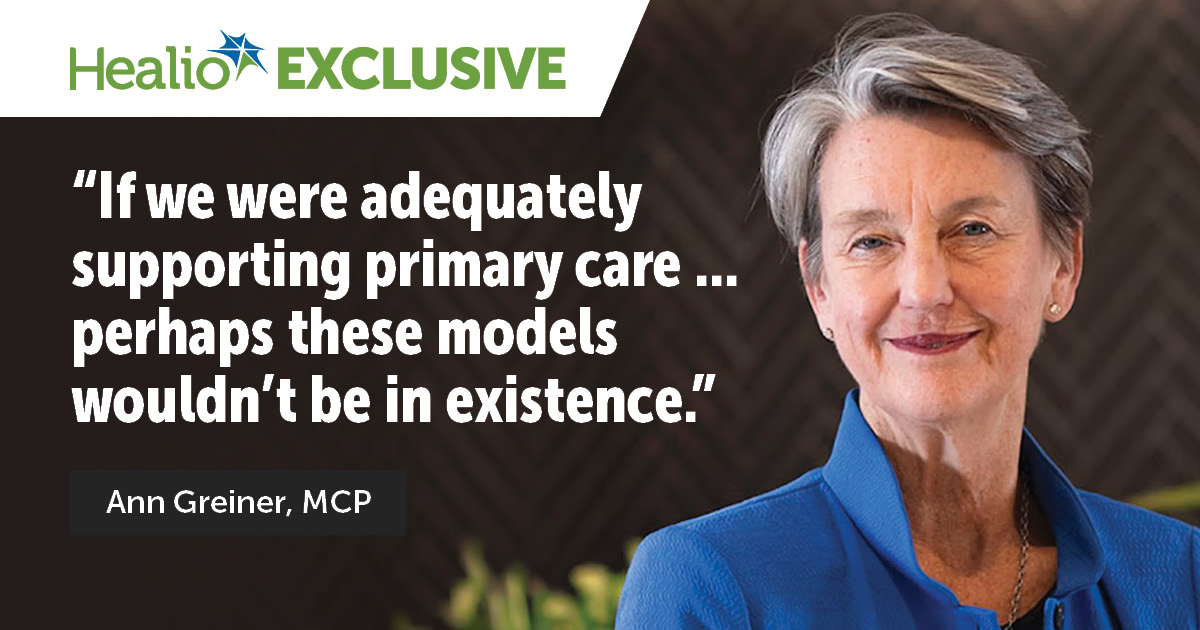
“If we were adequately supporting primary care, and we didn’t have all the administrative burden that is on primary care, perhaps these models wouldn’t be in existence,” she said.
As DPC continues to develop, Zhu said that “a key question is whether they ultimately increase overall primary care capacity or simply reallocate care toward patients who are able to access these models. Evaluation of these models will be important to promote or scale what is working well, but also to identify unintended consequences, and to ensure that we are investing in ways that improve access to primary care more broadly.”
For more information:
Ann Greiner, MCP, can be reached through Tod Didier, communications director at Primary Care Collaborative, at tdidier@thepcc.org.
Brian R. Forrest, MD, and Carolyn L. Engelhard, MPA, can be reached at primarycare@healio.com.
Jane M. Zhu, MD, MPP, MSHP, can be reached at zhujan@ohsu.edu.
Josh Umbehr, MD, a member of the Healio Primary Care Peer Perspective Board, can be reached through Carolina Cezari at carolina@entermotion.com.
Norman M. Dy, MD, MBA, FACP, can be reached at DirectPC@jhmi.edu
Philip Eskew, DO, JD, MBA, can be reached at philsq@gmail.com.
Sources/Disclosures
Source:
Healio Interviews
References:
- Answers to six common questions about direct primary care. https://www.aafp.org/pubs/fpm/blogs/inpractice/entry/dpc-faqs.html. Published Oct. 28, 2025. Accessed Feb. 18, 2026.
- Direct primary care. https://www.aafp.org/family-physician/practice-and-career/delivery-payment-models/direct-primary-care.html. Accessed Feb. 18, 2026.
- DPC frontier mapper. https://mapper.dpcfrontier.com. Accessed Aug. 31, 2026.
- Fee-based primary care is rapidly rising in U.S., hastening doctor shortages for public. https://carey.jhu.edu/news/fee-based-primary-care-rapidly-rising-us-hastening-doctor-shortages-public. Published March 16, 2026. Accessed July 1, 2026.
- Liao J, et al. Direct contracting and concierge medicine. Presented at: ACP Internal Medicine Meeting; April 16-18, 2026; San Francisco.
- Pondering direct primary care? 10 potential benefits and drawbacks. https://www.ama-assn.org/medical-residents/transition-resident-attending/pondering-direct-primary-care-10-potential-benefits. Published June 2, 2026. Accessed July 1, 2027.
- Slideshow: A week in the life of a family physician. Accessed March 12, 2026. https://www.aafp.org/pubs/fpm/multimedia/slideshows/fp-hours-compensation.html#:~:text=Average%20patient%20panel%20size:%201%2C727,AAFP%202023%20Practice%20Profile%20Survey.
- Treasury, IRS provide guidance on new tax benefits for health savings account participants under the One, Big, Beautiful Bill. https://www.irs.gov/newsroom/treasury-irs-provide-guidance-on-new-tax-benefits-for-health-savings-account-participants-under-the-one-big-beautiful-bill. Published Dec. 9, 2025. Accessed Feb. 18, 2026.
- What our study says about Direct Primary Care. https://www.milliman.com/en/insight/what-our-study-says-about-direct-primary-care. Published June 29, 2020. Accessed July 1, 2026.
- Why 2025 Is the Tipping Point for Employer-Sponsored Direct Primary Care. https://www.healthcompiler.com/resources/blogs/why-2025-is-the-tipping-point-for-employer-sponsored-direct-primary-care. Published Aug. 28, 2025. Accessed Aug. 26, 2026.
- Zhu JM, et al. Health Aff (Millwood). 2025;doi:10.1377/hlthaff.2025.00656.
Disclosures:
Dy, Engelhard, Eskew, Forrest, Greiner and Zhu report no relevant financial disclosures. Umbehr reports being the founder of Atlas.md.

Ask a clinical question and tap into Healio AI’s knowledge base.
- PubMed, enrolling/recruiting trials, guidelines
- Clinical Guidance, Healio CME, FDA news
- Healio’s exclusive daily news coverage of clinical data