
September 10, 2026
6 min read

Key takeaways:
- The 2025-2030 Dietary Guidelines for Americans emphasize total protein intake and red meat, both of which have been linked to fibrosis risk.
- Clear, evidence-based guidance on alcohol consumption was omitted.
Several dietary elements recommended in the 2025-2030 Dietary Guidelines for Americans, including total protein intake and red meat, have been linked to steatotic liver disease and fibrosis, analyses showed.
Conversely, other components that were removed from previous guidelines — including increased intake of greens, beans and seafood or plant proteins, as well as clear limitations on alcohol consumption — were deemed protective for liver health.

“This message of eating more protein is making a big impact on people’s diet,” Nicholas Dunn, a medical student at University of Missouri-Kansas City, told Healio. “You can even see that some varieties of Doritos have added protein.
“We should do our best to spread the message of what kind of protein people should be eating, and how much alcohol they should be consuming, because we want to minimize the risk for liver disease.”
As Healio previously reported, the new guidelines continue to recommend that Americans include high-quality protein, healthy fats, whole foods, and fruits and vegetables in their diet, and limit highly processed foods. However, the guidance removed clear, evidence-based alcohol consumption limits — no more than two drinks per day for men and one drink per day for women — and failed to address evidence linking alcohol and cancer.

Ashwani K. Singal
Dunn worked with Ashwani K. Singal, MD, MS, FACG, FAASLD, a transplant hepatologist at Trager Transplant Center, professor of medicine and director of clinical trials in hepatology at University of Louisville School of Medicine, and other researchers to evaluate the relationship between several of these dietary components and steatotic liver disease, fibrosis and cirrhosis.
They analyzed data from 10,944 adults in the 2017-2023 National Health and Nutrition Examination Survey, for whom vibration-controlled transient elastography and 24-hour dietary recall were available.
The researchers calculated Healthy Eating Index (HEI)-2020 component scores and energy-adjusted z-scores for food groups featured in the new guidelines.
In addition to greens, beans and seafood or plant-based protein, increased consumption of total fruit, whole fruit, vegetables and whole grains was associated with lower odds of steatotic liver disease and fibrosis. Red or processed meats, sodium, total protein, saturated fat and added sugars were linked to greater prevalence of these outcomes.
Limited alcohol use was “strongly protective” for all liver outcomes, the researchers wrote.
Healio spoke with Dunn and Singal about the guidelines’ messaging on protein and alcohol consumption, and how clinicians can offer dietary counseling for patients with existing liver disease.
Healio: What were your expectations going into this analysis? Did anything surprise you, and if so, what?
Dunn: We had an open mind going into this, but we thought more protein could potentially mean less fat and carbs, which is a good thing. What surprised us the most was an analysis suggested by a reviewer, who explicitly asked us to break down protein into subsets by source.
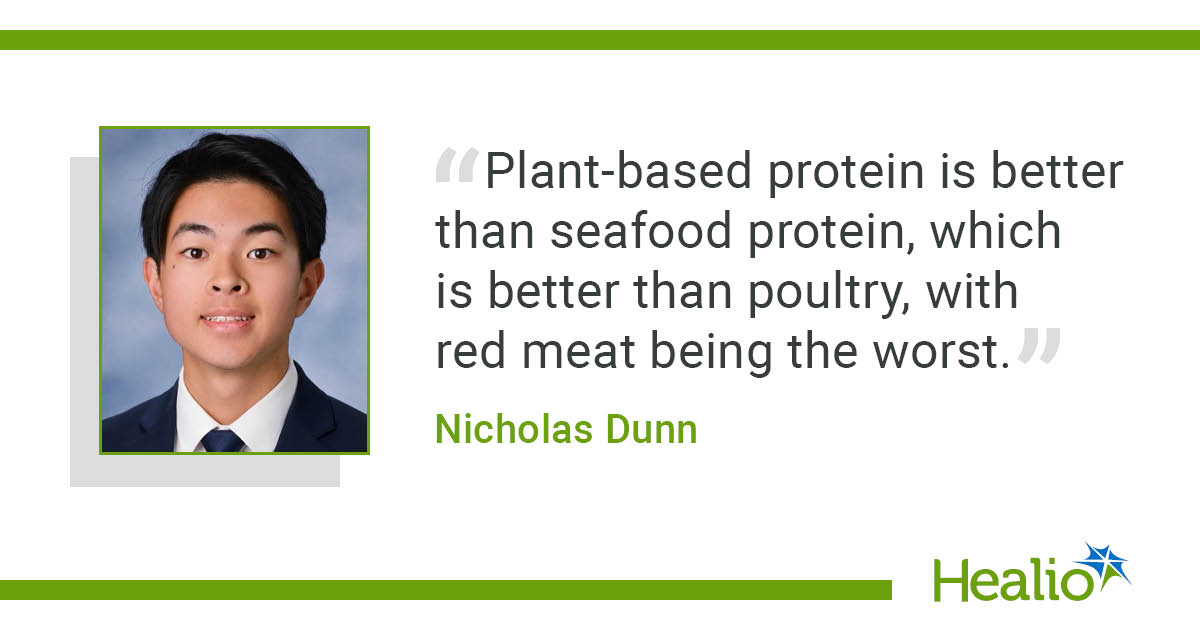
For the results, we saw a clear hierarchy: Plant-based protein is better than seafood protein, which is better than poultry, with red meat being the worst.
Healio: The guidelines put greater emphasis on total protein intake, but your analysis found the type of protein consumed matters. Are we giving patients protein advice that’s too general?
Dunn: What we found in our data was that high protein intake was associated with a higher risk for liver disease. It’s not that protein itself was inherently bad; it’s that when people are consuming so much protein, they usually aren’t eating lots of lentils or salmon. They’re eating a lot of red meat, and we found that red meat was associated with liver diseases. Such advice can be overly simplistic.
The previous HEI, based on the DGA-2020, is more balanced. It assigned five points toward protein intake and another five points toward plant- and seafood-based protein intake.
The current DGA-2025 no longer mentions protein sources. In fact, it implicitly promotes red meat by placing a picture of a very large ribeye steak in the center of the page.
Singal: In the context of liver disease, we were pleasantly surprised to see this observation that red meat is more harmful. When we see patients in the clinic with liver disease and cirrhosis, we generally recommend eating more protein. But we advise eating vegetable- or white meat-based protein and avoiding red meat-based protein. That’s because red meat-based protein worsens liver disease, as documented in this study, and for patients with advanced fibrosis and cirrhosis, the amino acids in red meat are more ammoniogenic.
Healio: For clinicians treating patients with metabolic dysfunction-associated liver disease, should the focus shift from how much protein to eat to where that protein comes from?
Dunn: That seems to be a very reasonable recommendation. The level of evidence is not as strong, since it’s all cross-sectional, but most Americans are not at risk of having too little protein. It may seem reasonable to be more selective toward protein sources and to favor pro-plant and seafood options.
While I think we should still pay attention to how much protein patients are eating, we certainly should also put the spotlight on what kinds of foods they are eating to get that protein.
Singal: This is an area where we could compare vegetable vs. animal sources of protein in a randomized controlled trial of patients with MASLD. This was observational and cross-sectional data — would randomized data show the same findings?
In more fibrotic or cirrhotic patients, we know there are several randomized controlled trials that have shown a vegetable source of protein is better than animal-sourced.
Healio: How should that message change for patients with advanced fibrosis or cirrhosis, who may need to consume higher protein levels to preserve muscle?
Dunn: Patients with cirrhosis will definitely need to eat at least 1.2 to 1.5 grams per kilogram of body mass per day. We’re not necessarily saying to never eat red meat, but I think there should be moderation; maybe consider a filet as opposed to a tomahawk steak.
We should be encouraging patients to get their protein from plants and seafood. Even poultry would be fine, but too much red or processed meat may be harmful.
Healio: Alcohol guidance was omitted from the latest recommendations. Given your findings linking prior alcohol guidance with lower prevalence of steatotic liver disease, fibrosis and cirrhosis, was this an important omission?
Dunn: This was by far the biggest disappointment to the entire liver community. When it comes to dietary guidance, especially alcohol, we should always aim to be as specific as possible. We want to avoid the idea that just because the specific alcohol guidelines were omitted they aren’t true. Americans deserve to have the most accurate and specific guidelines possible. Unless there is a good reason to remove the numerical limit, I think it’s better to include them for people to see.
Singal: It needs to be emphasized that more than two drinks per day, or 14 per week, in a male individual, and more than one drink per day, or 7 per week, in a female, can be hazardous to liver health and can be a risk for advanced liver disease, like cirrhosis.
That is something that needs to be not only told to the patients — and many of them will not know — but also needs to be emphasized in the guidelines.
Healio: Patients often ask their doctor simple questions, such as “Should I eat more protein?” “Should I cut fat?” “Is alcohol OK?” Are current guidelines giving clinicians enough clarity to provide liver-specific answers?
Dunn: I think that while the current guidelines have their strengths, Americans would benefit from greater specificity. The guidelines are absolutely correct that it’s better to drink less alcohol, but all they’re really saying is that nine drinks are better than 10.
When it comes to fat, the guidelines do a good job of maintaining the 10% daily limit of saturated fat. But I do find it quite interesting that they highlighted beef tallow as an alternative for olive oil.
When it comes to protein, I don’t want these guidelines to be an excuse to eat more red meat. Eating more protein has its benefits, but it is important that Americans know what kinds of foods they should get protein from.
Singal: The good parts of these guidelines are that they do emphasize avoiding refined and added sugar and sodium. They also mention saturated fat. Those are good things that were retained from the previous guidelines, and some of these components were even better emphasized in the current version. But people can very easily misinterpret the guidance on protein and alcohol.
For more information:
Nicholas Dunn can be reached at nicholasjcdunn@gmail.com.
Ashwani K. Singal, MD, MS, FACG, FAASLD, can be reached at ashwanisingal@gmail.com.

Ask a clinical question and tap into Healio AI’s knowledge base.
- PubMed, enrolling/recruiting trials, guidelines
- Clinical Guidance, Healio CME, FDA news
- Healio’s exclusive daily news coverage of clinical data