
September 10, 2026
6 min read

Key takeaways:
- Adults with disabilities are significantly less likely to undergo routine cancer screenings.
- The largest gaps exist for those with self-care disabilities and those with greater disability-related difficulty.
U.S. adults with disabilities are considerably less likely than those without them to undergo routine cancer screening, according to an analysis of national survey data.
Researchers observed the largest screening gaps among individuals with self-care disabilities, such as difficulty dressing or bathing.

Data derived from Mazzitelli N, et al. Cancer. 2026;doi:10.1002/cncr.70557.
Screening prevalence also declined as disability-related difficulty levels increased.
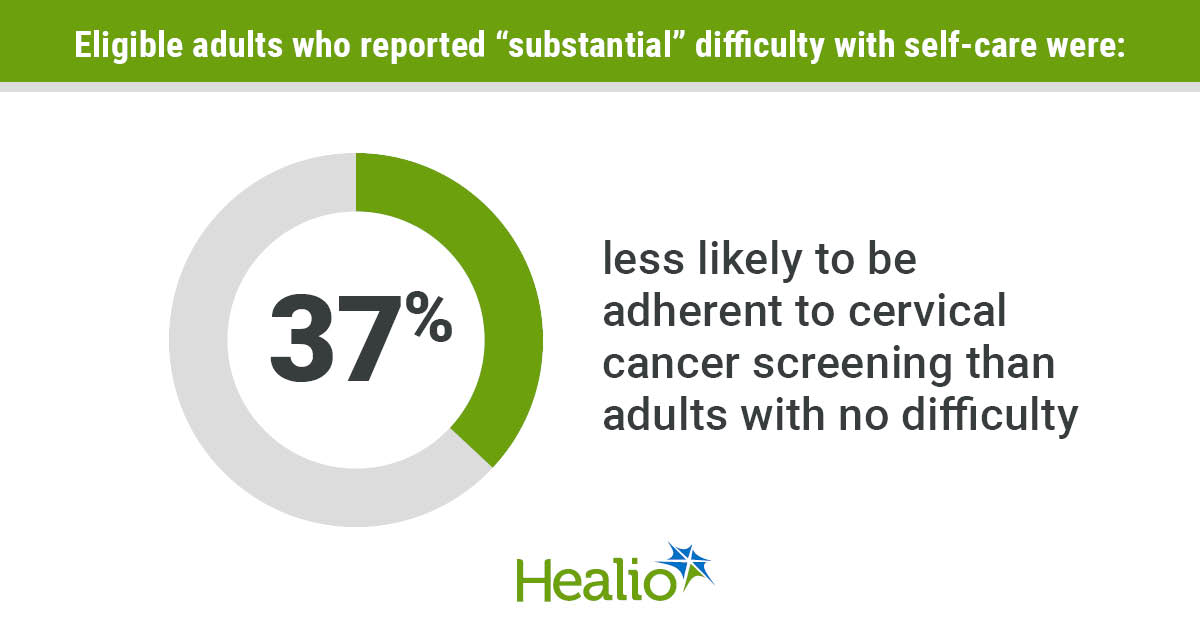
For example, adults who reported “substantial” difficulties with self-care appeared 37% less likely to undergo cervical cancer screening and 31% less likely to undergo breast cancer screening than adults with no difficulty. Screening also declined with greater difficulty in other disability domains, such as cognition, mobility and vision.

Priti Bandi, PhD
The findings are “cause for alarm,” according to senior author Priti Bandi, PhD, scientific director for cancer risk factors and screening surveillance research at American Cancer Society.
“We know individuals with disabilities tend to have lower access to healthcare, but the magnitude of the disparities we observed — and the consistency with which they showed up across different domains — really surprised me,” Bandi told Healio. “Being able to document this represents a call to action. This needs to be addressed.”
‘A clearer picture’
More than one in four adults in the United States have some type of disability, according to CDC statistics.
The most prevalent disabilities are those that affect cognition (13.9%), mobility (12.2%), independent living (7.7%), hearing (6.2%), vision (5.5%) and self-care (3.6%).
All-cause mortality risk is more than double among individuals with disabilities than without, and risk for death due to chronic conditions — including cancer — also is higher, according to study background.
Prior research showed people with cognitive, mobility or intellectual disabilities are less adherent to cancer screening. This may be due to barriers related to clinic access (eg, lack of transportation or insurance), personal factors (eg, fear of embarrassment or distrust of the medical system) or difficulties completing the physical aspects of screening, Bandi said.
However, evidence about how adherence varies based on disability domains and related difficulty is limited.
“Having a clearer picture about how disabilities impact receipt of cancer preventive services across disability domains — not just physical, but also the more ‘invisible’ disabilities related to cognition and communication — is critical to help develop interventions that are relevant and effective for these populations,” Bandi said.
Bandi and colleagues — including lead author Natalia Mazzitelli, MPH — evaluated self-reported adherence to U.S. Preventive Services Task Force recommendations for breast, cervical and colorectal cancer screening among adults with disabilities vs. those without, calculating adjusted prevalence ratios (aPR) to make the comparisons.
The researchers pooled data from the National Health Interview Survey in 2021 and 2023. Each survey collected a broad range of data about health topics from more than 29,000 noninstitutionalized adults.
Investigators assessed self-reported screening rates based on six functioning domains — vision, hearing, mobility, communication, cognition and self-care.
Because there often is overlap between domains, researchers analyzed the degree of difficulty for each one — using the Washington Group Composite Disability Indicator, a validated tool that classifies severity of functional limitations — to further clarify individuals at greatest risk for screening nonadherence.
Key findings
The researchers identified survey respondents with disabilities eligible for breast screening (n = 1,712; population weighted, n = 6.02 million), cervical screening (n = 1,147, population weighted, n = 5.1 million) and colorectal screening (n = 3,106; population weighted, n = 11.17 million).
Results revealed the following trends by screening type:
- Breast cancer: Eligible adults with “substantial” difficulties across multiple disability domains had lower screening prevalence than those who reported no difficulties, with the lowest prevalence in the self-care (52% vs. 79%; aPR = 0.69; 95% CI, 0.58-0.82), vision (62% vs. 79%; aPR = 0.83; 95% CI, 0.75-0.91) and mobility (68% vs. 79%; aPR = 0.89; 95% CI, 0.85-0.93) domains. Results showed significantly lower screening prevalence among those with “some” difficulties vs. no difficulty in self-care (71% vs. 79%; aPR = 0.93; 95% CI, 0.88-0.99), cognition (75% vs. 79%; aPR = 0.96; 95% CI, 0.94-0.99) and vision (75% vs. 79%; aPR = 0.96; 95% CI, 0.94-0.99).
- Cervical cancer: Eligible adults who reported “substantial” difficulties across multiple disability domains had lower screening prevalence than those who reported no difficulties, with the lowest prevalence in the self-care (37% vs. 78%; aPR = 0.63; 95% CI, 0.51-0.78), vision (64% vs. 78%; aPR = 0.89; 95% CI, 0.8-0.98), mobility (65% vs. 78%; aPR = 0.88; 95% CI, 0.82-0.94) and cognitive (64% vs. 78%; aPR = 0.91; 95% CI, 0.85-0.98) domains. Results showed significantly lower screening prevalence among those with “substantial” communication difficulties (35% vs. 78%; aPR = 0.65; 95% CI, 0.52-0.82) and “some” communication difficulties (62% vs. 78%; aPR = 0.89; 95% CI, 0.83-0.95) than those with no difficulty.
- Colorectal cancer: Eligible adults who reported “substantial” difficulty with self-care had significantly lower prevalence of any screening — colonoscopy or stool testing — than those who reported no difficulty (60% vs. 72%; aPR = 0.85; 95% CI, 0.76-0.95).
“Breast cancer screening is crucial for early detection, but cervical cancer screening and colorectal cancer screening with colonoscopy are preventive,” Bandi said. “Seeing such a significant proportion of eligible individuals with disabilities not being screened according to recommendations translates to a tremendous population burden — in the millions — of cancers that will not be prevented or detected early.”
There may be an opportunity for targeted intervention among adults who reported self-care disabilities, for whom “shocking” differences in screening adherence consistently emerged across all screenings studied, Bandi said.
‘A bright spot’
The analysis yielded a potentially actionable silver lining.
Results showed significantly greater utilization of colorectal cancer screening with stool testing among adults who reported higher levels of difficulty across several disability domains.
Compared with adults who reported no difficulty, results showed higher stool testing prevalence among those who reported “substantial” difficulty with mobility (22% vs. 16%; aPR = 1.24; 95% CI, 1.12-1.38), “some” difficulty with mobility (19% vs. 16%; aPR = 1.12; 95% CI, 1.03-1.21), “some” difficulty with self-care (24% vs. 16%; aPR = 1.28; 95% CI, 1.11-1.47) and “some” difficulty with vision (18% vs. 16%; aPR = 1.08; 95% CI, 1-1.17).
This observation “completely flipped the script” with regard to screening disparities and shows the “enormous potential” of more accessible testing options — including stool testing and the first FDA-approved at-home cervical cancer screening device — to mitigate screening disparities, Bandi said.
“I do think that is a bright spot, especially as more technologies are being made available for self-collection and at-home screening,” she said. “These modalities may be more acceptable to individuals with disabilities, who may face barriers on several levels. If we offer individuals with disabilities more opportunities to screen at home, though, the clinical touchpoints must be in place to make sure they are not left hanging. The key will be closing the loop in terms of the continuum from detection to treatment.”
The investigators acknowledged study limitations. For example, self-reported information about screening prevalence is subject to recall and social desirability bias. Also, because the National Health Interview Survey only encompasses noninstitutionalized adults, findings may not be generalizable to adults in assisted living or other settings.
Overall, however, the study provides valuable evidence across disability domains and difficulty levels that could inform strategies to reduce screening disparities, investigators concluded.
“Individuals with disabilities face barriers at multiple levels,” Bandi said. “Opportunities to intervene at the policy level include making it easier for them to get to a clinic for screening, helping individuals who are uninsured or underinsured, or addressing social barriers such as financial or housing insecurity.”
Individual clinicians also play a vital role, Bandi said, pointing to communication about self-sampling or at-home testing as one entry point.
“Healthcare personnel are the gateway to preventive services,” she said. “In the back of their minds, clinicians know this is an issue, but it has to become front of mind. This effort will require active outreach in a manner that is cognizant of the physical, psychological or social barriers that these individuals face.”
For more information:
Priti Bandi, PhD, can be reached at priti.bandi@cancer.org.
Sources/Disclosures
Source:
Mazzitelli N, et al. Cancer. 2026;doi:10.1002/cncr.70557.
References:
Disclosures:
Four study authors report employment with American Cancer Society, which receives grants from private and corporate foundations for research outside the submitted work. The other authors report no relevant financial disclosures. American Cancer Society supported this study.

Ask a clinical question and tap into Healio AI’s knowledge base.
- PubMed, enrolling/recruiting trials, guidelines
- Clinical Guidance, Healio CME, FDA news
- Healio’s exclusive daily news coverage of clinical data