
September 10, 2026
5 min read

Key takeaways:
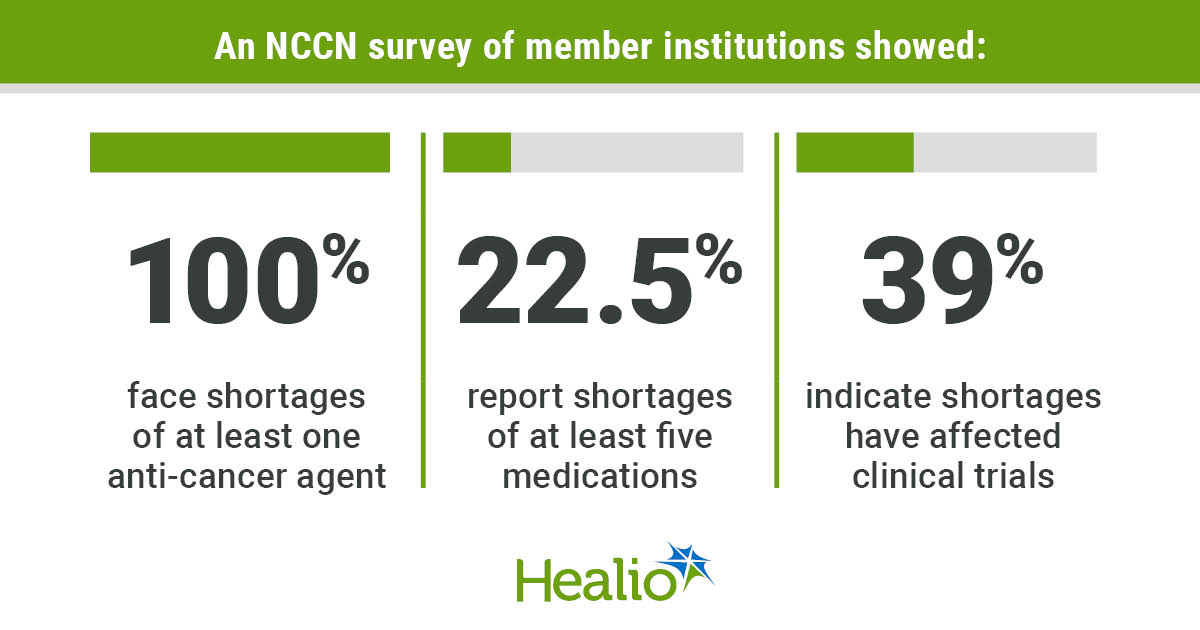
- All centers surveyed report shortages of at least one medication, and 22.5% report shortages of at least five agents.
- Most centers say the impact of drug shortages today is “about the same” as 3 years ago.
U.S. cancer centers continue to experience persistent shortages of medications that are foundational components of oncology care, according to survey results.
All cancer centers that participated in a late-summer survey administered by National Comprehensive Cancer Network reported current shortages of at least one cancer medication. One in five centers reported shortages of at least five different medications.

Although medical societies, policymakers and the press have paid closer attention to the issue in recent years, nearly all centers surveyed indicated the impact of drug shortages is “about the same” today as in 2023.

Crystal S. Denlinger, MD
“This has really become more of a chronic condition than an acute problem,” Crystal S. Denlinger, MD, CEO of NCCN and a medical oncologist at Fox Chase Cancer Center, told Healio. “It is disappointing that we have not moved the needle as much as we would have liked over the last few years, despite the fact that we have been raising the alarm and there has been increased conversation about this topic.”
Preserving the foundation
As Healio previously reported, persistent and prolonged drug shortages across the country are affecting delivery of care across more than 100 therapeutic areas.
They are lasting longer than ever, with the average duration exceeding 5 years, according to an analysis from United States Pharmacopeia (USP), a scientific nonprofit.
Although drug shortages in oncology are not new, NCCN began surveying member institutions about their impact a few years ago amid concerns about a shortage of the generic chemotherapy drugs cisplatin and carboplatin.
The organization conducted two surveys in 2023 and another in 2024.
NCCN’s most recent survey, administered in August to its member institutions, suggests generic cancer medication shortages continue to have widespread impacts across the country.
The survey — to which pharmacy directors and other clinical or administrative leaders from 31 institutions responded — showed:
- All centers continue to experience a shortage of at least one anti-cancer agent;
- 87.1% are experiencing shortages of at least two agents, and 22.5% reported shortages of at least five agents;
- 94% reported a shortage of ifosfamide, an IV chemotherapy medication used to treat bladder and ovarian cancer, sarcomas, leukemia, lymphoma and other malignancies;
- 71% reported a shortage of carboplatin, comparable to findings of a fall 2023 survey;
- 51.6% reported shortages of Bacillus Calmette Guérin, used to treat bladder cancer;
- 16% reported cisplatin shortages, down from 59% in fall 2023; and
- 39% reported drug shortages have affected clinical trials at their centers.
The challenges extend beyond academic medical centers. Three-quarters (77%) of centers surveyed indicate that drug shortages are affecting community practices in their areas.
“We have seen tremendous progress in cancer care and that has led to the development of many effective therapies,” Denlinger said. “But that doesn’t mean the contribution of older cytotoxic drugs — the ones that are more often now generic — should be discounted. In fact, a lot of the progress we have made is built on the foundation of those older regimens. Cancer care is built incrementally, and we have to make sure that those foundations remain available.”
‘Agility and resilience’
The survey revealed some silver linings.
Nearly all centers (93%) indicated they have been able to continue treating all patients according to intended dose and schedule, although a higher percentage did so with mitigation strategies than without (61% vs. 32%).
The most common mitigation strategies include waste management (79%), limiting use of current stock (43%), using the minimum value of a recommended dose range (32%) and using the maximum value of a recommended treatment interval range (21%).
A majority of centers (71%) reported having a multidisciplinary committee in place to address issues related to drug shortages.
Centers report relying on these committees to notify clinical staff of interim protocols (95%), develop therapeutic substitution protocols or other conservation strategies (91%), track inventory or forecast health system shortages (86%), or create prioritization or allocation criteria when supply must be rationed (82%).
This best practice reduces the need for centers to “reinvent the wheel” when new shortages arise, Denlinger said.
“It is heartening to see that organizations have been able to respond with agility and resilience,” Denlinger said. “They have created infrastructure that they can rely on when there is a shortage, and they have mitigation strategies that work so they do not have to delay or discontinue treatment.”
However, 90% of centers indicated they have been required to re-obtain prior authorization at some point when treatment plans are modified or altered because of drug shortages, and 17% indicated that re-obtaining prior authorization due to shortage-prompted treatment modifications resulted in treatment delays.
‘This isn’t an easy fix’
Despite greater attention placed on drug shortages the past few years, the overall landscape has not improved much, survey results suggest.
When asked if national or state policies enacted since 2023 have had an impact on drug shortages, 4% of centers reported seeing improvement, whereas 96% indicated the situation is “about the same.”
The USP report released earlier this year pointed to several key drivers of shortages across specialties.
Low prices for generic medicines often result in slim margins for manufacturers, reducing their willingness to enter or stay in a market.
“Economics are at play here,” Denlinger said. “Generic drugs are not necessarily celebrated as an important component of oncology care, so we have to make sure there are incentives for manufacturers to continue to value generic drug manufacturing.”
Supply chain challenges are another important consideration, as a natural disaster, one regulatory action or geopolitical turmoil in a specific region can cause disruptions that have considerable downstream implications.
“There is not a lot of resiliency in the supply chain,” Denlinger said. “We need to build that so if one component is disrupted, there is enough buoyancy in the chain that it can continue to work.”
Because the causes of shortages are multifactorial, there is “no one-size-fits-all solution,” Denlinger said.
Collaboration between leaders in the healthcare field, policymakers, manufacturers and payers will be required to address the root causes, she said, but that may take considerable time and effort.
“This isn’t an easy fix. It’s a long-term fix,” she said.
In the meantime, improved communication could alleviate at least some of the burden that shortages create, Denlinger said.
“We need better ways to forecast and communicate when a shortage is coming so it can be anticipated as opposed to simply reacted to,” she said. “We need to be more proactive in how we manage this, whether that be supporting FDA in its ability to report or making sure that manufacturers communicate well with the people they supply.”
Clinical practice guidelines also can help cancer centers ensure they deliver appropriate care amid ongoing shortages.
“This is an area where clinical practice guidelines continue to shine,” Denlinger said. “Most disease settings have more than one treatment regimen. If one drug is on shortage, the guidelines can specify what else is appropriate for that setting and allow for a pivot, if needed.
“It also is important that we advocate for continued coverage for NCCN guidelines and other nationally recognized clinical practice guidelines so we can minimize the burdens of reauthorization or utilization management when there is a shortage,” she added. “Our role in the oncology community is not just to define what good cancer care looks like but to advocate to ensure everyone has access to it.”
For more information:
Crystal S. Denlinger, MD, can be reached at denlinger@nccn.org.
Sources/Disclosures
Source:
References:
Disclosures:
Denlinger reports no relevant financial disclosures.

Ask a clinical question and tap into Healio AI’s knowledge base.
- PubMed, enrolling/recruiting trials, guidelines
- Clinical Guidance, Healio CME, FDA news
- Healio’s exclusive daily news coverage of clinical data