
September 15, 2026
3 min read

Key takeaways:
- Despite a plethora of colorectal cancer screening options, 1 in 4 eligible U.S. adults remain unscreened.
- Matching screening options to patient preferences may help turn recommendations into action.
Clinicians have more colorectal cancer screening options than ever before. The challenge is helping more eligible patients complete them.
Colorectal cancer screening has the power to change patient outcomes by detecting disease earlier and, in some cases, preventing cancer altogether. Yet despite well-established screening recommendations and continued advances in testing, one in four eligible U.S. adults remains unscreened for colorectal cancer.

With cases continuing to rise in the U.S., closing the screening gap is becoming even more urgent. Nearly 159,000 Americans are expected to be diagnosed with colorectal cancer in 2026, and approximately one in five new cases now occur among adults younger than 55 years.
The challenge is not a lack of screening guidance or options. Clinical recommendations are clear, and average-risk adults are now advised to begin routine screening at age 45. There are many screening options available, including convenient, noninvasive tests that can be completed at home. Instead, the more pressing challenge is closing the gap between screening recommendations and patient action.
Why do so many eligible patients remain unscreened? And what can health care professionals do to help more patients take that first step? One answer may be expanding access to screening options that better align with patients’ preferences.
Patient preference matters more than ever
One reason participation continues to lag is that patients do not all want the same screening experience.
Recent Labcorp research found that 53% of adults would prefer to begin colorectal cancer screening with an at-home test; among adults who have never been screened, that number jumps to 70%.
The research also provides insight into why some patients hesitate to complete stool-based testing: 41% reported they disliked the process of preparing or mixing stool samples, while 34% described their experience as messy or uncomfortable.
These findings suggest that patient preference may be one of the most important factors influencing whether screening happens at all. By understanding what matters most to each patient and discussing the range of evidence-based screening options, clinicians can engage patients in shared decision-making and recommend an approach they are willing to complete.
Growing screening toolbox
In recent years, the colorectal cancer screening landscape has expanded considerably.
While colonoscopies remain the gold standard for screening, some patients face inherent barriers. Concerns about the bowel preparation process, insurance coverage and logistical complexities — such as scheduling and the downtime required for the procedure — can all contribute to delayed screening.
Various noninvasive stool-based colorectal cancer screening tests are available for patients who may prefer this screening modality. Fecal immunochemical tests detect occult blood in stool samples. Multitarget stool DNA tests combine blood detection with DNA biomarkers associated with colorectal cancer. More recently, RNA-based stool tests have entered clinical practice and are now recognized by both the American Cancer Society and the National Comprehensive Cancer Network.
One example is ColoSense (Geneoscopy), an RNA-based stool test that detects changes in biomarkers associated with colorectal cancer and advanced adenomas that may be an early indication of disease. Blood-based screening tests are also available, although current professional guidelines do not recommend them as a preferred screening option.
While a positive result from any noninvasive screening test still requires follow-up colonoscopy, these evidence-based options can help clinicians engage patients in screening discussions and encourage more eligible individuals to begin the screening process.
Making screening work for more patients
Innovation has given clinicians more tools than ever to screen for colorectal cancer. But the success of any screening strategy ultimately depends on whether patients complete it.
Improving participation should remain a key priority as screening technologies continue to evolve. Better biomarkers and stronger clinical performance will always matter, but so will convenience, accessibility and patient acceptance.
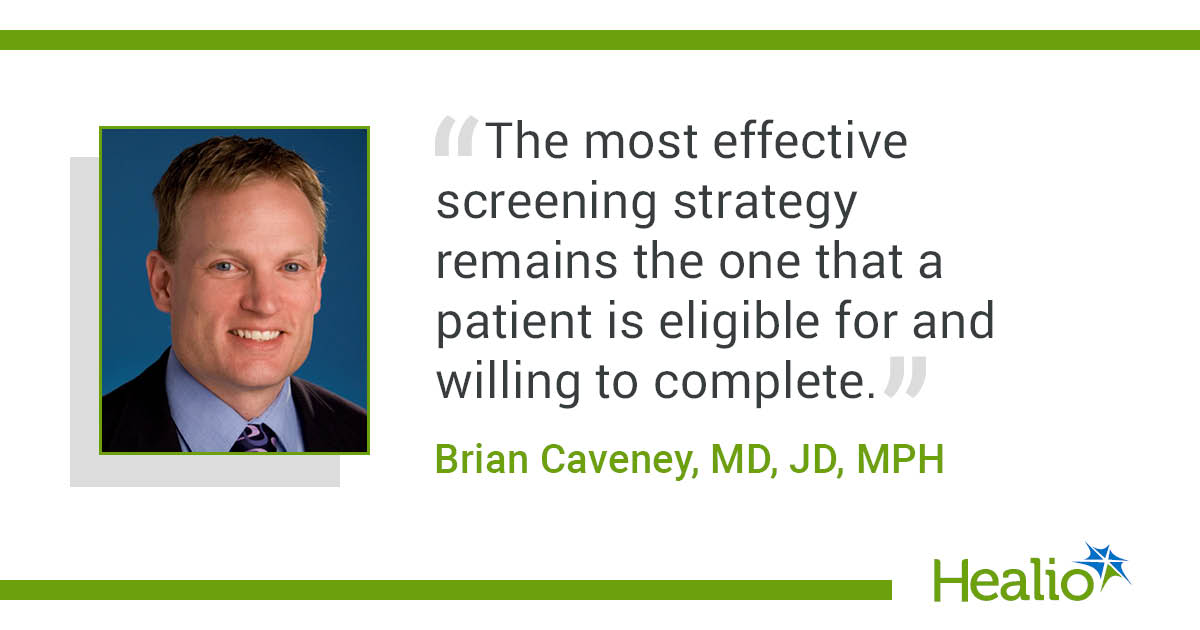
No single screening test will be right for every patient. The most effective screening strategy remains the one that a patient is both eligible for and willing to complete. By engaging patients in shared decision-making and offering a range of evidence-based screening options, clinicians can help close the gap between recommendations and action, ultimately improving earlier detection and colorectal cancer outcomes.
For more information:
Brian Caveney, MD, JD, MPH, is executive vice president and president of biopharma laboratory services and chief medical and scientific officer at Labcorp. He can be reached at gastroenterology@healio.com.
Sources/Disclosures
Source:
Expert Submission
References:
- Baseline estimates of colorectal cancer screening among adults aged 45 to 75 years, behavioral risk factor surveillance system, 2022. https://www.cdc.gov/pcd/issues/2025/25_0175.htm. Published Aug. 7, 2025. Accessed Sept. 10, 2026.
- Colorectal cancer drops in older adults and rises in younger ones. https://www.cancer.org/research/acs-research-news/colorectal-cancer-drops-in-older-adults-and-rises-in-young-ones.html. Published March 2, 2026. Accessed Sept. 10, 2026.
- Colorectal cancer facts & figures. https://www.cancer.org/research/cancer-facts-statistics/colorectal-cancer-facts-figures.html. Accessed Sept. 10, 2026.
- Colorectal cancer (CRC) screening. https://www.labcorp.com/treatment-areas/colorectal-cancer/crc-screening. Accessed Sept. 10, 2026.
- Ike B, et al. PEC Innov. 2026;doi:10.1016/j.pecinn.2026.100475.
- Jones RM, et al. Am J Prev Med. 2010;doi:10.1016/j.amepre.2010.01.021.
- Ozogbo S, et al. J Clin Oncol. 2024;doi:10.1200/JCO.2024.42.16_suppl.e23149.
Disclosures:
Caveney reports employment with Labcorp.

Ask a clinical question and tap into Healio AI’s knowledge base.
- PubMed, enrolling/recruiting trials, guidelines
- Clinical Guidance, Healio CME, FDA news
- Healio’s exclusive daily news coverage of clinical data