
September 24, 2026
7 min read
Key takeaways:
- Overton answered questions on vaccines, food safety, mifepristone and more.
- Senators on both sides of the aisle pressed the nominee for more direct answers.
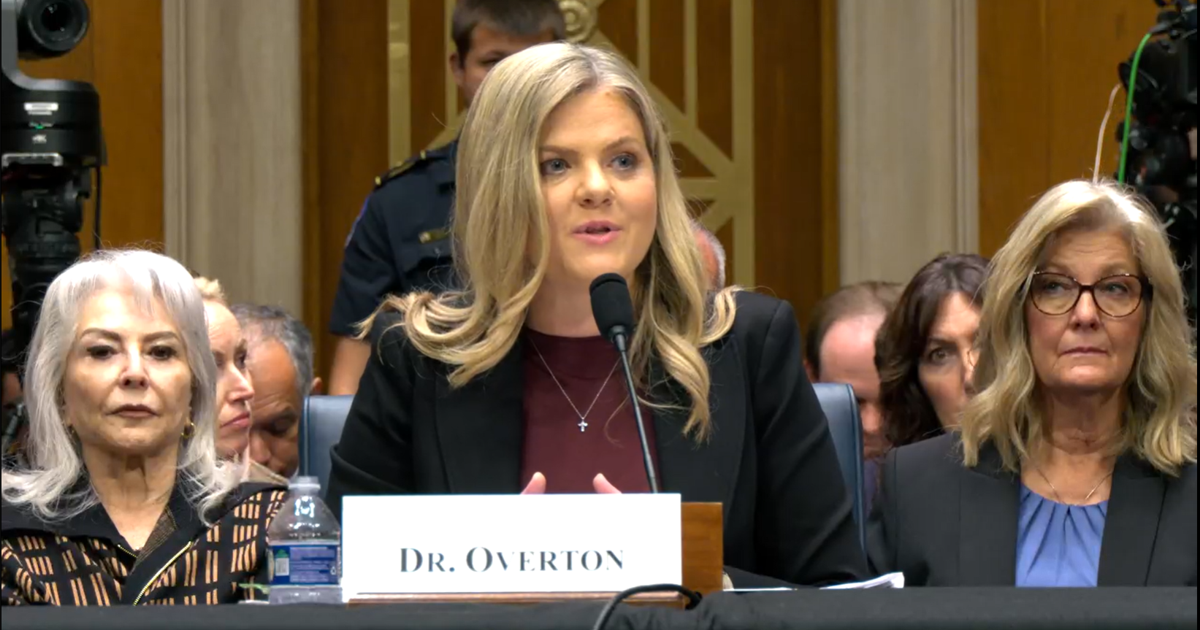
Senators asked Heidi Overton, MD, about some critical issues in medicine during her hearing to become FDA commissioner.
If confirmed, Overton would replace Martin Makary, MD, MPH, who resigned as FDA commissioner in May. Overton is currently deputy assistant to the president for domestic policy. She previously served as a White House fellow in Trump’s first term and chief policy officer and vice chair of the Center for a Healthy America at the America First Policy Institute, a conservative thinktank.

Key moments
At the beginning of the hearing, Committee Chairman Sen. Bill Cassidy, MD, R-La., — typically considered a swing vote in these proceedings — asked about her thoughts on the measles, mumps and rubella vaccine considering her presence behind President Donald J. Trump during the issuing of a recent executive order recommending that the U.S. reduce the number of vaccines recommended for all children.
“The MMR vaccine is safe and effective,” Overton replied. “If confirmed as FDA commissioner, my role would be individual product determinations and what the law requires for statutory standards of safety and efficacy. The MMR vaccine is currently licensed and approved by the FDA. It is safe and effective, and it is our best tool right now in the public health response to the measles outbreak.”
When asked if any vaccine on the market right now is unsafe, she said every one is “safe and effective, according to the FDA.”
But Cassidy dug in on the point. In his opening remarks, he said that HHS Secretary Robert F. Kennedy Jr. gave him guarantees that he later did not follow through on. When he asked why not, Cassidy said Kennedy told him “opposed to keeping his promise to me, to this committee, by extension the American people, he had to do what the president told him to do.” So, he pressed Overton, asking, “When someone is saying things, alleging that the FDA was wrong in approving a drug as safe — let’s assume that that someone is your boss — what is your role?”
“What I would do in this role is to communicate and use my scientific training and my clinical background to describe what is currently known. And what is currently known is that the vaccines that have been approved by the FDA have met the standards for safety and efficacy,” Overton said. “Right now, every vaccine that is on the market has been determined to be safe and effective, and there’s ongoing review.”
Later, senator Ed Markey, D-Ma., questioned her response here. He quoted the conservative thinktank she previously worked for in saying that Overton was “critical” in the executive order.
“We’ve heard you and other members of the administration repeatedly champion gold standard science. At that signing, you told the country, ‘Take a look at this scientific assessment.’ And for more than 50 years, the FDA, the agency you want to run, has found the combined MMR vaccine safe and effective. You have said today that it is safe and effective,” Markey said. “Minutes after, the president suggested it could be ‘quite lethal.’ You had the microphone. You didn’t correct him. Instead, you said parents should have ‘the option to separate them.’ So, why didn’t you correct the president at that moment so that the correct science was understood by American parents?”
“I do believe that what the president is responding to is providing additional options,” Overton said. “[That vaccine] is the best tool that we have. Anything new to the market would take time to develop. But … he wanted to provide an option to Americans that right now are getting zero vaccinations after COVID trust plummeted, and … he wants to provide an additional option while saying that it is safe and effective.”
Then, when Markey asked when FDA’s science “and the president’s erroneous scientific claims conflict — as they did that day — which one will you defend?” Overton said she would “use my clinical training, my research experience and the career expertise that is at the agency to get their input on and to take a review of all of the scientific determinations for individual products that have been determined to be safe and effective.”
Another important issue was food safety. In his opening remarks, Senator Bernie Sanders, I-Ve., said, “It seems like every day there’s a new food product being recalled due to contamination.”
“Under the Trump administration, our country has experienced an unprecedented number of outbreaks of foodborne illnesses linked to healthy foods like lettuce, eggs and blueberries,” Sanders said. “At the same time, the number of food facility inspections conducted overseas by FDA is down by more than 35% compared to 2019. How can we expect to make America healthy again when we have to worry about the safety of the food we eat?”
Senator Lisa Murkowski, R-Ak., asked about the issue later, and Overton said she is committed to “making sure that every food safety review is to the highest standard, and communication about it is accurate.”
Several senators asked Overton about mifepristone.
Senator Tammy Baldwin, D-Wi., laid out the safety data for mifepristone, and asked if Overton believes the drug is safe and effective.
“Mifepristone has been approved by the FDA with the appropriate risk evaluation mitigation strategies. So, it has met the safety and efficacy determinations of the FDA for those standards. The Risk Evaluation and Mitigation Strategy did change … and the current safety review that is happening at the FDA is taking an internal study and look at safety,” Overton said. “According to FDA standards, the drug is safe and effective as labeled today with the appropriate risk evaluation mitigation strategy.”
Josh Hawley, R-Mo., brought up this conversation later, arguing that mifepristone is “unsafe.”
“Right now, there is an ongoing safety review that is being done to assess if the risk evaluation mitigation strategy is appropriate,” Overton replied. “It is appropriate to be doing the safety review because the FDA has not done an internal updated recent safety analysis…. There has not been a change to the label. That safety study is ongoing and very important. Women’s health and women’s safety is a critical piece of this.”
In fact, Overton said that, if confirmed, “the most urgent thing that I would go and get briefed on and updated on” is “the status of that safety review to reach the best decision for Americans.”
Chris Murphy, D-Ct., also asked about politicization of the agency and the importance of advisory boards, some of which have been disbanded.
“My goal would be to not shut down any advisory committees, but to look at all of them to make sure they are fulfilling their highest purpose, getting the best experts on providing recommendations,” Overton said. “They are a key part of the administrative record of the FDA, and the FDA does rely on that. I hear that would be a huge part of my role, if confirmed.”
“I think it’s careful wording that your goal will be to not shut down advisory committees. That’s not a commitment,” Murphy replied.
What’s next?
Next, the Senate committee will vote on whether to send the nomination to the full Senate for a confirmation vote. Nominees need only a simple majority to be approved by the committee or confirmed by the Senate. Notably, Republicans have a one-seat majority on the committee and control the Senate.
Cassidy gave senators until 5 p.m. ET Friday, Sept. 25, to submit additional questions for the record.
What’s the diagnosis?
Arthur L. Caplan, PhD, professor emeritus and founding head of the division of medical ethics at NYU Grossman School of Medicine, told Healio that food safety “has been a disaster” recently and “it’s clear that surveillance and staffing” issues at FDA are to blame, so “she needed to be, I think, tougher in her response, given the situation.”
“She said she’d work with it, but it’s worse than that. It’s broken. So, I was disappointed that she just didn’t say, ‘We’ve got to step up staff, and we’ve got to step up budget. We have to restore surveillance. The system is crucial to Kennedy’s goal of keeping America healthy,’” Caplan said. “I don’t even think that’s all that politically controversial. I’m not sure who exactly is against food safety. There are other issues where there are divided opinions, but not there. So, I think that’s disappointing.”
Caplan also stressed that, as “one of the most reviewed drugs of all time,” mifepristone has been proven unequivocally safe.
“Every once in a while, there’s so much evidence that an issue is closed. Information about the safety of mifepristone, prior FDA reviews, and data that’s been coming out of Europe make it crystal clear that that’s a safe drug for women. The only reason that that’s being brought forward is the politics of abortion,” Caplan said. “I think she’s still trying to court favor with the pro-life movement about this pill…. It’s a very controversial drug, and people want to use safety concerns as a way to get rid of it, but they’re just not there. And she, I think, didn’t stand up for what I’ll call gold standard science.”
Amid ongoing measles outbreaks, Caplan also took issue with her responses about vaccines.
“She was not strong enough. She basically gave us what I would call a PR-shaped response,” he said. “We need a little more than that out of the candidate to run FDA, given the mess that vaccine policy is right now. So that was very disappointing…. We know Trump had that meeting where she was there and issued many statements about vaccines that were just dangerous and false.”
Promising to offer the president her best advice “isn’t saying the same thing as I will honor my commitments here to be a zealous, truthful advocate for science-based policy,” Caplan concluded.
For more information:
Arthur Caplan, PhD, can be reached at primarycare@healio.com.
Sources/Disclosures
Source:
References:
Disclosures:
Caplan reports no relevant financial disclosures.

Ask a clinical question and tap into Healio AI’s knowledge base.
- PubMed, enrolling/recruiting trials, guidelines
- Clinical Guidance, Healio CME, FDA news
- Healio’s exclusive daily news coverage of clinical data