October 01, 2026
4 min read

Key takeaways:
- The proposed rule would replace the word “animal” with “nonclinical” in references to studies and tests.
- The rule is one of several HHS initiatives shifting away from animal testing.
The FDA has issued a final rule that would remove references to animal studies in its drug safety regulations, as part of a larger effort across HHS to reduce what it calls “unnecessary animal testing” in biomedical research.
In addition to the new FDA rule, which would take effect Feb. 4, 2027, the NIH simultaneously announced a series of new initiatives intended to develop and promote alternatives to animal testing, including more than $88 million in funding for biomedical infrastructure projects nationwide.

“We are moving HHS toward a new era of biomedical research that puts human biology at the center of science,” HHS Secretary Robert F. Kennedy Jr. said in a statement. “We are modernizing outdated regulations, investing in human-based technologies, and breaking down barriers that have kept researchers dependent on animal models when better tools are available. Under President Trump, we will use the best science to protect patients, accelerate medical breakthroughs and end unnecessary animal testing.”
The current push to reduce animal testing in biomedical research dates back to Dec. 29, 2022, when then-President Joe Biden signed into law the FDA Modernization Act 2.0, allowing the FDA to pursue preclinical drug testing that included “nonanimal or human biology-based test methods, such as cell-based assays, microphysiological systems, or bioprinted or computer models,” according to the legislation.
In April 2025, the FDA announced plans to shift biomedical research for monoclonal antibodies away from animal testing toward new approach methodologies, or NAMs. These new approaches could include lab-grown human organoids, organ-on-a-chip systems, computer modeling and AI, according to the FDA roadmap released at the time.
Meanwhile, the FDA Modernization Act 3.0, intended to shore up implementation of the previous law by directing FDA regulators to update the agency’s rules, was approved by the U.S. Senate in December 2025. A nearly identical version of the bill was approved by the U.S. House of Representatives in July. That version must now be approved by the Senate before it can be signed into law.
According to the FDA, the new direct final rule announced on Sept. 21 would replace references to “animal” tests or studies with “nonclinical” tests or studies. It would additionally define “nonclinical” tests and studies in line with the Food and Drug Omnibus Reform Act of 2022.
The change is intended to make clear that non-animal methods can be used “where appropriate” for testing the safety of drugs and biological products intended for human use.
“The update reflects advances in science and technology that have expanded the range of testing options available in human drug development, including methods using human cells, organs-on-chips, computer models and other advanced technologies,” the FDA wrote in a press release announcing the rule.
“The rule removes language that could suggest that animal testing is the only acceptable way to generate safety information for regulatory decisions in products intended for human use,” read the release. “It does not eliminate or prohibit animal studies, change evidentiary standards or impose new costs or requirements on drug developers.”
The FDA is accepting public comments on the rule until Dec. 7.
The direct final rule issued by the FDA was among several initiatives announced by HHS last week related to its ongoing effort to shift away from animal testing.
In its own Sept. 21 statement, the NIH announced five programs to “build the infrastructure needed to develop, validate, and scale human-based research.” These included:
- More than $88 million in funding for biomedical infrastructure projects nationwide;
- a new challenge offering more than $7 million in awards to those who can demonstrate how quantum-enabled approaches can improve detection and measurement in lab-based NAMs;
- a laboratory at the NIH Clinical Center, in Bethesda, Maryland, that will “integrate standardized human organoid models, robotics, AI and advanced data capabilities” to allow tests on reproducible human biological systems;
- recruiting grant reviewers with expertise in human-based science; and
- a new request for information from the scientific community to assess the feasibility of an annual public report tracking the number of vertebrate animals used in NIH-funded research.
According to the NIH statement, the $88 million in infrastructure spending will fund 10 construction projects designed to “spur the advancement of NAMs and enable investigation into a host of major health issues facing Americans, including chronic disease, environmental health, rare childhood diseases, cancer research, obesity and metabolic dysfunctions.”
Matthew R. Bailey, president of the Foundation for Biomedical Research and the National Association for Biomedical Research, said that while he supports the “reduction and refinement” of animal testing, he cautioned that the practice cannot, at present, be fully eliminated from safety research.
He urged the FDA to use “the best available science” when assessing the safety of drugs intended for human use.
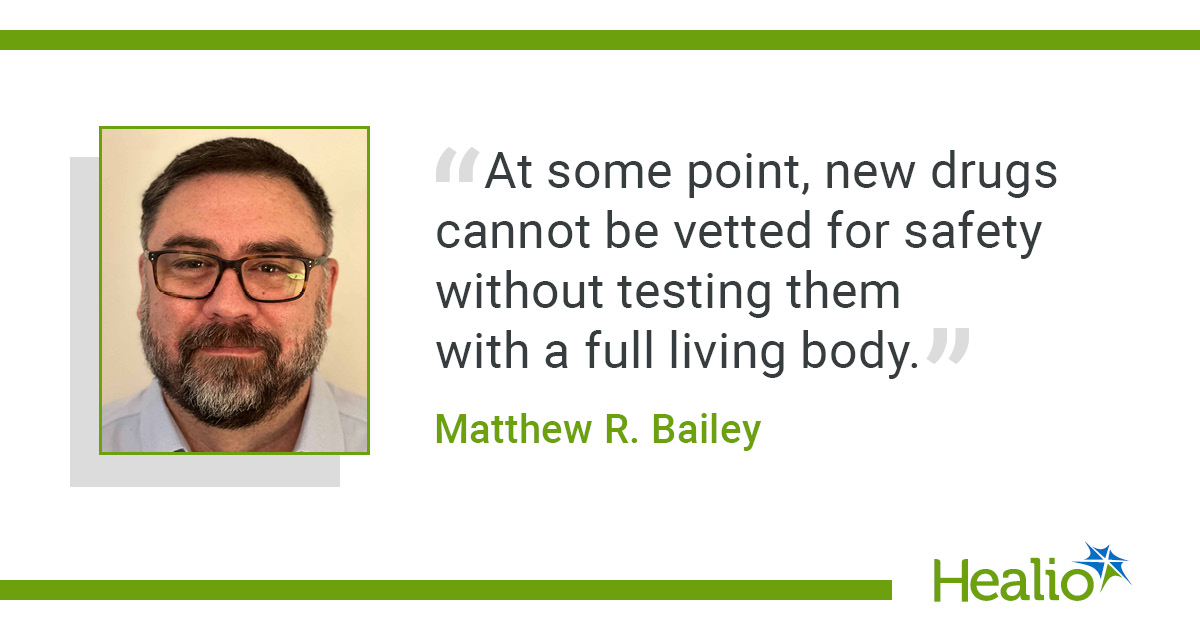
“NABR and FBR support the reduction and the refinement of animal testing when it is possible, but at some point, new drugs cannot be vetted for safety without testing them with a full living body,” Bailey told Healio. “Full living bodies/organisms also remain necessary in basic research to understand biological processes across a living body/organism’s interconnected systems.
“Further, we believe that the FDA’s direct final rule that replaces references to animal testing with the term ‘nonclinical’ does not soften the FDA’s responsibility to use the best available science to protect human health when evaluating drugs and biologics,” he added.
For more information:
Matthew R. Bailey can be reached at emaciejewski@nabr.org.
Sources/Disclosures
Source:
Healio Interview
Reference:
Disclosures:
Bailey reports no relevant financial disclosures.

Ask a clinical question and tap into Healio AI’s knowledge base.
- PubMed, enrolling/recruiting trials, guidelines
- Clinical Guidance, Healio CME, FDA news
- Healio’s exclusive daily news coverage of clinical data