October 02, 2026
5 min read

Key takeaways:
- Early intervention may lower risk for cancer-specific mortality among older adults with depression.
- Those who received psychotherapy soon after diagnosis had lower risk than those prescribed medication.
Early intervention may mitigate elevated risk for cancer-specific mortality observed among people with pre-existing depression, according to retrospective findings.
Individuals with pre-existing major depressive disorder appeared significantly more likely than those without it to die of their cancer within 1 year or 5 years; however, receipt of psychotherapy within 4 weeks of cancer diagnosis considerably reduced that risk, an analysis of Medicare data presented at American Society for Radiation Oncology Annual Meeting showed.

Data derived from Qiao M, et al. Abstract 195. Presented at: ASTRO Annual Meeting; Sept. 26-30, 2026; Boston.
“These findings emphasize the importance of early recognition, and they show mental health screening at the first clinic visit is essential to optimize depression management and cancer management,” lead author Edmund M. Qiao, MD, radiation oncology resident at University of California, San Diego, told Healio. “There are well-established treatments for this comorbidity — which is associated with increased risk for dying of cancer — and this study shows the longer we wait to help our patients get those interventions, the less impact those interventions have on cancer mortality.”
Underrecognized, undertreated
Up to one-quarter of people with cancer experience depression, according to NCI.
That prevalence is four to five times higher than the general population, based on WHO estimates.
Although prior research has linked the condition to poorer cancer outcomes, it often is underrecognized and undertreated in oncology settings, according to study background.
“It is likely that one, two or maybe three patients during every clinic day are dealing with depression but, unfortunately, it doesn’t always get talked about,” Qiao said. “In a time-stressed situation like a clinic consult — when we’re focusing on cancer therapies, the logistics of radiation and survival — the mental health component sometimes gets lost. Patients who are already facing an overwhelming burden from their cancer care are not necessarily connected to the right resources.”
Depression symptoms — such as fatigue or problems with concentration — also can mirror the effects of cancer and its treatments, which compounds the challenge.
Qiao and colleagues evaluated associations between pre-existing depression and cancer-specific mortality among older adults with common malignancies. They also assessed whether early intervention with two common depression treatment approaches — psychotherapy or antidepressant medications — affected cancer-specific mortality.
The researchers used SEER-Medicare data and ICD codes to identify 265,639 people aged 66 years or older diagnosed with one of six cancer types — bladder, breast, colorectal, kidney, non-small cell lung or prostate — between 2010 and 2017.
Investigators used ICD codes to identify those with depression.
‘A great opportunity’
Approximately one in five (22%) people in the cohort had a diagnosis of major depressive disorder, with the highest prevalence among individuals with NSCLC (27%) and the lowest among those with prostate cancer (13%).
A higher percentage of those with depression than without it died of their cancer within 1 year (29% vs. 21%) or 5 years (43% vs. 35%) of diagnosis.
Patients with preexisting major depressive disorder exhibited significantly higher risk for cancer-specific mortality (subdistribution HR = 1.11; 95% CI, 1.09-1.12). Elevated risks reached statistical significance for people with prostate cancer (subdistribution HR = 1.34; 95% CI, 1.26-1.43), bladder cancer (subdistribution HR = 1.2; 95% CI, 1.12-1.28) and colorectal cancer (subdistribution HR = 1.14; 95% CI, 1.1-1.17).
Researchers used CPD codes and Medicare Part D claims to identify individuals with depression who underwent psychotherapy or received antidepressants within 1, 2, 4 or 8 weeks of cancer diagnosis.
Results showed 3% had a psychotherapy session within 4 weeks of cancer diagnosis and 4.6% had a session within 12 weeks of diagnosis.
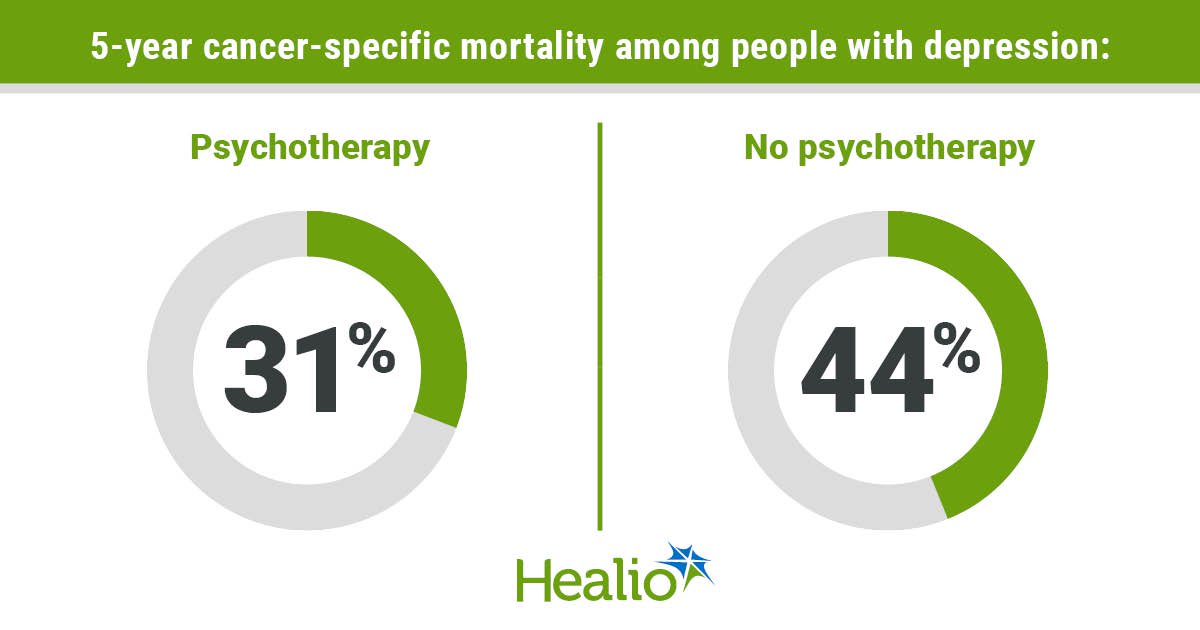
Individuals who received any psychotherapy had a lower rate of 5-year cancer-specific mortality than those who did not (31% vs. 44%).
The association between psychotherapy within 4 weeks of cancer diagnosis and cancer-specific mortality reached statistical significance for the overall cohort (subdistribution HR = 0.79; 95% CI, 0.73-0.87), as well as for those with breast cancer (subdistribution HR = 0.77; 95% CI, 0.59-0.997), kidney cancer (subdistribution HR = 0.37; 95% CI, 0.19-0.71) or prostate cancer (subdistribution HR = 0.68; 95% CI, 0.47-0.98).
Analyses adjusted with propensity score matching showed the value of early intervention.
Psychotherapy delivered at later time points still offered benefit, although reductions in risk for cancer-specific mortality appeared lower for those who received it 8 weeks (subdistribution HR = 0.87; 95% CI, 0.85-0.88) or 12 weeks (subdistribution HR = 0.88; 95% CI, 0.83-0.94) after cancer diagnosis.
Nearly one-third (32.5%) of patients with depression received medication within 4 weeks of cancer diagnosis. Results showed no significant association between pharmacotherapy and cancer-specific mortality in the overall cohort (subdistribution HR = 0.99; 95% CI, 0.97-1.02), although a significant association with reduced cancer-specific mortality emerged in the subgroup of adults with prostate cancer (subdistribution HR = 0.84; 95% CI, 0.74-0.95).
Qiao said he was struck by the magnitude of difference in cancer-specific mortality between patients who received psychotherapy and those who did not.
“A cancer diagnosis is very stressful, and it places a tremendous burden on a person’s mental health,” Qiao said. “Psychotherapy is a little bit more dynamic than pharmacotherapy, so it makes sense that psychotherapy may have a more significant effect in that cohort and stand out as a potentially better first-line option.”
However, the low rate of utilization for both psychotherapy and antidepressant medications is “troubling,” Qiao said.
“This isn’t like a new form of cancer or an aggressive variant for which we don’t have any treatments,” Qiao said. “We know a good proportion of patients have this diagnosis and we have treatments for it, so the issue is making that connection. We have a great opportunity to increase their use. Less than 5% of patients had undergone psychotherapy 12 weeks after diagnosis. If we can get that to 10%, it’s still not very high but it would double the number of patients who could benefit.”
A nuanced approach
The variation in outcomes by cancer type suggests there may be a more nuanced relationship between mental health and cancer outcomes than one depression treatment approach can capture, researchers concluded.
Cancer-related inflammatory syndromes — as well as some treatments, such as androgen deprivation therapy for prostate cancer — can elevate certain patients’ risks for depression, Qiao said. This underscores the importance of a personalized approach.
“When we think about depression management, we have to think about the whole context,” Qiao said. “What type of cancer is it? What stage is it and what is the prognosis? What treatment is the person receiving? Those questions can help tailor depression management.”
Investigators acknowledged study limitations. For example, its retrospective design can reveal associations between psychotherapy and reduced cancer mortality but cannot prove causality. In addition, the cohort only included Medicare beneficiaries — limiting generalizability to other populations — and other unmeasured factors may have influenced psychotherapy access or cancer outcomes.
Qiao and colleagues intend to replicate this study with a younger cohort to see if the signals they observed in the current analysis remain consistent.
The research group also would like to conduct a prospective study at their cancer center in hopes of improving recognition of patients with depressive symptoms.
“We hope to identify ways to improve depression screening and ensure those who screen positive are able to access appropriate services,” he said.
Sources/Disclosures
Source:
Qiao M, et al. Abstract 195. Presented at: ASTRO Annual Meeting; Sept. 26-30, 2026; Boston.
References:
Disclosures:
Qiao reports no relevant financial disclosures. Please see the study for all other authors’ relevant financial disclosures.

Ask a clinical question and tap into Healio AI’s knowledge base.
- PubMed, enrolling/recruiting trials, guidelines
- Clinical Guidance, Healio CME, FDA news
- Healio’s exclusive daily news coverage of clinical data