October 06, 2026
3 min read

Key takeaways:
- Probiotic use was associated with 51% lower risk for necrotizing enterocolitis in preterm infants.
- All-cause infant mortality remained stable, but mortality unrelated to necrotizing enterocolitis increased.
Routine use of a multistrain probiotic supplement was associated with 51% decline in necrotizing enterocolitis incidence among high-risk preterm infants in two neonatal ICUs, according to results of a retrospective study.
Researchers also observed an increase in mortality not associated with necrotizing enterocolitis after probiotic implementation, although all-cause mortality remained unchanged. The causes of these deaths were spread across categories with no plausible link to probiotics and may reflect differences in case mix between the two periods.

Data derived from Imren C, et al. JAMA Netw Open. 2026;doi10.1001/jamanetworkopen.2026.31601.
Necrotizing enterocolitis is most common among preterm infants, particularly extremely preterm ones born before 28 weeks, according to study background. It is a life-threatening condition associated with microbial imbalance in the gut.

Chris H. P. van den Akker
“[Necrotizing enterocolitis] remains one of the most feared complications in neonatal intensive care, and its incidence is highest in the most immature infants,” study author Chris H. P. van den Akker, MD, PhD, consultant neonatologist and pediatrician at Emma Children’s Hospital in the Netherlands, told Healio. “Randomized trials and meta-analyses have shown that certain probiotic strains reduce [risk for necrotizing enterocolitis], but uptake in clinical practice has been uneven.”
Probiotics as ‘standard care’
Van den Akker identified two reasons for hesitancy in probiotic uptake: safety concerns stemming from rare cases of probiotic-associated sepsis and difficulty in quantifying probiotic impact, given the varied array of available probiotic formulations.
“We implemented a well-characterized, high-quality three-strain product as standard care in two Dutch level IV NICUs in late 2020 and early 2021, and we wanted to know whether the benefit seen in trials also holds under routine conditions,” he said. “The question became more pressing after the FDA issued a warning against the use of probiotics in preterm infants in 2023.”
Van den Akker and colleagues compared outcomes before and after implementation of the probiotic (ProPrems, Neobiomics) among 1,413 preterm infants (52.5% boys) born between January 2018 and July 2024. All were younger than 30 weeks and/or weighed less than 1,000 grams.
The researchers divided the cohort into preimplementation (n = 598; median gestational age, 27.7 weeks; median birth weight, 950 g) and postimplementation (n = 815; median gestational age, 27.9 weeks; median birth weight, 975 g) groups.
The probiotic, given only to the postimplementation group, contained Bifidobacterium infantis Bb-02, Bifidobacterium lactis BB-12 and Streptococcus thermophilus TH-4 and was administered during enteral feeding.
Incidence of necrotizing enterocolitis served as the primary outcome. Secondary outcomes included all-cause mortality and mortality not associated with necrotizing enterocolitis.
‘Closely matched’ real-world, trial results
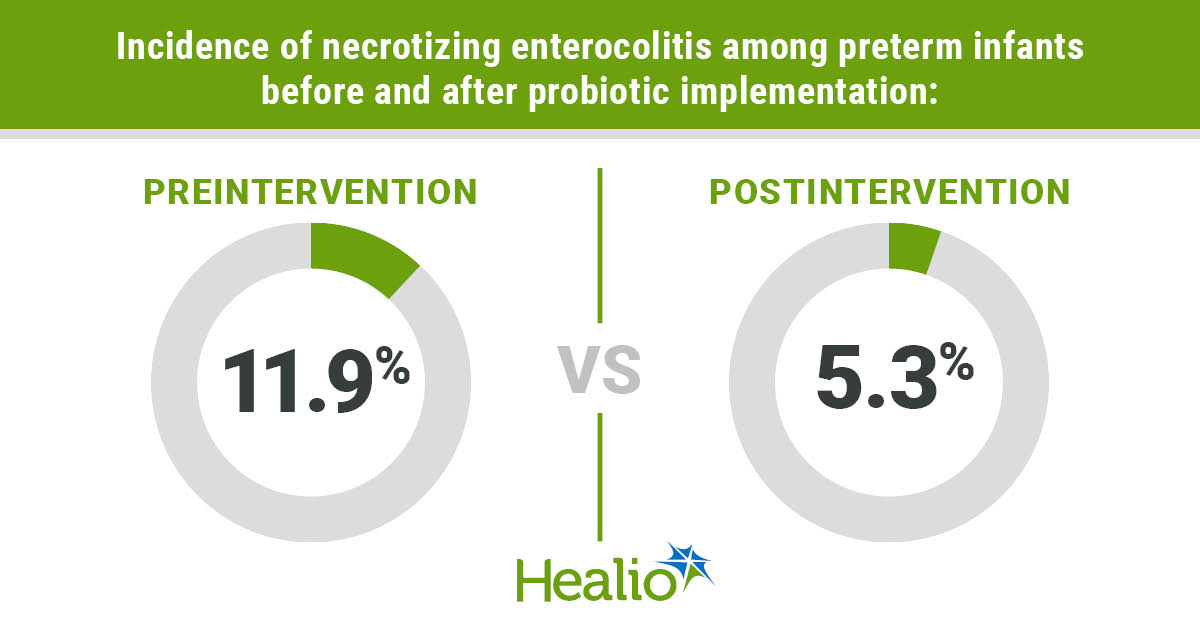
Incidence of necrotizing enterocolitis was higher in the preimplementation group (11.9%) than the postimplementation group (5.3%), with an adjusted risk ratio of 0.49 (95% CI, 0.34-0.7).
“The magnitude of the association closely matched what the randomized trial of this same formulation had reported,” van den Akker said. “That is not something you can take for granted when moving from trial conditions to routine care, where infants are less selected and protocols are applied less rigidly.”
Probiotic implementation also was linked to reduced incidence of medical (aRR = 0.5; 95% CI, 0.26-0.95), surgical (aRR = 0.44; 95% CI, 0.22-0.88) and fatal necrotizing enterocolitis (aRR = 0.47; 95% CI, 0.26-0.86). The association was seen, too, in the subgroup of extremely preterm infants born before 28 weeks (aRR = 0.49; 95% CI, 0.34-0.72).
Notably, the researchers observed an increase in mortality not associated with necrotizing enterocolitis after probiotic implementation (aRR = 1.42; 95% CI, 1.01-1.98), although all-cause mortality remained stable (aRR = 1.06; 95% CI, 0.82-1.39).
“This was an unexpected finding at first, but I would caution against overinterpreting it in either direction,” van den Akker said. “When we examined the causes of those deaths, they were distributed across several categories with no plausible biological link to probiotic administration, including persistent pulmonary hypertension of the newborn, perinatal asphyxia, and cardiac and neurological causes.”
One infant developed probiotic-associated sepsis, the researchers reported.
“[Probiotic] implementation should be paired with ongoing outcome monitoring, including for rare adverse events,” van den Akker said. “One case of probiotic-associated sepsis occurred among more than 800 exposed infants in our cohort.”
He acknowledged that the risk is rare, but not nonexistent, and advised clinicians to be familiar with signs of probiotic-associated sepsis to facilitate early intervention.
Van den Akker noted that harmonization in probiotic use should be a key focus of future research.
“Studies continue to use different strains, combinations and doses, which makes pooled estimates difficult to interpret and slows clinical adoption,” he told Healio. “We need strain-specific evidence, rather than evidence about probiotics as a category.”
For more information:
Chris H. P. van den Akker, MD, PhD, was first author of the 2020 ESPGHAN position paper on probiotics in preterm infants and of a subsequent ESPGHAN/EFCNI statement responding to the FDA warning. He can be reached at c.h.vandenakker@amsterdamumc.nl.

Ask a clinical question and tap into Healio AI’s knowledge base.
- PubMed, enrolling/recruiting trials, guidelines
- Clinical Guidance, Healio CME, FDA news
- Healio’s exclusive daily news coverage of clinical data