
October 09, 2026
7 min read
Key takeaways:
- Although environmentally beneficial, a permanent transition to LED lighting may be associated with negative health effects.
- Socially vulnerable populations may be disproportionately impacted.
By 2027, LED lighting will be the predominant source of artificial light available worldwide, after a permanent transition that some physicians are concerned will cause unique, modern-day health risks.
LED, or light-emitting diode, is a type of light that harnesses blue light wavelengths to create visible white light. In November 2023, delegates from 147 countries agreed under the United Nations’ Minamata Convention on Mercury treaty to phase out fluorescent lighting by 2027 due to environmental reasons, including mercury exposure, extreme energy waste and high greenhouse gas emissions.

Data derived from interview.
“According to the U.S. Department of Energy, residential LEDs use at least 75% less energy than incandescent lighting and can last up to 25 times longer,” Dong-Wouk Park, MD, assistant professor of ophthalmology at Oregon Health & Science University, told Healio.
The invention of LEDs was so impactful that the inventors received the 2014 Nobel prize in physics for it, according to Park. Despite these benefits, the use of LED light has been debated for decades. The AMA has warned that blue-rich LEDs can disrupt circadian rhythms and suppress melatonin. As modern-day society spends less time outdoors, many physicians are resurrecting concerns about LED light and its impact on the skin, eyes, brain and more.
“This may be a public health issue on par with concerns surrounding air and water,” Park said. “LED transition is an exposure change that affects nearly everyone for most of the day.”
Healio spoke with Park about the harms associated with blue-light emitting LEDs and how future research could find potential solutions. Park’s editorial on LED lighting was recently published in Annals of Internal Medicine.
Healio: How does LED differ from incandescent or halogen light bulbs?
Park: An LED is a semiconductor that emits light when a current passes through it. Most white LEDs pair a blue-emitting chip with a phosphor coating that converts part of the blue light into longer visible wavelengths so that the combined output looks white.
Incandescent and halogen bulbs work very differently. They are hot when we touch them because they heat a filament until it glows, producing a smooth, continuous spectrum that rises toward red and extends well into near-infrared. Roughly 90% of the energy an incandescent bulb uses comes off as heat rather than light, with much of it being infrared radiation. This is why it is considered “inefficient.” A conventional white LED concentrates its output near 450 nanometers (blue color) and emits very little beyond 700 nanometers (red color).
That is the heart of our paper: The efficiency gain and the spectral change are the same design decision. Lighting efficiency is defined by what the eye can see, which means eliminating invisible near-infrared light registers purely as savings.
Fluorescent tubes, which lit most offices and schools for decades, also emitted little near-infrared light. So, for many workplaces, this lighting shift began earlier. It is also important to note that fluorescent tubes have smoother spectral curves compared with LEDs. LEDs completed the transition from incandescent and halogen bulbs and were brought into homes, where they are now the dominant indoor light source in the United States. LEDs also differ in timing, as their electronic circuitry can sometimes produce a flicker that is too fast to see.
Healio: What are the concerns with using LED lighting?
Park: In our paper, we organized the concerns along three axes: what conventional LED light has more of, what it lacks and how it varies over time.
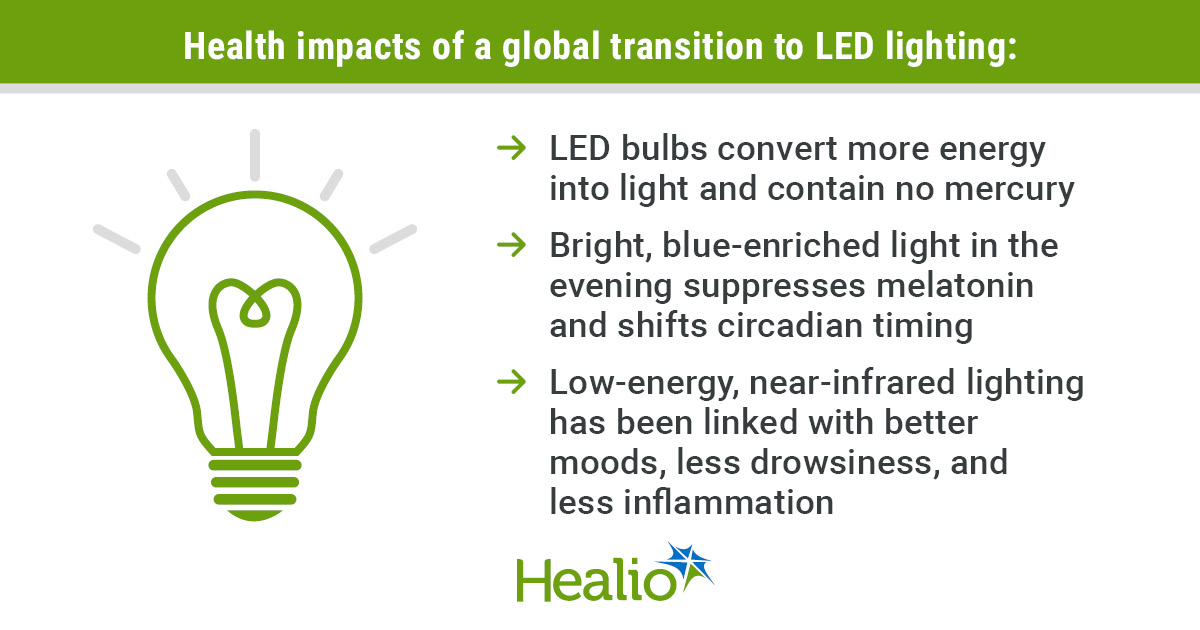
The first is short-wavelength content. A specialized class of retinal cells containing the photopigment melanopsin, most sensitive to blue-cyan light around 480 nanometers, signals the brain’s master clock. Bright, blue-enriched light in the evening suppresses melatonin and shifts circadian timing, with downstream effects on sleep and potentially metabolism. The shortest visible wavelengths, violet into blue, also drive photochemical stress in the retina at high intensities. Skin has light sensors of its own: Melanocytes detect blue light directly through a protein called opsin-3, and the blue component of sunlight can cause strong, persistent hyperpigmentation in darker skin.
The second is the loss of long wavelengths. Red and near-infrared light penetrate deeply through the skin into underlying tissue and are absorbed by cytochrome c oxidase in mitochondria, the mechanism proposed for photobiomodulation therapy. Under incandescent lighting, anyone indoors receives a steady dose of near-infrared light; under conventional LEDs, they receive almost none. That spectral deficiency is a measured physical fact. Whether it is a biological deficiency is the open question. In children, the spectral content of light also appears to influence eye growth and myopia, though which wavelengths matter is still being worked out.
The third is temporal modulation. Some LED drivers make light pulse 100 to 120 times per second. That is invisible, but the visual system still registers it.
Healio: What are the benefits of LED lighting?
Park: The benefits are substantial. Unlike the fluorescent lamps they are replacing, LEDs contain no mercury and they emit essentially no ultraviolet light. For households without reliable electricity, solar-powered LED lanterns can replace kerosene lamps and candles, with real gains in health and safety. I am not a light engineer, but my guess is that LEDs may be the most controllable light source we have ever had. From what I have gathered, their spectrum and timing can be engineered precisely.
Some may say that these benefits outweigh the potential harms, but I would gently reframe the perspective here. The choice is not LEDs vs. the old bulbs, and no one is arguing for a return to incandescent. The real question is what is “healthy light?” The same engineering that removed long wavelengths can restore them, and drivers can be designed not to flicker. We are now finding that the wavelengths we have actively taken out can be used to treat elderly patients with macular degeneration, children with myopia and cancer patients with oral mucositis.
Is it possible that this is a coincidence? Perhaps. Is it also possible that we forgot to ask, “What is healthy light?” What we lack is the evidence to know which of those changes matter enough to justify their cost. Restoring near-infrared does cost energy because, by definition, it does not count as light.
Healio: Are the concerns surrounding LED lighting supported by evidence?
Park: This is a broad question. Some effects are well established. Bright, blue-enriched light in the evening suppresses melatonin and shifts circadian timing. That isn’t unique to LEDs, but LEDs have made blue-rich light cheap and ubiquitous. This is why the AMA came out with their policy statement 10 years ago. Flicker has some strong real evidence too. In a double-blind crossover study of office workers, removing invisible 100-Hz flicker from fluorescent lighting cut headaches and eyestrain by more than half. Short-wavelength retinal injury is well-documented at high intensities, but whether ordinary, lifelong indoor exposure contributes to retinal disease has not been established.
The long-wavelength question is where the evidence is thinnest, but we are starting to learn more. Red and near-infrared light are clearly biologically active in defined therapeutic settings. International supportive-care guidelines recommend photobiomodulation to prevent oral mucositis in certain cancer treatments, for example.
However, it is important to point out that the therapeutic devices deliver concentrated doses to targeted tissue, and that doesn’t prove that losing low-level ambient near-infrared harms anyone. Data from a randomized, placebo-controlled trial showed people exposed to low-energy near-infrared lighting at home had better moods, less drowsiness, lower resting heart rates and lower levels of an inflammatory signaling molecule at the highest dose, but only in winter, with no effect on sleep or circadian rhythms.
A nonrandomized classroom study in China reported slower eye growth in children when far-red light was added to classroom LEDs. These findings are interesting, but they are small, mixed and unreplicated. The honest summary is there is a plausible biological rationale and early signals, not proof of harm, and the population-level effects of the indoor transition remain essentially unstudied.
Healio: For the harms that are supported by evidence, what are potential solutions?
Park: Set standards in measurements robustly first, then test these in larger trials, starting where exposure is longest.
We are asking for federal funding of longitudinal and mechanistic studies that measure people’s real-world exposure, meaning spectrum, intensity, timing, duration and flicker, rather than inferring it from bulb labels. I believe that the “kelvin” number on the package, correlated color temperature, is biologically incomplete. It collapses the violet-blue band relevant to retinal stress and the blue-cyan band that drives the circadian system into a single value and says nothing about red, near-infrared or flicker. So, two lamps with the same rating can differ in exactly the ways that matter biologically.
We proposed that standard bodies develop biologically meaningful metrics: a minimum red or near-infrared content, a ratio of circadian-effective to visual light and a measure of temporal modulation. Hospitals, schools and long-term care facilities should come first, because that is where people have the longest uninterrupted exposures and the least control over their lighting. In the meantime, the low-regret steps are familiar: brighter days, dimmer and warmer evenings, time in daylight with sensible sun protection and low-flicker products.
Healio: What are your key takeaways for healthcare professionals?
Park: Think about indoor light the way you already think about sunlight: as a spectrum with a dose.
We are not arguing that the LED itself is harmful. It is the transition to LED that may have caused harm because of lack of other wavelengths we are getting. I like to think of light spectrum as food. Carbs are not bad, but if you eat only carbs, that is not healthy. By exposing ourselves to “spectral junk food” (high in blue peak and missing some other wavelengths of light), we are not “eating” the balanced spectral diet. However, LED by itself is a great invention and likely has its place.
Screens and devices emit blue light at roughly 100 to 1,000 times lower irradiance than the sun. Marketing claims about blue light from screens or room lighting deserve scrutiny. However, I am concerned that using screens and blue peaking LED lights at night likely interferes with circadian rhythm. In particular, I am concerned about the increased use among our children at young ages.
Healio: Anything else you would like to add?
Park: One more interesting fact to think about is that the loss of near-infrared light indoors is not only about lamps. I often hear parents or older patients say, “When I was young, I played outside all day.” They are worried that our children are not spending enough time outdoors. Americans spend roughly 90% of their time indoors, and the transition is becoming effectively permanent. LEDs have essentially removed much of our near-infrared red light exposure indoors, and energy-efficient windows filter out near-infrared daylight, so the indoor environment offers less exposure to red light. Measurement remains a central problem: We do not yet have practical ways to measure the long-wavelength light people actually receive as they move through their day. I would welcome dermatology’s involvement in this research. No specialty has more experience measuring how human tissue responds to specific wavelengths and doses than dermatology.
For more information:
Dong-Wouk Park, MD, can be reached at padon@ohsu.edu.
Sources/Disclosures
Source:
Healio Interviews
References:
Disclosures:
Park reports no relevant financial disclosures.

Ask a clinical question and tap into Healio AI’s knowledge base.
- PubMed, enrolling/recruiting trials, guidelines
- Clinical Guidance, Healio CME, FDA news
- Healio’s exclusive daily news coverage of clinical data