October 07, 2026
8 min read

An aircraft’s autopilot can guide every aspect of a flight, from takeoff to landing. But it is expected, and reassuring to know, that a pilot has the skills to intervene and assume manual control at any time, especially during an emergency.
There is a similar expectation for healthcare professionals, who increasingly encounter AI’s expansion in practice to aid clinical diagnoses, documentation and decision-making. The concern? That overreliance on AI could eventually erode clinical skills and competencies, a phenomenon dubbed “deskilling.”

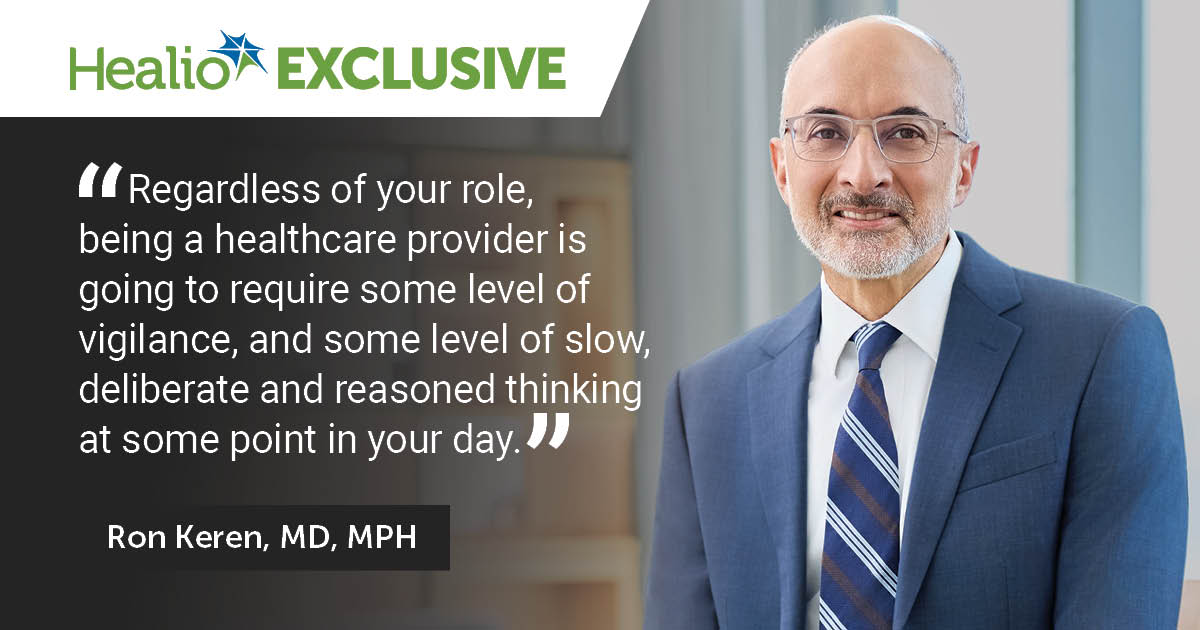
Image: Ron Keren, MD, MPH. Reprinted with permission.
“Research is showing that there is a fine line between augmentation and deskilling, and there’s a slippery slope between the two,” Ron Keren, MD, MPH, senior vice president and chief medical officer at Children’s Hospital of Philadelphia, told Healio.
Impact on care
Public-facing AI became mainstream with the launch of ChatGPT in 2022, but the technology’s impact is already felt across medical specialties.
A 2025 observational study published in The Lancet Gastroenterology & Hepatology found that adenoma detection rates during colonoscopies performed without AI fell from 28.4% in the 3 months before AI was introduced into practice to 22.4% in the 3 months afterward.

Maxim Topaz
“Because adenoma detection correlates with interval colorectal cancer risk, that could translate to approximately 18% more missed cancers,” Maxim Topaz, PhD, RN, MA, Elizabeth Standish Gill Associate Professor of Nursing at Columbia University Medical Center, told Healio.
He emphasized an urgent need to monitor AI’s impact on care quality, as well as to develop oversight strategies to address deskilling concerns.
“We still have hundreds of trials asking whether AI improves care and almost none measuring what happens when it is switched off,” Topaz said.
“There’s no doubt AI is here to stay in some form,” Amy Oxentenko, MD, MACP, MACG, AGAF, professor of medicine at Mayo Clinic College of Medicine and Science and vice dean of practice and chief patient experience officer for all Mayo Clinic sites, told Healio. She also noted it is easy to imagine “a day in the life” in which these AI systems may fail.
As healthcare becomes more reliant on AI, clinicians may be less prepared to function when those systems are unavailable: Algorithms can go offline, vendors can fail and hospitals can get hit by cyberattacks, Topaz cautioned.
Disruptions are not the only concern. Anxieties about deskilling are shared by healthcare professionals and patients alike. In a Wolters Kluwer survey, 77% of doctors, 70% of nurses and 68% of patients expressed concern about AI-driven deskilling.
“AI helps augment clinicians’ capabilities, but the core judgment about a clinical scenario should always be made by the clinicians themselves,” Deepti Pandita, MD, FACP, FAMIA, chief AI officer and vice president of clinical informatics and chief medical informatics at University of California Irvine Healthsystem, told Healio.
“What AI helps with is pattern recognition, documentation, triage support, decision support and suggestions — or what I call AI nudges — but ultimately, clinicians themselves are always responsible for the final diagnosis, the final output and final accountability,” she added.
‘Active role’ in AI integration, oversight
Human oversight is critical to ensure AI tools support quality patient care and preserve clinical skills.
Topaz advised healthcare systems to identify frontline practitioners, including nurses and other clinicians, to serve on governance boards.
“Deskilling is a workforce and patient safety issue, not an IT issue,” he said.
Keren also encouraged clinicians to become involved in AI governance at their practices and institutions, regardless of whether they personally embrace AI or are skeptical of it.
“[Clinicians] should play an active role in helping us design how AI tools are integrated into clinical care,” Keren said. “They will know best what’s going to help them, and what’s going to potentially negatively impact their performance.”
The clerical areas of practice — where AI tools are being applied at the fastest rate — raise fewer deskilling-related concerns, according to Keren.
“Wisely, both the developers of AI technologies, as well as the health systems that are implementing them, have started with these clerical tasks, like documentation, note-taking, coding and billing, facilitating communications with patients through portals, and scheduling,” Keren said. “In that setting, errors are consequential, but less likely to cause serious patient harm.”
Oxentenko concurred, noting AI tools that handle clerical and administrative tasks can save time and give clinicians more bandwidth to connect with their patients. However, she did highlight an important caveat.

Amy Oxentenko
“It’s still incumbent on [the clinician] to review notes that AI has generated,” Oxentenko, who also serves on the Healio AI advisory board, said. “You can’t get complacent and assume it’s going to be accurate. An incorrect medication or dosage could have grave consequences.”
On the other hand, AI tools that perform clinical care tasks — summarizing patient records, interpreting medical images, generating differential diagnoses and providing clinical decision support — require the greatest oversight from clinicians and governance boards, Keren emphasized.
In these areas, “errors have the potential to really harm patients,” he said.
When it comes to tackling governance of AI tools, Topaz advised healthcare systems and practices to “start with measurement, because you cannot govern what you do not measure.”
Topaz proposed several metrics that health systems and practices could employ including, “periodic unassisted performance assessments in quality programs, manual-mode protocols where a defined share of cases — for example, one in five — is completed without AI, and monitoring of automation bias signals such as override and agreement rates.”
Developing a governance structure does not necessarily require new hires.

Deepti Pandita
“In a resource-constrained environment where you don’t have a green light to hire new [full-time employees] all the time, I think the best process is to reskill or upskill current roles and fit them into the governance process,” Pandita said.
When budget and resources are tight, governance initiatives monitoring clinical skills also can be scaled appropriately.
“Smaller practices can run a lighter version and pick one core skill each quarter and audit it without AI assistance,” Topaz said.
‘A required competency’
In addition to deskilling, Topaz raised concern about “never-skilling,” the risk that medical students may rely too heavily on AI tools during training and never fully develop clinical competencies necessary for practice.
Keren said he is optimistic about the future of medical education if AI-assistive tools are thoughtfully designed and receive proper oversight.
“Trainees are coming into those programs more savvy with AI and digital tools than ever before, which is great,” Oxentenko said. “However, we need to balance that with making sure we’re teaching trainees the fundamental baseline skills.”
Keren encouraged educators to adopt or develop AI tools with features that protect the development and maintenance of clinical skills. That might include AI tools that carefully explain their own “reasoning” or provide references to primary sources that trainees or clinicians can interrogate and evaluate.
He also suggested that clinical care AI programs only provide diagnoses or treatment plans after a student or clinician submits their own. Users of the tool can then compare their conclusion with the AI output and see where they align or conflict.
Keren emphasized further study in this area is critical.
“The research we need should evaluate optimal AI implementation design features that minimize the deskilling phenomenon, which is measured in terms of errors of omission or commission,” he said. “If you can solve the problem with one design feature, there’s no point in adding the second one, because it’s more cost and more potential inconvenience.”
While it may be impractical to unilaterally ban trainees from using AI tools, Keren said it may be valuable to introduce “AI-free zones” — time periods or locations where AI is not available — to promote self-reliance.
“Education should require demonstrated competence without AI before granting competence with it,” Topaz said. “Practically, that means shadow-mode training where learners form their own assessment before seeing the AI output, simulation that exposes trainees to AI failures and hallucinations, and AI-free components in board certification.”
According to Pandita, medical education should retain its emphasis on clinical reasoning, differential diagnoses, and interpretation of history and exam features, but also expand to comprehensively address AI proficiency.
“AI literacy should be a required competency,” she said.
Pandita emphasized that students should understand what AI is and how it works. For this education to be thorough, it should include knowledge of how to identify bias in AI, how data can drive good or bad output from AI and how to avoid automation bias, as well as address data governance.
Oxentenko expressed concern that the absence of AI tools in underserved areas might compound challenges related to healthcare deserts.
“It may be harder to attract clinicians to come to those areas if they don’t have the AI resources that people have been trained with,” she said.
Overreliance on AI in medical training might undermine care in rural or resource-constrained regions in other ways, as well.
“If a trainee trains in a program that’s very AI supported, and then goes out to provide care in a rural community where they don’t have those resources, are they going to be able to have the same level of disease recognition and the same quality outcomes?” Oxentenko asked.
Vulnerabilities
The specialties and areas of practice most vulnerable to AI-driven deskilling include endoscopy, radiology, pathology, dermatology and cardiology, according to Topaz.
A narrative review of research on clinical deskilling found that available data, while limited, indicate the presence of AI-driven deskilling across these specialties, with particular concern for endoscopists, computational pathologists and breast-imaging radiologists.
Topaz said the study highlights that “performance can drop when AI is removed, and automation bias affects clinicians at every experience level.”
These specialties carry the greatest risk for automation bias, according to Keren, because many cases fit obvious patterns. If clinicians in these specialties are not vigilant, they may miss a “curveball” that slipped past the AI.
Pandita noted similar areas of concern.
“High-volume specialties with very standardized workflows are ones that are very amenable to readily accept AI outputs,” she said.
However, the risk for AI-driven deskilling is not limited to those areas of medicine.
“Everyone’s potentially at risk,” Keren said. “Regardless of your role, being a healthcare provider is going to require some level of vigilance, and some level of slow, deliberate and reasoned thinking at some point in your day.”
The risk for harm to patients may be most pronounced in critical care settings.
“High-stakes environments concentrate the risk because they have no slack,” Topaz said.
He pointed to AI systems that detect early warning signs of sepsis as an example.
“Recognizing deterioration in an intensive care unit or triaging in an emergency department is a minutes-matter skill, and skill decay surfaces exactly when time pressure peaks,” Topaz said. “A nurse who has spent 2 years deferring to an early-warning score must suddenly spot the septic patient without it, and that moment tends to arrive at 3 a.m. during a downtime event.”
While system-level solutions are key to mitigate risk for deskilling, Oxentenko encouraged clinicians to consider what they can do as an individual to maintain their skills.
“Within your institution or practice, what are you doing to continue to make sure that your eyes, hands and thinking stay sharp in times without those AI tools?” she asked.
As AI evolves, governance boards and committees will have to keep pace with new tools and technologies.
“Currently most governance programs are about AI implementation, guardrails and security evaluations,” Pandita said. “As we move forward from implementation to maintenance, we have to evolve governance into a long-term process.”
Pandita emphasized that AI governance is different than oversight for other healthcare technologies.
“AI changes very rapidly,” she said. “You have to constantly monitor models — whether they are your own or vendor-delivered — and that should be looped into your governance ecosystem.”
For more information:
Ron Keren, MD, MPH, can be reached at keren@chop.edu.
Amy Oxentenko, MD, MACP, MACG, AGAF, can be reached at oxentenko.amy@mayo.edu.
Deepti Pandita, MD, FACP, FAMIA, can be reached at panditad@hs.uci.edu.
Maxim Topaz, PhD, RN, MA, can be reached at mt3315@cumc.columbia.edu.

Ask a clinical question and tap into Healio AI’s knowledge base.
- PubMed, enrolling/recruiting trials, guidelines
- Clinical Guidance, Healio CME, FDA news
- Healio’s exclusive daily news coverage of clinical data