October 12, 2026
5 min read

Key takeaways:
- Workforce and policy pressures, as well as emerging AI technologies, are reshaping gastroenterology practice.
- ACG is tackling these issues with advocacy, support for biomedical innovation and by rethinking CME.
NASHVILLE, Tenn. — ACG is addressing AI- and workforce-driven shifts in gastroenterology with investment in biomedical innovation and modernized education initiatives, the outgoing president said at ACG Annual Scientific Meeting.
“While we have all these challenges that we’re facing, I would argue that there’s never been a more exciting time to be a gastroenterologist than now,” William D. Chey, MD, AGAF, FACG, told Healio, reflecting on his address to attendees.

Chey, who also is H. Marvin Pollard Professor of Gastroenterology and chief of the division of gastroenterology and hepatology at Michigan Medicine, detailed achievements within the college in 2026 and initiatives that will be continued by his successor, President-elect Costas H. Kefalas, MD, MMM, MS-PopH, FACG.
A shifting landscape
Chey enumerated the changes ACG and its members will be grappling with in 2027.
“We’re facing all these challenges: increasing clinical demands with diminishing reimbursement models, problems with loss of autonomy and general change in the whole care model,” he said.
Patterns within the workforce reflect significant shifts in employment in the field.
“We’re [moving] from a phase where the majority of gastroenterologists were their own bosses in private practice to an employment model,” Chey said.
He also highlighted the challenges presented by physician shortages and healthcare deserts.
“We not only have too few gastroenterologists, but there’s also this tremendous maldistribution of gastroenterologists in rural vs. urban areas.”
Changes to gastroenterology care models also stem from AI, which Chey called a “double-edged sword,” acknowledging that AI presents risks for the field, but brings opportunity as well.
“It’s incredible to think about how [AI] is going to fuel biomedical innovation in drugs, devices, home health monitoring and imaging,” Chey said.
In particular, he emphasized the potential AI holds to advance precision medicine, which he dubbed the “holy grail” of medical practice, within the next decade.
“One of the areas that I really focus in is IBS, and we choose therapy based on the patient’s predominant symptoms,” Chey said. “That’s a pretty blunt instrument and — surprise, surprise — some of the therapies we use make a whole lot less than half the patients better, and that’s because of the imprecision by which we choose treatments for individual patients.”
Chey said he is “very optimistic” about how AI may advance a precision-based, rather than an empiric, model of medicine.
Amidst these changes, Chey said ACG remains focused on helping gastroenterologists and other healthcare professionals take care of patients with digestive disorders, and plans to address the challenges of the day with advocacy and task forces dedicated to timely topics.
Advocacy and innovation
According to Chey, “the crown jewel” of ACG’s policy-related efforts this year was its Advocacy Day on April 16.
“More than 100 people — 100 ACG members from all over the U.S. — descended on Washington and conducted over 200 meetings with congresspersons and senators, addressing clinically important topics like step therapy, prior authorization and Medicare reimbursement,” he said. “We also talked about the important topic of NIH funding.”
At the event, ACG members encouraged legislators to cosponsor the bipartisan Safe Step Act, which would provide exemptions for step therapy requirements where delay could cause harm, as well as the Specialty Physicians Advancing Rural Care Act, which would aid student loan repayment for physicians practicing in rural areas, among other initiatives.
Chey highlighted another key target for ACG: ongoing challenges that clinician scientists face as they seek NIH funding.
“There are a lot of things happening right now that those of us in academic medicine who conduct NIH-funded research know, but that clinical gastroenterologists that may not be as tuned in to,” he said.
Under the current administration, political appointees review research awards. If they determine research is not aligned with administrative policies and priorities, these appointees can override decisions made by peer review, Chey said.
ACG’s answer to another key issue facing gastroenterologists — the advancement of AI technologies — is the ACG Biomedical Innovation Task Force.
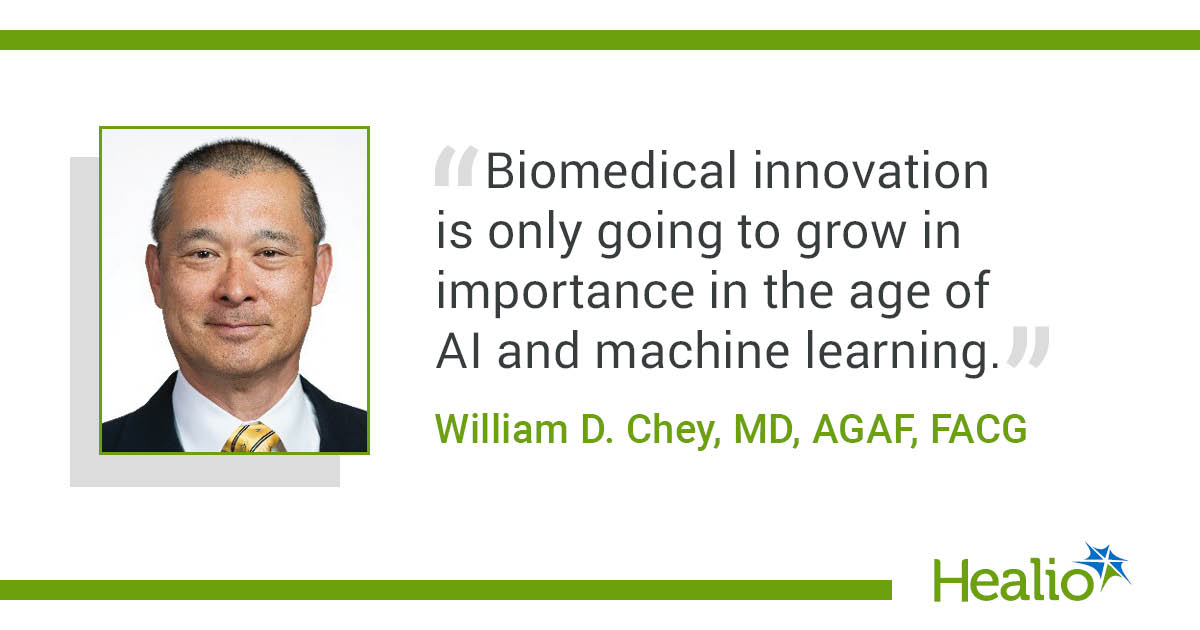
“Biomedical innovation is only going to grow in importance in the age of AI and machine learning,” Chey said.
The task force, commissioned by Chey, includes physician entrepreneurs and innovators, industry leaders, and individuals from the finance and venture capital world.
“This task force was [created] to better understand the landscape for innovation in GI and hepatology and where ACG might create assets that can help innovators who are trying to prototype an idea and bring it to market,” Chey said.
He anticipates the task force will begin issuing hardware and software grants in 2028 to develop and validate emerging medical tools.
The task force also will work on developing a “sandbox network, which will be community ASC and academic-affiliated sites where these innovations and technologies can be tested in real-world clinical settings.”
Educational initiatives
During his tenure, Chey also commissioned an Education Innovation Task Force designed to tailor ACG’s training initiatives to the needs of its membership.
“ACG is widely recognized as one of the preeminent organizations in providing clinically focused education for gastroenterologists and other providers that care for patients with digestive disorders,” Chey said. “I wanted this task force to think about how we’re delivering that education.”
The task force surveyed ACG members about their educational preferences and developed three key recommendations that evolved into ongoing projects. These include a bite-sized video learning series focused on high-yield lectures and high-impact journals, rather than lengthy lecture videos, as well as a “question of the week,” similar to anesthesiologists’ MOCA Minute.
Chey noted the latter initiative will “provide an alternative means to get CME and [maintenance of certification (MOC)] credit, and hopefully provide a mechanism for discussion between members of the college — and maybe even some friendly competition between fellowship programs or practice groups.”
Additionally, the task force is developing ACG Vista GI, an interactive AI-powered training and assessment platform designed to teach users how to handle difficult conversations with patients.
“We spend a tremendous amount of time and effort training young physicians how to do endoscopy, but we’re not nearly as intentional about teaching them how to talk to and interact with patients, especially when talking about difficult topics,” Chey said. “We think there’s a role for this platform in helping to provide that cognitive training that will supplement the endoscopic training we provide all GI fellows.”
As Chey passes the torch to the next ACG president, he told Healio that he hopes his address provides healthcare professionals with a sense of belonging and support — and a roadmap for success.
“[I hope it] helps our membership understand that ACG deserves to be their professional home, and that we spend a lot of time and effort not only thinking about what’s happening right now in gastroenterology and hepatology, but what is going to be happening in the future, and how we can create assets to prepare our members to be more effective in that future,” he said.
For more information:
William D. Chey, MD, AGAF, FACG, can be reached at gastroenterology@healio.com.
Sources/Disclosures
Source:
Healio Interviews
Reference:
Disclosures:
Chey reports no relevant financial disclosures.

Ask a clinical question and tap into Healio AI’s knowledge base.
- PubMed, enrolling/recruiting trials, guidelines
- Clinical Guidance, Healio CME, FDA news
- Healio’s exclusive daily news coverage of clinical data