October 13, 2026
2 min read

Key takeaways:
- Transplant may be a “meaningful” treatment for select patients with unresectable colorectal liver metastases.
- Patient survival at 1, 3 and 5 years after transplant was 90.9%, 69.8% and 48.9%, respectively.
NASHVILLE, Tenn. — Liver transplantation yielded favorable short- and intermediate-term outcomes for patients with unresectable colorectal liver metastases confined to the liver, according to a study presented at ACG Annual Meeting.
Additionally, incidence of graft-related mortality after transplant was low, with most deaths among transplant recipients related to malignancy.

“Liver transplantation for unresectable colorectal liver metastases is an emerging indication, but its role in the United States remains highly selective and continues to evolve,” Ragesh B. Thandassery, MD, a hepatologist at University of Arkansas for Medical Sciences Health, told Healio.
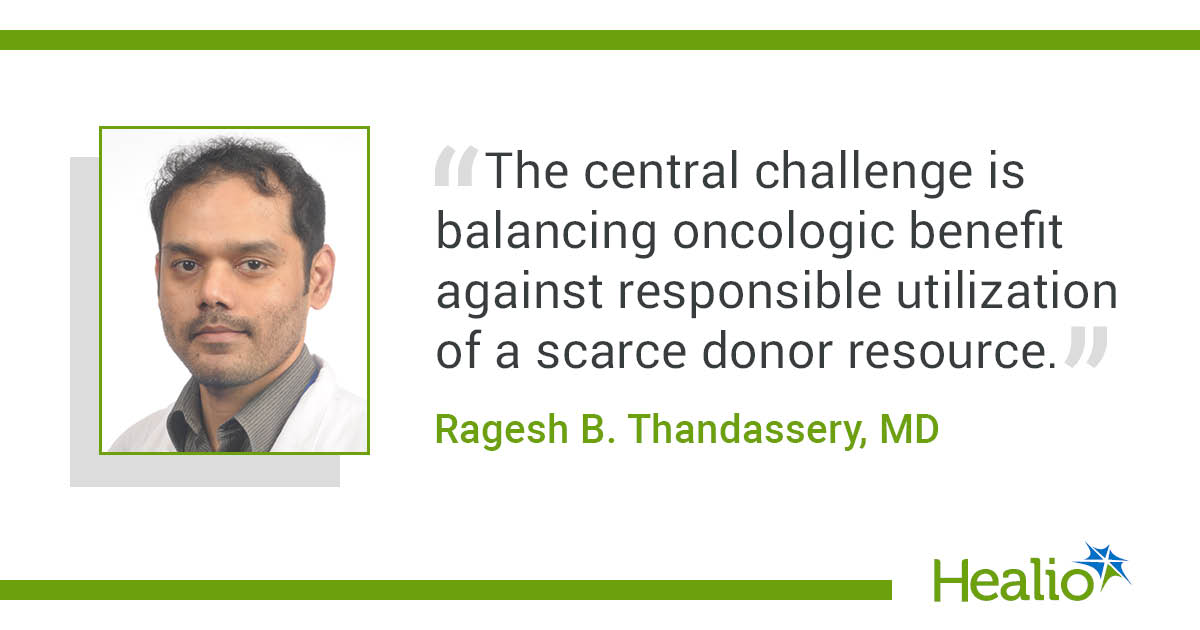
“We therefore wanted to understand how these patients are actually being selected in contemporary U.S. practice, what types of grafts are being used and what their posttransplant outcomes look like at a national level,” he added. “The central challenge is balancing oncologic benefit against responsible utilization of a scarce donor resource.”
Thandassery and colleagues collected data on 203 adults (mean age, 49.6 years; 64% men; 82.3% white; median MELD score, 8) from the Scientific Registry of Transplant Recipients.
All recipients received liver transplants between 2017 and 2025, with study follow-up ending in March.
More than three-quarters (76.8%) were privately insured. The median transplant waitlist time was 118 days and median length of hospital stay after transplant was 8 days. Most patients (94.1%) had a Karnofsky performance status greater than 70.
“One important nuance is that the favorable outcomes should not be generalized to all patients with [colorectal liver metastases],” Thandassery said. “This was a highly selected population with excellent functional status and low MELD scores, so selection is likely central to the observed outcomes.”
Nearly half (41.4%) of grafts came from living donors, 26.6% from extended-criteria donors and 22.2% from donation after cardiac death.
By the end of the study period, 16.3% of recipients had died. About half (45.5%) of deaths among transplant recipients were related to malignancy, while graft failure accounted for 3% of deaths.
“Our study shows that liver transplantation for [colorectal liver metastases] is evolving from an experimental concept into a highly specialized treatment strategy in the United States, with encouraging short- and intermediate-term outcomes in carefully selected patients,” Thandassery said. “Importantly, the major determinant of long-term outcome appears to be recurrent malignancy rather than graft failure, highlighting that oncologic selection and disease control remain key to success.”
Survival rates at 1, 3 and 5 years after transplant were 90.9%, 69.8% and 48.9%, respectively.
“The survival we observed suggests that transplantation is certainly a promising and important step forward,” Thandassery said.
The researchers also conducted a meta-analysis of studies investigating the effectiveness of liver transplantation for patients with colorectal liver metastases, and observed a pooled 5-year overall survival of 57% (95% CI, 46%-67.3%) after transplant.
“Liver transplantation is becoming a potentially meaningful therapeutic option for a small, carefully selected group of patients with unresectable CRLM confined to the liver,” Thandassery told Healio. “These patients should be recognized early and discussed in a multidisciplinary setting involving oncology, hepatobiliary surgery and transplant hepatology.”
For more information:
Ragesh B. Thandassery, MD, can be reached at gastroenterology@healio.com.
Sources/Disclosures
Source:
Thandassery RB, et al. Liver transplantation for colorectal liver metastases in the United States: Contemporary outcomes and a comparative analysis of international survival trends. Presented at: ACG Annual Scientific Meeting; Oct. 12-14, 2026; Nashville, Tenn. (hybrid meeting).
Disclosures:
Thandassery reports no relevant financial disclosures. Please see the study for all other authors’ relevant financial disclosures.

Ask a clinical question and tap into Healio AI’s knowledge base.
- PubMed, enrolling/recruiting trials, guidelines
- Clinical Guidance, Healio CME, FDA news
- Healio’s exclusive daily news coverage of clinical data