October 13, 2026
3 min read

Key takeaways:
- Individuals who were physically active had a 16% lower risk for all-cause mortality than those who were inactive.
- Baseline fibrosis did not affect the association between physical activity and mortality.
NASHVILLE, Tenn. — Individuals with steatotic liver disease who engaged in leisure-time physical activity had a 16% lower risk for all-cause mortality, regardless of fibrosis status, according to a presenter.
Data presented at ACG Annual Scientific Meeting also showed that the greatest reduction in mortality was observed when individuals moved from a sedentary lifestyle to even modest levels of physical activity.

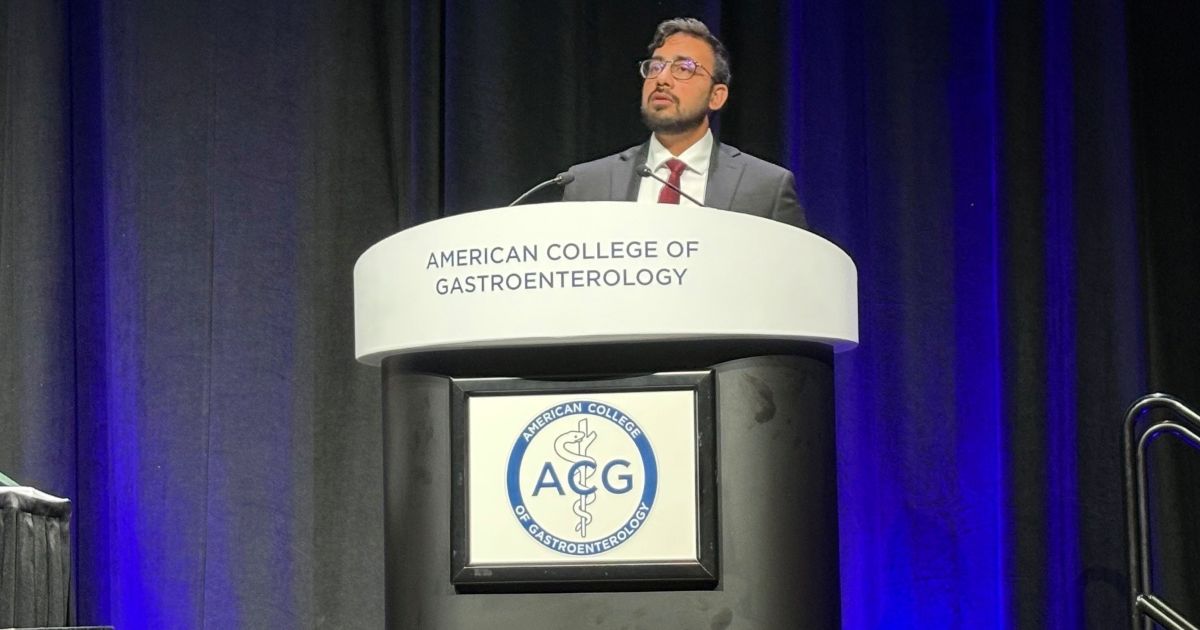
Sanhiljot Singh Bhupal, MD, MSHIST, speaks at the podium during ACG Annual Scientific Meeting. Photo: Heather Biele.
“It is already established that cardiovascular disease remains a major cause of death in these patients, and we do see poor cardiovascular status,” Sanhiljot Singh Bhupal, MD, MSHIST, a second-year internal medicine resident at St. Francis Medical Center in Lynwood, California, told Healio. “We already know that exercise is one of the foundations of treatment. It can improve hepatic steatosis and cardiometabolic health even without significant weight loss.
“But we felt there were still some important unanswered questions about why physical activity is associated with better long-term outcomes,” he added.
Bhupal and colleagues analyzed data from the 1988-1994 National Health and Nutrition Examination Survey and National Death Index through 2019 to evaluate the dose-response relationship between physical activity and all-cause mortality among individuals with steatotic liver disease.
The researchers classified participants as “physically active” if they reported any leisure time activity (>0 MET-minutes per week) and “inactive” if they reported none (0 MET-minutes), using self-reported data from NHANES interviews. They also estimated liver fibrosis via FIB-4 index values and stratified participants as low, intermediate or high risk.
Final analysis included 4,441 adults aged 20 to 74 years, representing 46.3 million adults. Most (85.5%) had metabolic dysfunction-associated liver disease, 12.2% had metabolic dysfunction and alcohol-associated liver disease, and 2.3% had alcohol-associated liver disease.
Over median follow-up of 26 years, 1,903 deaths occurred. Mortality was significantly lower among individuals who were physically active vs. inactive (36.4% vs. 44%; P = .008).
Those who were physically active were more likely to be men (55% vs. 34.9%), had attained at least a college education (19.8% vs. 6.4%) and had a higher income-to-poverty ratio (3.27 vs. 2.35).
The link between physical activity and lower all-cause mortality was significant only for MASLD.
Analysis adjusted for demographic, socioeconomic and clinical factors showed physical activity was associated with a 16% lower risk for all-cause mortality (adjusted HR = 0.84; 95% CI, 0.71-0.99). This risk remained the same after including FIB-4 values.
“The hazard ratio essentially did not change,” Bhupal told Healio. “Although fibrosis itself remained an important predictor of mortality, it did not appear to explain most of the survival benefit associated with physical activity. That suggests much of the benefit may be coming through extrahepatic pathways, particularly cardiometabolic health.”
The researchers also found that the protective association between physical activity and mortality appeared strongest during the first 10 years of follow-up (aHR = 0.68; 95% CI, 0.49-0.94). However, physical activity was measured only at baseline, Bhupal noted.
“Over 20 or 30 years, people’s activity levels can change substantially,” he said. “The further we get from that original measurement, the less accurately it represents what that person is actually doing. Clinically, I think that reinforces the idea that physical activity is something we need to reassess and encourage over time, rather than discuss once.”
Dose-response analysis also showed a significant nonlinear relationship, with the greatest reduction in mortality occurring when individuals went from being completely inactive to incorporating even modest physical activity.
“We should be talking about physical activity with essentially every patient with steatotic liver disease, and especially with patients who are completely sedentary,” Bhupal told Healio. “We should still encourage patients to work toward guideline-recommended levels of activity, but if somebody is doing no physical activity at all, getting them to start walking or doing another activity they can realistically maintain may already be an important step.
Bhupal emphasized that these results highlight the importance of holistic care for patients with steatotic liver disease, rather than solely focusing on progression of liver disease.
“Physical activity matters in steatotic liver disease, and its benefits appear to go well beyond the liver,” he said.
For more information:
Sanhiljot Singh Bhupal, MD, MSHIST, can be reached at gastroenterology@healio.com .
Sources/Disclosures
Source:
Bhupal SS, et al. Relationship between leisure-time physical activity and mortality in SLD: A 31-year population-based study. Presented at: ACG Annual Scientific Meeting; Oct. 12-14, 2026; Nashville, Tenn. (hybrid meeting).
Disclosures:
Bhupal reports no relevant financial disclosures. Please see the study for all other authors’ relevant financial disclosures.

Ask a clinical question and tap into Healio AI’s knowledge base.
- PubMed, enrolling/recruiting trials, guidelines
- Clinical Guidance, Healio CME, FDA news
- Healio’s exclusive daily news coverage of clinical data