October 14, 2026
3 min read

Key takeaways:
- DNA methylation test detected Barrett’s esophagus with 90% sensitivity and 86% specificity, rising to 99% for long-segment disease.
- The test reached 100% sensitivity for dysplasia and esophageal adenocarcinoma.
NASHVILLE, Tenn. — A novel DNA methylation test using the EndoSign capsule-sponge detected Barrett’s esophagus with 90% sensitivity and 86% specificity, excelling in longer segments and patients with dysplasia or esophageal adenocarcinoma.
Late-breaking clinical trial data presented at ACG Annual Scientific Meeting suggest that this minimally invasive approach with Cyted Health’s biomarker test could expand screening for at-risk individuals and help reduce esophageal adenocarcinoma mortality through earlier detection.

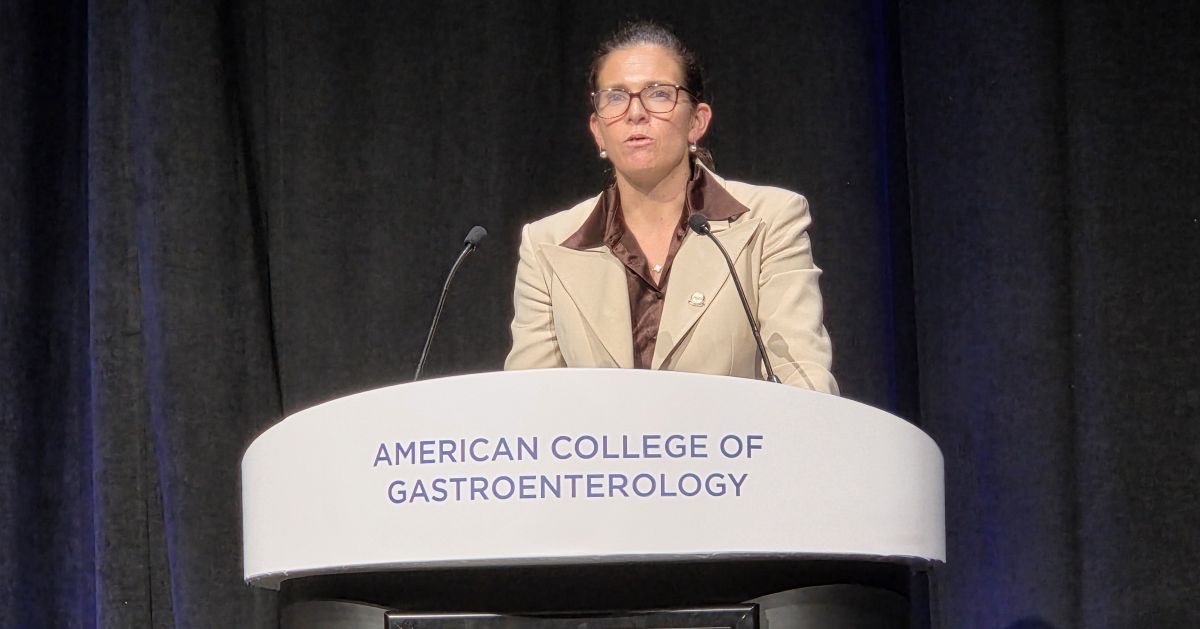
Nicholas J. Shaheen, MD, MPH, MACG, speaks at the podium during ACG Annual Scientific Meeting. Photo by: Robert Stott.
“Ninety percent of patients with Barrett’s esophagus are undiagnosed right now,” Marcel Gehrung, PhD, cofounder and CEO of Cyted Health, told Healio. “In the U.S., we have around 30 to 32 million people that — according to the ACG guideline — have risk factors that might make them eligible for endoscopic or non-endoscopic screening. With 90% being undiagnosed, we have to ask ourselves: Are we scoping the right patients at the right time to pick up those patients with Barrett’s esophagus who are at increased risk for developing esophageal adenocarcinoma?”
In the DETECT-ME trial, Nicholas J. Shaheen, MD, MPH, MACG, senior associate dean for clinical research at University of North Carolina School of Medicine, and colleagues prospectively evaluated the accuracy, safety and tolerability of the DNA methylation biomarker panel paired with the EndoSign device.
The multicenter study enrolled 324 patients across 18 sites, including individuals undergoing screening due to elevated risk and patients with an established diagnosis of BE undergoing surveillance or endoscopic eradication treatment.
Shaheen and colleagues analyzed DNA methylation in EndoSign samples collected before esophagogastroduodenoscopy, examining 654 BE-associated regions and 1,561 reference regions to establish baseline methylation levels.
The researchers used the Mann–Whitney rank-sum test to compare methylation in BE-associated and reference regions, with higher scores signaling a stronger likelihood for BE. Test sensitivity and specificity for BE served as primary endpoints, alongside tolerability, safety and sensitivity by dysplasia grade and BE length.
Of the 324 participants in the primary analysis, 181 had BE and 143 did not. The test identified 163 of 181 patients with BE, corresponding to a sensitivity of 90% (95% CI, 84%-94%). Among patients without BE, 123 of 143 tested negative, yielding a specificity of 86% (95% CI, 79%-91%). The test also demonstrated 100% sensitivity for dysplasia and esophageal adenocarcinoma, with sensitivity for BE increasing with segment length.
The researchers reported a sensitivity of 82% for short-segment BE (95% CI, 73%-89%) and 99% for long-segment BE (95% CI, 94%-100%), with an 87% sensitivity for nondysplastic BE. Detection improved significantly with each 1 cm increase in BE segment length (OR = 3.68; 95% CI, 1.56-8.68).
Sensitivity was found to be lower in the high-risk screening group than in patients with previously diagnosed BE (69% vs. 92%), a difference consistent with the shorter BE segments in the screening group.
“With 100% sensitivity for dysplasia and neoplasia, this is a test that has an exceptional negative predictive value, which really means you can trust a negative result, while at the same time having a massively increased yield in endoscopy in the patients who have tested positive,” Gehrung told Healio.
Additionally, Shaheen and colleagues reported that sampling was successful in 95% of participants, with no reported device-related adverse events. The test was also well tolerated, with 82% of participants rating its tolerability as excellent and 81% noting they would undergo the test again.
“Perhaps next year, or even before that, we are hopeful that, because we’re using a very extensive biomarker panel, not only will we be able to [determine] Barrett’s yes/no, but we will actually be able to differentiate the degree of dysplasia,” Shaheen told attendees. “Not ready for prime time yet but stay tuned.”
Shaheen also noted that rather than viewing this technology as a threat to their existing endoscopy practice, gastroenterologists should be leading its adoption.
“Ultimately, we hope this will become a primary care test, and as such, we should be embracing this,” Shaheen said. “This is actually going to increase our business — if we do it right — because 90% of these patients aren’t getting screened anyway. You are going to be doing more endoscopy, but you’re going to be doing endoscopy for patients who are high risk and have already had a positive test. So, we should be leading the charge here.”
For more information:
Marcel Gehrung, PhD, can be reached at gastroenterology@healio.com.
Sources/Disclosures
Source:
Shaheen NJ, et al. A prospective, multicenter cohort study of a novel methylation biomarker panel using non-endoscopic cell collection to detect Barrett’s esophagus – The DETECT-ME study. Presented at: ACG Annual Scientific Meeting; Oct 12-14, 2026; Nashville, Tenn. (hybrid meeting).
Disclosures:
Gehrung reports consulting/advisory relationships, employment, leadership and ownership interests with Cyted Health and Medtronic. Please see the study for all other authors’ relevant financial disclosures.

Ask a clinical question and tap into Healio AI’s knowledge base.
- PubMed, enrolling/recruiting trials, guidelines
- Clinical Guidance, Healio CME, FDA news
- Healio’s exclusive daily news coverage of clinical data