October 14, 2026
4 min read

Key takeaways:
- At week 12, clinical remission and endoscopic response rates were higher with risankizumab than placebo.
- Remission and response rates also were numerically higher at week 24.
NASHVILLE, Tenn. — Patients with Crohn’s disease achieved significantly higher clinical remission and endoscopic response rates at week 12 with subcutaneous risankizumab induction than with placebo, study results showed.
In addition, subcutaneous risankizumab (Skyrizi, AbbVie) induction demonstrated a similar safety profile to other indications for the drug, according to a speaker at ACG Annual Scientific Meeting.

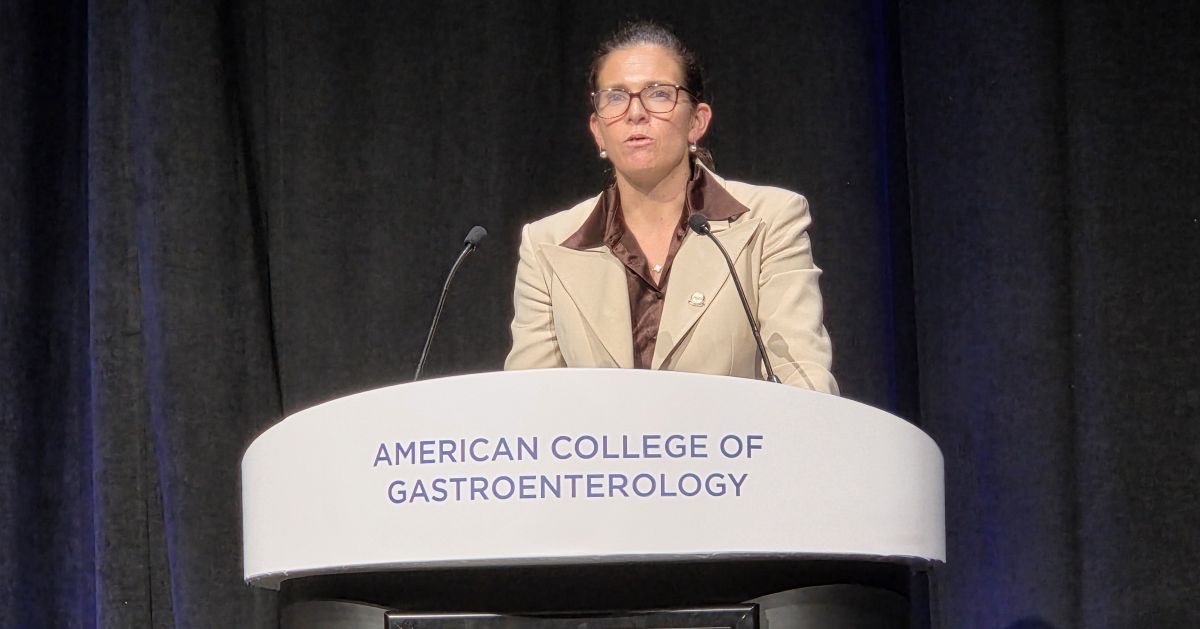
Millie D. Long, MD, MPH, FACG, speaks at the podium during ACG Annual Scientific Meeting. Photo by: Octavia Feliciano.
“One of the things that we as gastroenterologists want to do is use the safest, most effective therapy to hopefully treat [inflammatory bowel disease] early, achieve mucosal healing and prevent need for surgery or other complications in our patients,” Millie D. Long, MD, MPH, FACG, professor of medicine and vice chief of education at University of North Carolina School of Medicine, told Healio regarding her presentation. “One of the things we have learned with this class of medicines — the [interleukin]-23 p19 agents — is they seem to be incredibly safe for advanced therapies and highly effective.
“It’s a very nice combination when you compare it to some of our older biologic therapies, where we have seen some specific safety signals,” she added.
AFFIRM study
The FDA approved risankizumab in 2022 for the treatment of moderately to severely active CD, with a dosing regimen of IV induction followed by subcutaneous maintenance.
However, accessing the required induction can be a barrier for some individuals, according to Long.
“I practice in North Carolina, where I see patients from a five-state radius,” she said. “Arranging infusions at remote sites and prescribing across state borders can be a challenge.”
Long and colleagues conducted the phase 3 AFFIRM study to investigate the efficacy and safety of subcutaneous risankizumab induction.
They enrolled 289 adults with moderate to severe CD, all of whom had a confirmed diagnosis for at least 3 months prior to enrollment and Crohn’s Disease Activity Index (CDAI) scores ranging from 220 to 450 at baseline.
Participants were randomly assigned 2:1 to receive subcutaneous risankizumab (n = 191; mean age, 39.8 years; 42.9% women; mean CDAI, 310.9) or placebo (n = 98; mean age, 38.4 years; 42.9% women; mean CDAI, 317.5).
All participants demonstrated prior intolerance or inadequate response to conventional CD therapies.
About a third of patients in the treatment and placebo groups had received advanced therapy (35.1% and 33.7%, respectively), and nearly two-thirds had inadequate response to advanced therapy (64.9% and 66.3%).
Participants received a 720 mg induction dose of risankizumab, followed by 720 mg doses at weeks 2, 4 and 8.
Those who achieved clinical response at week 12 continued blinded treatment, with maintenance doses administered at weeks 12 and 20.
Clinical remission and endoscopic response at week 12, measured by CDAI score, served as primary endpoints. Secondary endpoints included clinical remission and endoscopic response at week 24, as well as endoscopic remission and ulcer-free endoscopy at both time points.
‘Higher than we’ve seen’
At week 12, risankizumab outperformed placebo in clinical remission (55% vs. 29.6%; delta = 26.6; 95% CI, 15.6-37.6) and endoscopic response (44% vs. 14.3%; delta = 29.4; 95% CI, 19.9-38.9).
Rates of endoscopic remission (27.7% vs. 10.2%; delta = 17.1; 95% CI, 8.8-25.4) and ulcer-free endoscopy achievement rates (26.2% vs. 10.2%; delta = 15.9; 95% CI, 7.7-24) also were higher in the treatment group.
Similar results were reported among patients who had not received prior advanced therapy (clinical remission, 73.1% vs. 27.3%; endoscopic response, 61.2% vs. 15.2%) and those who were intolerant or had inadequate response to other biologic therapies (clinical remission, 45.2% vs. 30.8%; endoscopic response, 34.7% vs. 13.8%).
“The numeric values are higher than we’ve seen — particularly for the advanced therapy-naive patients — helping us to understand that this drug may be a very appropriate first-line choice for patients with Crohn’s disease,” Long said.
A total of 134 patients in the risankizumab group and 44 in the placebo group continued therapy through week 24.
At week 24, the treatment group achieved numerically higher rates of clinical remission (67.2% vs. 29.6%), endoscopic response (57.5% vs 11.4%), endoscopic remission (35.8% vs. 9.1%) and ulcer-free endoscopy (36.6% vs 9.1%) than the placebo group.
Incidence and severity of treatment-related adverse events were comparable with the established safety profile of risankizumab. Similar rates of adverse events were reported in treatment and placebo groups for the duration of the study.
Long anticipates that she and colleagues will present the AFFIRM study’s period B results early next year.
“In this presentation, we’re sharing the responder data, but because of the period B study design, individuals who didn’t respond in the first 12 weeks were essentially given another induction,” she said.
Long also expressed interest in research exploring subcutaneous risankizumab in subpopulations of patients with IBD, including those with shorter CD duration.
“Typically, we think the longer you have Crohn’s disease, the harder it is to treat and to achieve mucosal healing,” Long told Healio. “I think the fact that this was a refractory population in terms of numbers of drugs, as well as data in terms of number of years of disease, that we’re still seeing such high efficacy speaks volumes about the therapy and about this subcutaneous load.”
For more information:
Millie D. Long, MD, MPH, FACG, is professor of medicine, vice chief of education and director of the gastroenterology and hepatology fellowship program at University of North Carolina School of Medicine. She can be reached at gastroenterology@healio.com.
Sources/Disclosures
Source:
Long MD, et al. Efficacy and safety of risankizumab subcutaneous induction and maintenance in patients with moderately to severely active Crohn’s disease: Results from the phase 3 AFFIRM study. Presented at: ACG Annual Scientific Meeting; Oct 12-14; Nashville, Tenn. (hybrid meeting).
Disclosures:
Long reports consulting roles with AbbVie, Bristol Myers Squibb, Boehringer Ingelheim, Celltrion, Eli Lilly & Co., Intercept, Janssen/Johnson & Johnson, Pfizer, Prometheus, Takeda and Target PharmaSolutions; and research support from Eli Lilly & Co., Pfizer and Takeda. Please see the study for all other authors’ relevant financial disclosures.

Ask a clinical question and tap into Healio AI’s knowledge base.
- PubMed, enrolling/recruiting trials, guidelines
- Clinical Guidance, Healio CME, FDA news
- Healio’s exclusive daily news coverage of clinical data