October 20, 2026
3 min read

Key takeaways:
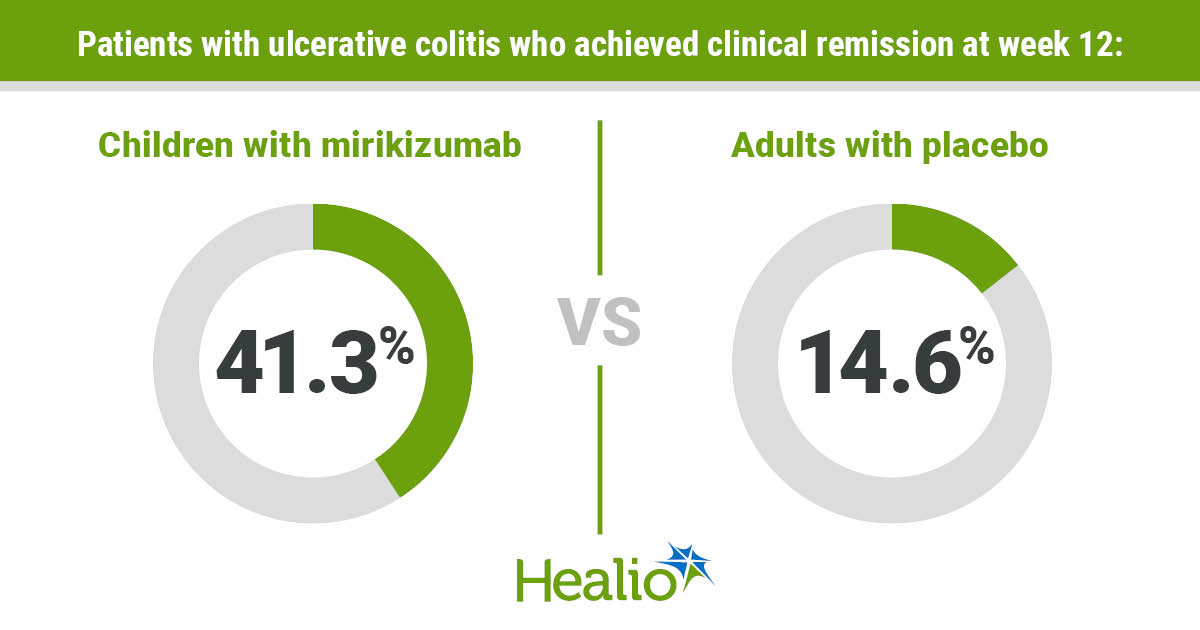
- About 41% of pediatric patients treated with mirikizumab achieved clinical remission, compared with 15% of adults receiving placebo.
- Mirikizumab also was associated with endoscopic and symptomatic remission.
NASHVILLE, Tenn. — Among children with ulcerative colitis, mirikizumab achieved clinical and endoscopic remission rates exceeding those of historical adult outcomes with placebo at week 12, according to data presented.
Researchers also reported associations between mirikizumab (Omvoh, Eli Lilly & Co.) and clinical, symptomatic and endoscopic responses at this time point, as well as a reduction in fecal calprotectin levels.

Data derived from Dubinsky MC, et al. Mirikizumab induction therapy achieves early clinical, endoscopic, and biomarker improvement in children and adolescents with moderately to severely active ulcerative colitis: Week 12 results from the SHINE-2 study. Presented at ACG Annual Scientific Meeting; Oct 12-14; Nashville, Tenn. (hybrid meeting).
“Simply put, we have very limited advanced therapy options for pediatric patients,” Marla C. Dubinsky, MD, chief of pediatric gastroenterology and nutrition at Mount Sinai Kravis Children’s Hospital and codirector of the Susan and Leonard Feinstein Inflammatory Bowel Disease Clinical Center at Mount Sinai, told attendees at ACG Annual Scientific Meeting. “We just had antiTNF until not too long ago, when we had ustekinumab approved.
“So here, we’re excited to talk about — hopefully — the next new advanced therapy for pediatric UC,” she added.
The phase 3, open-label SHINE-2 study enrolled 63 children aged 2 to 17 years (58.7% girls; mean age, 13.2 years; mean weight, 48.3 kg) with at least a 3-month diagnosis of moderately to severely active UC, confirmed by endoscopy. Eligible patients had inadequate or lost response or intolerance to at least one conventional or advanced therapy.
Participants received three weight-based IV induction doses of mirikizumab at 4-week intervals, followed by subcutaneous maintenance every 4 weeks. Induction doses ranged from 5 mg/kg for patients weighing less than 40 kg to 300 mg for those weighing more than 40 kg. Maintenance doses ranged from 50 mg to 200 mg based on weight.
“What differentiates the way we study pediatric IBD is weight and weight matching, exposure response matching and [pharmacokinetic] modeling, so it gets a little bit tricky when we’re trying to ensure that we have the right dose,” Dubinsky said.
The primary endpoint was clinical remission at week 52, based on modified Mayo score, among week 12 clinical responders. Other endpoints included change in fecal calprotectin at week 12; pharmacokinetic measures; clinical, endoscopic and symptomatic remission and response, and Pediatric Ulcerative Colitis Activity Index (PUCAI) scores.
The researchers compared SHINE-2 outcomes with corresponding results from the phase 3 LUCENT-1 study of mirikizumab in adult patients with UC.
“The closer we are to mirroring what we see with adults, the better it is for pediatric patients, and why we use the same inclusion criteria and same outcome measures,” Dubinsky said.
The study met its primary endpoint of clinical remission at week 52 (50%), which exceeded the placebo rate (26.6%) and was comparable to the mirikizumab rate (50.7%) among adults in LUCENT-1.
At week 12 in SHINE-2, clinical remission rates with mirikizumab induction also exceeded those of adults on placebo in LUCENT-1 (41.3% vs. 14.6%). Similar results were reported for clinical response (81% vs. 43.4%), endoscopic remission (25.4% vs. 4.5%) and endoscopic improvement (50.8% vs. 21%).
Overall PUCAI clinical remission and response rates reached 58.7% and 87.3%, respectively, in SHINE-2. More than a third (38.1%) of patients achieved symptomatic remission at week 4, which nearly doubled (69.8%) by week 12.
“When you look at symptomatic response, you can also see that we achieved faster, better depth of symptomatic response in children than we did with adults,” Dubinsky said.
Change in fecal calprotectin from baseline to week 12 was –1,229.9 µg/g among pediatric patients in SHINE-2 vs. –124 µg/g among placebo recipients in LUCENT-1.
The safety profile of induction mirikizumab in SHINE-2 was comparable to established safety data from previous studies.
“From a safety perspective, there’s absolutely nothing new to see here,” Dubinsky said.
Two serious adverse events occurred, a large intestinal polyp and a UC flare, the latter of which led to discontinuation.
Mirikizumab exposures among children in SHINE-2 were generally comparable across weight subgroups, according to the researchers.
“Modeled across different age groups … with the exception of a few that fell under the lower limit of quantification, the dose was matched correctly for all weight groups in pediatric patients in this trial,” Dubinsky said.
The researchers acknowledged study limitations, including the small sample size of patients in the lowest weight category.
“In summary, SHINE-2 met its primary efficacy objective in week 52, supporting its efficacy in pediatric UC,” Dubinsky told attendees. “We saw meaningful endpoints, even endoscopy, as early as week 12, symptomatic response as early as week 4, well tolerated and [pharmacokinetic] exposure. Remember: We got the dose right.”
Sources/Disclosures
Source:
Dubinsky MC, et al. Mirikizumab induction therapy achieves early clinical, endoscopic, and biomarker improvement in children and adolescents with moderately to severely active ulcerative colitis: Week 12 results from the SHINE-2 study. Presented at ACG Annual Scientific Meeting; Oct 12-14; Nashville, Tenn. (hybrid meeting).
Disclosures:
Dubinsky reports consulting roles with AbbVie, Arena Pharmaceuticals, Boehringer Ingelheim, Bristol Myers Squibb, Celgene Corp., Eli Lilly & Co., F. Hoffmann-La Roche, Genentech, Gilead Sciences, Janssen, Pfizer, Prometheus Laboratories, Takeda Pharmaceuticals and UCB Inc.; research support from AbbVie, Janssen, Pfizer and Prometheus Laboratories; royalties from Takeda Pharmaceuticals; and stock options in Trellus Health.

Ask a clinical question and tap into Healio AI’s knowledge base.
- PubMed, enrolling/recruiting trials, guidelines
- Clinical Guidance, Healio CME, FDA news
- Healio’s exclusive daily news coverage of clinical data