October 21, 2026
2 min read

Key takeaways:
- More than half of early childhood HBV exposures may be missed under new CDC guidelines.
- “It is important that other sources of potential exposure are not ignored,” a researcher said.
WASHINGTON — A new retrospective cohort study revealed that more than half of early childhood exposures to hepatitis B virus come from household members other than the birth mother.
Researcher Karen B. Jacobson, MD, MPH, said the study’s shows that delaying HBV vaccination based strictly on maternal status puts infants at risk from other household members.

Data derived from Jacobson K, et al. Household exposure to hepatitis B virus in children <5 years. Presented at: IDWeek; Oct. 21-24, 2026; Washington.
Last year, the CDC’s Advisory Committee on Immunization Practices voted to end a 34-year federal policy recommending universal HBV vaccination for all medically stable newborns within 24 hours of birth and instead recommended the birth dose be given only to infants born to mothers with active HBV infections or unknown status.
That recommendation — and all the others made by the new-look ACIP last year — remain blocked by a federal judge, pending appeal.
“The most recently proposed guidelines are really focusing on that maternal exposure, and I think it is important that other sources of potential exposure are not ignored,” Jacobson told reporters during a press briefing ahead of IDWeek.
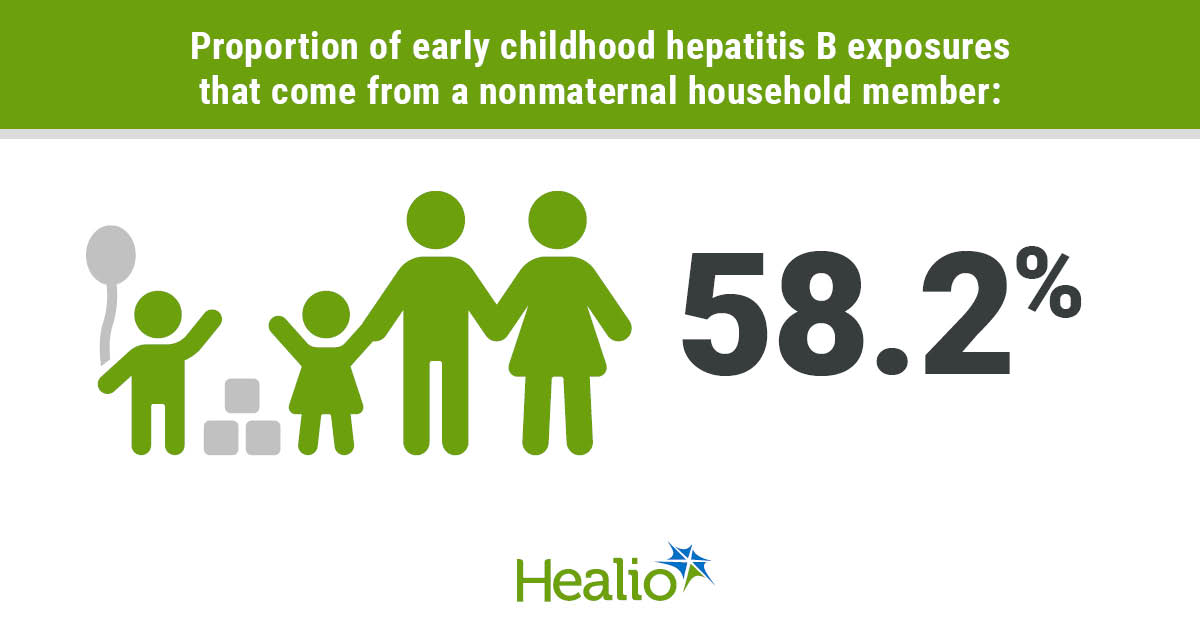
For their study, Jacobson and colleagues analyzed the medical records of more than 158,000 children aged younger than 5 years and identified 2,024 living with someone with an active HBV infection. Among them, 58.2% were exposed to the virus not at birth but by a household contact who was not the birth mother, researchers found. Most of the nonmaternal contacts — 76.5% — were male, with a median age of 44.
The CDC advises that vaccination as “the best way” to prevent HBV, a contagious viral infection that causes inflammation and damage to the liver and can develop into a chronic lifelong condition.
The Infectious Diseases Society of America rebuked last year’s ACIP vote, saying in a statement, “Eliminating the universal birth dose recommendation will end a public health practice that has prevented 95% of new hepatitis B infections and an estimated 90,100 deaths in the United States.”
“Our study just highlights the importance of being very comprehensive in how we think of exposures and knowing that the risk is not just limited to that perinatal period,” she said.
In terms of overall protection, the study showed 100% of infants born to HBV-positive mothers received a vaccine within 7 days of birth, but the rate dipped to 93.5% for children exposed via other household members and 86.7% for unexposed children.
Jacobson pointed out that HBV transmission to children from nonmaternal sources remains “quite rare in the United States” due to the high vaccination rates, but she fears “more infants could be at risk” if vaccination rates begin to fall.
Perspective

These findings highlight an important limitation of relying solely on maternal hepatitis B status to determine whether an infant should receive a birth dose of hepatitis B vaccine. HBV can remain infectious on environmental surfaces for days, and household transmission during childhood outside the perinatal period has been well documented. Universal vaccination of neonates has long served as a safeguard against HBV transmission from both perinatal exposure and infected household contacts. Although the study does not establish that household transmission occurred, it sheds light on “hidden” exposures that may be missed if broader household risks are not carefully considered in vaccination policy.
Kengo Inagaki, MD
Disclosures: Inagaki reports no relevant financial disclosures.
Sources/Disclosures
Source:
Jacobson K, et al. Household exposure to hepatitis B virus in children <5 years. Presented at: IDWeek; Oct. 21-24, 2026; Washington.
References:
Disclosures:
Jacobson reports receiving grant and research support from Pfizer.

Ask a clinical question and tap into Healio AI’s knowledge base.
- PubMed, enrolling/recruiting trials, guidelines
- Clinical Guidance, Healio CME, FDA news
- Healio’s exclusive daily news coverage of clinical data