October 22, 2026
3 min read

Key takeaways:
- Tegoprazan 50 mg and 100 mg outperformed placebo in 24-hour and nighttime heartburn frequency, as well as in days without regurgitation.
- Results persisted through 20 weeks.
NASHVILLE, Tenn. — Tegoprazan demonstrated significant improvements in 24-hour and nighttime heartburn among patients with nonerosive reflux disease, with numerical differences from placebo as early as day 1, according to a presenter.
Study results presented at ACG Annual Scientific Meeting also showed once-daily tegoprazan — a rapid-onset potassium-competitive acid blocker, or P-CAB, with sustained acid control —improved regurgitation over the 4-week treatment period.

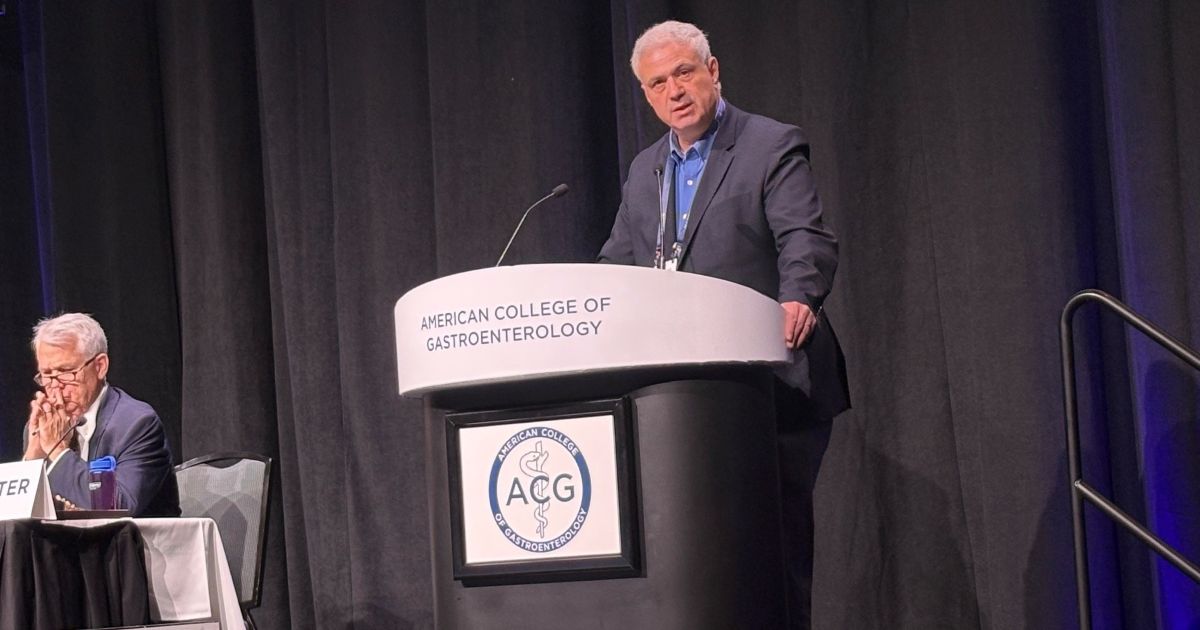
Ronnie Fass, MD, MACG, speaks at the podium at ACG Annual Scientific Meeting. Photo: Heather Biele.
Nearly 70% of patients with GERD present with nonerosive reflux disease (NERD), according to study background. However, symptom relief reaches only about 50% with standard-dose proton pump inhibitors, the researchers wrote.
“NERD can be particularly challenging because many patients continue to experience symptoms despite available therapy, and those symptoms aren’t limited to daytime heartburn,” Ronnie Fass, MD, MACG, medical director of the Digestive Health Center at MetroHealth in Cleveland, told Healio regarding the presentation. “Regurgitation and overnight heartburn can also be major contributors to symptom burden.”
Fass and colleagues conducted a phase 3, multicenter trial to evaluate the efficacy and safety of tegoprazan vs. placebo among adults with symptomatic NERD.
Eligible participants had at least a 6-month history of heartburn, normal esophageal mucosa on endoscopy and heartburn duration on at least 4 of 7 consecutive days.
The researchers enrolled 783 patients who were randomly assigned to tegoprazan 50 mg (n = 259), 100 mg (n = 262) or placebo (n = 262) for weeks 1 to 4. An extension phase followed from weeks 5 to 24, in which patients assigned tegoprazan 50 mg (n = 231) or 100 mg (n = 228) continued treatment, and those assigned placebo switched to tegoprazan 50 mg (n = 115) or 100 mg (n = 123).
Demographics were balanced across groups (mean age, 51-52.7 years; women, 65%-74%), as was heartburn severity score (mean, 1.5-1.6).
The percentage of 24-hour days without heartburn through week 4 served as the primary endpoint. Other endpoints included percentage of days without overnight heartburn, regurgitation or both.
Tegoprazan outperformed placebo in percentage of 24-hour heartburn-free days at both 50 mg (26.2% vs. 17.3%, P = .0006) and 100 mg doses (30.1% vs. 17.3%, P < .0001), for improvements over placebo of 51% and 74%, respectively.
Results for percentage of regurgitation-free days were similar, with tegoprazan 50 mg besting placebo by 35% (31.9% vs. 23.6%, P = .0012) and tegoprazan 100 mg outperforming placebo by 43% (33.8% vs. 23.6%, P < . 0001).
Both 50 mg and 100 mg tegoprazan doses also increased the percentage of days without daytime heartburn (36% and 38.4% vs. 27.4%) and nighttime heartburn (36.1% and 39.9% vs. 27%), as well as days without both heartburn and regurgitation (24.5% and 27% vs. 15.3%).
“Numerical differences from placebo were apparent from day 1, and symptom control continued through the 20-week extension phase,” Fass said. “That provides a more complete picture of symptom control and better reflects what we see in clinical practice than looking at heartburn alone.”
The percentage of 24-hour heartburn-free days increased among patients who continued tegoprazan 50 mg (47.8%) and 100 mg (50.4%) in the extension phase, as did those of patients who switched from placebo to 50 mg (40.2%) or 100 mg (48.3%).
The researchers noted that mean gastric levels increased during both trial phases but remained within normal limits and returned to baseline levels with 2 weeks of treatment discontinuation.
Treatment-emergent adverse events during the first 4 weeks were similar across groups, ranging from 22.9% with placebo and tegoprazan 100 mg to 27% with tegoprazan 50 mg.
Fass emphasized that these patients had frequent NERD symptoms —6% to 8% 24-hour heartburn-free days at baseline — which should be considered when reviewing these results and comparing outcomes across other NERD trials.
Still, “these data add to the evidence for tegoprazan across both erosive and nonerosive manifestations of GERD,” Fass told Healio.
“If approved, tegoprazan could provide another option for clinicians seeking rapid and more comprehensive symptom control in patients with NERD.”
For more information:
Ronnie Fass, MD, MACG, is director of gastroenterology and hepatology at MetroHealth and professor of medicine at Case Western Reserve University School of Medicine. He can be reached at gastroenterology@healio.com.
Sources/Disclosures
Source:
Fass R, et al. Tegoprazan significantly improves heartburn and regurgitation in a randomized, double-blind, placebo-controlled phase 3 study in patients with nonerosive reflux disease. Presented at: ACG Annual Scientific Meeting; Oct. 12-14, 2026; Nashville, Tenn. (hybrid meeting).
Disclosures:
Fass reports an advisory or review panel role with Braintree Laboratories/Sebela Pharmaceuticals. Please see the study for all other authors’ relevant financial disclosures.

Ask a clinical question and tap into Healio AI’s knowledge base.
- PubMed, enrolling/recruiting trials, guidelines
- Clinical Guidance, Healio CME, FDA news
- Healio’s exclusive daily news coverage of clinical data