October 23, 2026
4 min read

Key takeaways:
- ASH released new guidelines to improve iron deficiency diagnosis.
- Higher serum ferritin thresholds for multiple at-risk groups are intended to overcome variations in testing and diagnostic criteria.
ASH has released new clinical practice guidelines designed to improve diagnosis of iron deficiency, the most common nutritional deficiency in the world.
The guidelines recommend higher thresholds of serum ferritin — a protein that stores iron in cells — to improve diagnosis in multiple at-risk populations.

Data derived from Powers J, et al. Blood Adv. 2026;doi:10.1182/bloodadvances.2025015950.
The goal is to overcome variations in testing practices and diagnostic criteria to increase the likelihood that iron deficiency is identified earlier and more accurately, regardless of whether anemia is present.

Angela C. Weyand
“This condition affects billions of people worldwide. We know it can cause debilitating symptoms, and there are inexpensive, readily available medications to treat it, yet we’re not really doing anything about it,” guideline co-author Angela C. Weyand, MD, pediatric hematologist and clinical professor of pediatrics at University of Michigan Medical School, told Healio. “It is underdiagnosed, undertreated and understudied. In that sense, these guidelines are a huge step forward.”
A problem before anemia
Iron plays an essential role in hemoglobin production. It also regulates the immune system and supports brain function, according to background information provided in the guideline.
About 14% of U.S. adults have absolute iron deficiency, meaning the body has run out of stored iron, according to a study by Tawfik and colleagues. Another 15% have functional iron deficiency, meaning sufficient iron is stored but it is trapped by inflammation, reducing the body’s ability to use it, the researchers continued.
Guideline study background also specified that children and individuals who are pregnant or menstruating are at elevated risk, as are people with dietary restrictions, blood loss, or chronic conditions such as heart failure, kidney disease, inflammatory bowel disease or cancer.
However, the majority of cases in high-risk populations go undiagnosed, Weyand said. If untreated, it can progress to iron deficiency anemia, which impairs oxygen transport in the body and can lead to life-threatening complications.
“In medical school, most physicians learned about iron deficiency in the context of anemia,” Weyand said. “But iron plays so many other important roles in the body, and people don’t become anemic until they are severely iron deficient. There hasn’t been enough focus on the problems this can cause long before patients become anemic.”
Several factors may contribute to underdiagnosis, Weyand said.
Symptoms of iron deficiency — which include extreme fatigue, rapid heartbeat, shortness of breath, pale skin or headaches — can overlap with other conditions or may be attributed to psychosocial causes. Lack of consensus recommendations also has a role, Weyand said, noting neither the U.S. Preventive Services Task Force nor American College of Obstetricians and Gynecologists recommend iron screening during pregnancy.
Higher ferritin thresholds
Even when screening is performed, the ferritin thresholds used to diagnose iron deficiency vary widely.
CDC and WHO use 15 ng/mL as the diagnostic threshold, but some physiologic studies of iron status and metabolism demonstrated thresholds of 25 ng/mL to 30 ng/mL — and possibly as high as 50 ng/mL — offer greater sensitivity.
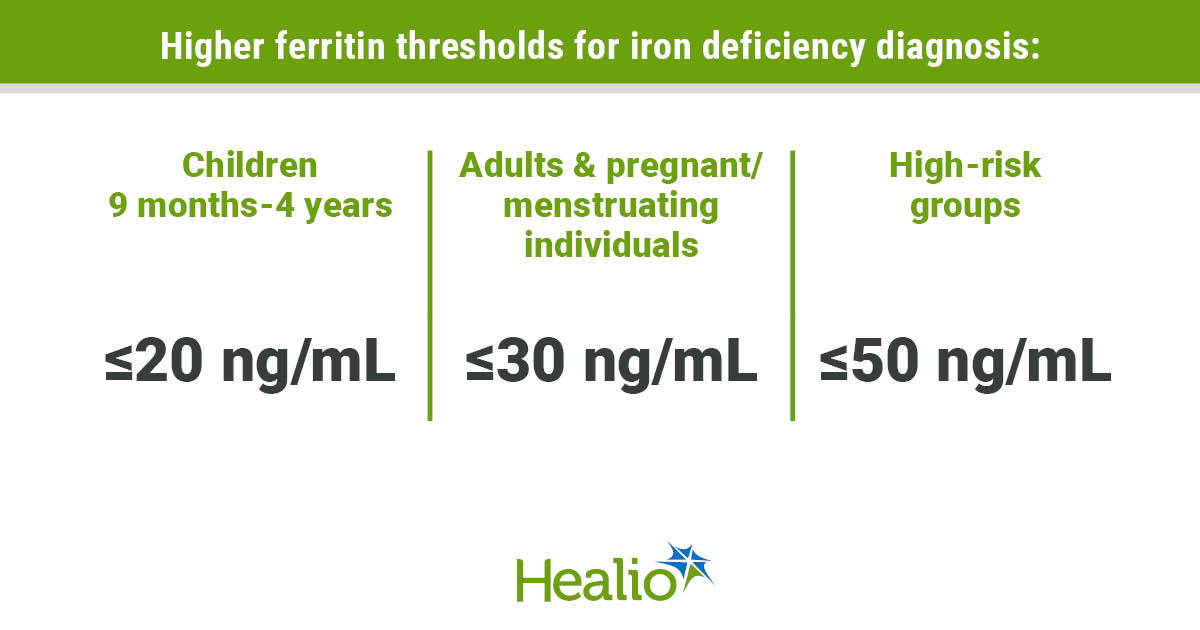
The ASH guidelines aim to provide some clarity by issuing conditional recommendations that suggest higher diagnostic serum ferritin thresholds for high-risk groups, including:
- 20 ng/mL or lower for children ages 9 months to 4 years, instead of 12 ng/mL or lower;
- 30 ng/mL or lower for adults and pregnant/menstruating individuals, instead of 15 ng/mL or lower;
- 50 ng/mL or lower for high-risk groups, such as those with heavy menstrual bleeding or pregnant individuals with anemia.
Adults with inflammation — including those with infectious disease, cancer or inflammatory bowel disease — also are at risk. However, because inflammation is on a continuum, establishing a serum ferritin threshold for iron deficiency diagnosis has proved challenging. The guidelines recommend using a serum ferritin threshold of 100 ng/mL or lower, or a transferrin saturation below 20% for this group.
Guideline authors emphasized the need for more evidence to strengthen the current conditional recommendations. Ideally, they would have found evidence to support thresholds of 50 ng/mL for all at-risk groups, Weyand said.
“Because this topic has been underfunded and understudied for so long, we did not have the quality of evidence or caliber of studies needed to support that,” she said. “Another challenge is that we are relying on ferritin. It is the best option we have but, like most of our markers, it is imperfect. We are measuring what we can in the blood, but iron is important in so many different tissues and organs in our body. We don’t know anything about what iron is getting to our brain or to our muscles.”
‘No downside to checking’
An important next step will be spreading awareness in the clinical community about the ASH guidelines, as well as American Academy of Pediatrics guidelines issued earlier this year that recommend universal iron deficiency and iron deficiency anemia screening for all menstruating adolescent females who are at least 1 year post menarche, with screening to be done by age 14 years.
“The biggest takeaway for the clinical community is how prevalent this is, and remembering iron is important to consider before anemia develops,” Weyand said.
Clinicians should be mindful that widely used reference levels are “suboptimal,” Weyand said. This means some patients who previously underwent ferritin tests that did not identify them as iron deficient now may meet the more stringent criteria.
She also emphasized ferritin is not a standard component of complete blood count (CBC), noting some studies suggest CBCs miss more than 80% of people with iron deficiency.
“There are some groups for whom prevalence is so high that, if there is any concern whatsoever, there is really no downside to checking ferritin,” Weyand said. “This is so highly prevalent that we should be doing more universal screening.”
Treatment options for iron deficiency include oral iron supplementation, IV iron or blood transfusions. However, the goal should be to address the underlying cause, Weyand said.
“Iron deficiency is something that every doctor will see in their practice at some point,” Weyand said. “It sometimes gets missed that iron deficiency is not really a disease itself. It is a symptom of something else. If you don’t treat the underlying cause, you can end up in a never-ending cycle of infusions or supplements, and it sometimes can be impossible to make the patient better.”
For more information:
Angela C. Weyand, MD, can be reached at acweyand@med.umich.edu.
Sources/Disclosures
Source:
Powers JM, et al. Blood Adv. 2026;doi:10.1182/bloodadvances.2025015950.
References:
Disclosures:
Weyand reports having financial relationships with Bayer Healthcare, Genentech, Hema Biologics, Hemab Therapeutics, Novo Nordisk, Octapharma, Pfizer, Sanofi, Sobi and Takeda. Please see the guideline for all other authors’ relevant financial disclosures.

Ask a clinical question and tap into Healio AI’s knowledge base.
- PubMed, enrolling/recruiting trials, guidelines
- Clinical Guidance, Healio CME, FDA news
- Healio’s exclusive daily news coverage of clinical data