October 28, 2026
2 min read

Key takeaways:
- Saroglitazar showed superior biochemical and pruritus response in U.S. vs. non-U.S. patients with PBC.
- ALP normalization rates were similar between groups despite greater ALP reductions in U.S. patients.
NASHVILLE, Tenn. — Patients in the U.S. with primary biliary cholangitis exhibited greater biochemical response and improvement in pruritus with saroglitazar magnesium than non-U.S. patients, according to data presented here.
Despite slightly higher baseline liver enzyme levels for U.S. patients, alkaline phosphatase normalization rates were similar between U.S. and non-U.S. groups.

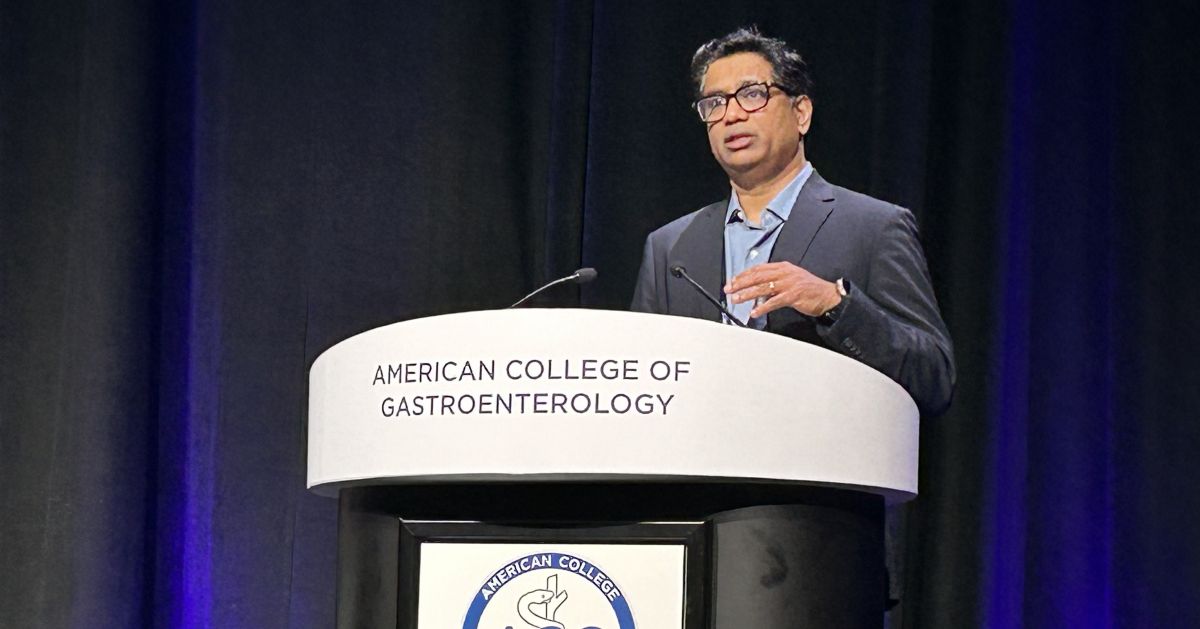
Raj K. Vuppalanchi, MD, FACG, speaks at the podium during ACG Annual Scientific Meeting. Photo: Robert Stott.
“Saroglitazar is PPAR-alpha/gamma agonist with an interesting targeting pathway in the pathogenesis of PBC,” Raj K. Vuppalanchi, MD, FACG, director of hepatology at Indiana University School of Medicine, told attendees at ACG Annual Scientific Meeting. “[Saroglitazar primarily acts] as a PPAR-alpha agonist [which] results in beneficial effects through bile acid homeostasis and decreasing cholestatic inflammation. It also has a modest PPAR-gamma effect, which results in potential benefits through anti-inflammatory and possibly antifibrotic effects.”
In findings from the phase 2b/3 EPICS-III trial presented at EASL Congress earlier this year, Vuppalanchi and colleagues reported that saroglitazar 1 mg (Zydus Therapeutics) significantly improved biochemical response in patients with PBC. At week 52, 56.7% of patients receiving saroglitazar achieved the primary endpoint, compared with 9.8% on placebo. Complete ALP normalization, the key secondary endpoint, was achieved by 8.2% of patients treated with saroglitazar vs. none who received placebo (P = .016).
“To see if patients in the United States have consistent treatment response compared to the rest of the world,” Vuppalanchi and colleagues conducted a post hoc analysis of the EPIC-III trial. The researchers compared outcomes among 42 participants in the U.S. — 28 randomly assigned to saroglitazar and 14 to placebo — with those from 106 participants from outside the U.S., including 69 who received saroglitazar and 37 who received placebo.
Baseline demographic and disease characteristics were generally comparable between the regional subgroups, although median baseline ALP was slightly higher among participants in the U.S. compared with non-U.S. participants (302 U/L vs. 287 U/L).
At week 52, saroglitazar outperformed placebo for composite biochemical response among both U.S. and non-U.S. participants, with a greater placebo-adjusted treatment difference reported in the U.S. subgroup (60.7% vs. 41.6%).
“The primary endpoint that we saw was that composite biochemical response favors saroglitazar in both the U.S. and non-U.S. regions, but the larger treatment difference was seen in the U.S. population,” Vuppalanchi said.
At week 52, saroglitazar produced a greater mean reduction in ALP among participants in the U.S. vs. those outside the U.S. (–166.2 U/L vs. –104.7 U/L). However, ALP normalization rates were similar between the subgroups (7.1% vs. 8.7%). At week 24, the treatment difference in 5-D itch score also demonstrated a greater reduction in the U.S. subgroup (–4.4 vs. –2.8).
“This exploratory regional analysis of the EPICS-III trial shows saroglitazar favored over placebo in both U.S. and non-U.S. populations, but the treatment differences in the U.S. population were numerically higher compared to the non-U.S. population,” Vuppalanchi said. “Although ALP normalization rates were similar, the treatment differences in the 5-D itch score also appeared to be higher in the U.S. subgroup, and saroglitazar was well tolerated and demonstrated a great safety profile.”
Sources/Disclosures
Source:
Vuppalanchi RK, et al. Greater treatment response to saroglitazar in US versus non-US patients with primary biliary cholangitis: A geographic subgroup analysis of the phase 3 EPICS-III trial. Presented at: ACG Annual Scientific Meeting; Oct 12-14, 2026; Nashville, Tenn. (hybrid meeting).
Disclosures:
Vuppalanchi reports an advisory board role with and grant/research support from Takeda Pharmaceuticals and grant/research support from Eli Lilly & Co. and Zydus Therapeutics. Please see the study for all other authors’ relevant financial disclosures.

Ask a clinical question and tap into Healio AI’s knowledge base.
- PubMed, enrolling/recruiting trials, guidelines
- Clinical Guidance, Healio CME, FDA news
- Healio’s exclusive daily news coverage of clinical data