October 30, 2026
2 min read

Key takeaways:
- Guselkumab reduced inflammation in the intestinal lining in patients with moderate to severe UC.
- These improvements persisted for nearly 3 years.
NASHVILLE, Tenn. — The dual-acting interleukin-23 inhibitor guselkumab improved histologic outcomes in patients with moderately to severely active ulcerative colitis over a 3-year span, according to a presenter here.
“We certainly have had an increased appreciation and understanding for the role of histological inflammation and healing in patients with ulcerative colitis,” David T. Rubin, MD, FACG, director of the Inflammatory Bowel Disease Center at University of Chicago Medicine, told attendees at ACG Annual Scientific Meeting. “And the actual correlation between histology, endoscopy and symptoms hasn’t been fully clarified, nor have we settled on whether we should be treating the histological endpoints for our treatment goals.”

While some clinical trials have shown histologic outcomes in patients with UC, researchers noted that not much is known about the long-term effects of guselkumab (Tremfya, Johnson & Johnson).
The study included patients with moderately to severely active UC incrementally over the course of about 3 years to understand how the drug reduced inflammation in the lining of the colon in the long term.
Patients were first given 200 mg or 400 mg guselkumab every 4 weeks over a 12-week induction phase, and those who achieved a clinical response were randomly assigned to one of two maintenance doses: either100 mg of guselkumab every 8 weeks or 200 mg every 4 weeks, or placebo. Researchers took biopsy samples at the beginning of the study and then at 44 weeks, 92 weeks and 140 weeks, and the samples were assessed with a Geboes score to measure inflammation.
After the initial 12 weeks, about 63% of patients in the 100 mg group and 64% of patients in the 200 mg group displayed lower levels of tissue inflammation.
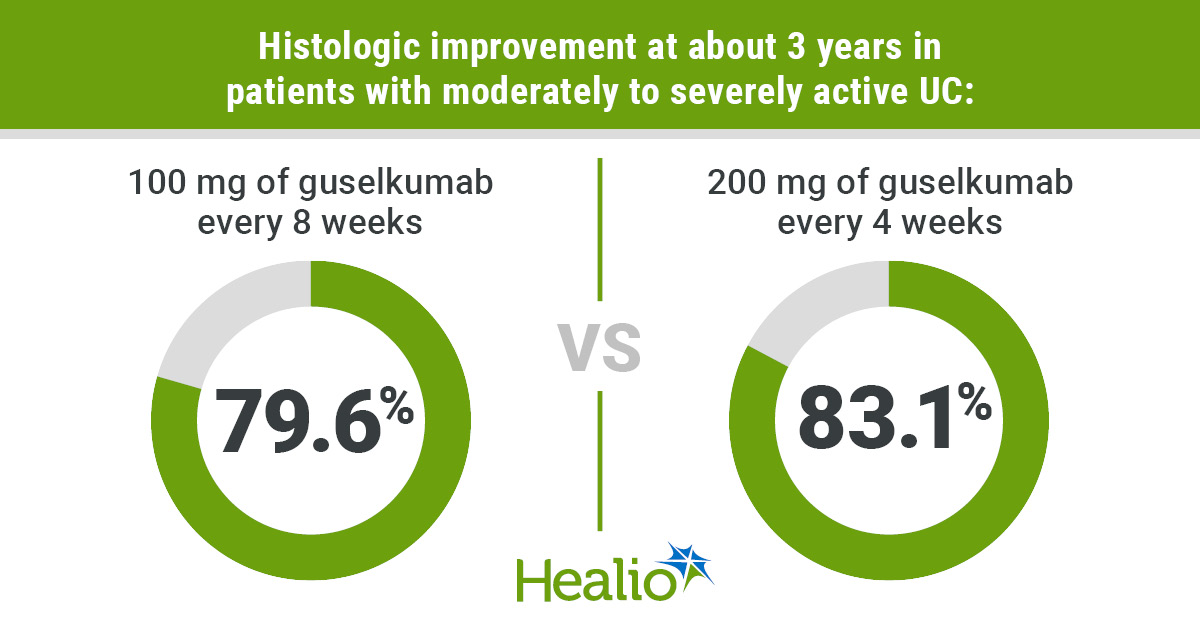
There was continued improvement at 44 weeks, with 76.6% of patients in the 100 mg group and 83.9% of patients in the 200 mg group showing lower levels of tissue inflammation. This was maintained through the 144-week mark, with 79.6% of the 100 mg group and 83.1% of the 200 mg group showing improvement.
Patients who entered the study with severe inflammation (28.4% in the 100 mg group and 26.1% in the 200 mg group) saw significant improvement over 140 weeks, with 3.6% of the 100 mg group and 2.3% of the 200 mg group still displaying severe inflammation during that period.
Of the patients who achieved histologic remission after the 12-week induction period (56.4% in the 100 mg group and 57.3% in the 200 mg group), a majority remained in remission at the 140-week point (75.9% in the 100 mg group and 81.3% in the 200 mg group).
These findings suggest that guselkumab reduced inflammation in the intestinal lining in patients who initially responded to treatment, and those improvements persisted for up to 3 years, Rubin and colleagues wrote.
“Approximately 40% of induction clinical responders had moderate to severe histologic activity when they started,” Rubin said. “The improvement was observed after 1 year and continued, and even increased slightly, by 3 years.”
Sources/Disclosures
Source:
Rubin DT, et al. Histology outcomes over time in patients with moderately to severely active ulcerative colitis treated with guselkumab in the QUASAR long-term extension study. Presented at: ACG Annual Scientific Meeting; Oct. 12-14; 2026; Nashville, Tenn. (hybrid).
Disclosures:
Rubin reports consulting, advisory and/or speakers bureau roles with, grant/research support from or stock options in AbbVie, Abivax, AltruBio, Apex, Athos Therapeutics, Avalo, Bristol Myers Squibb, Celgene, Celltrion, ClostraBio, Cornerstones Health Inc., Eli Lilly & Co., Genentech/Roche, Iterative Health, Johnson & Johnson, Merck, Mirador, Odyssey Therapeutics, Palisade Bio, Pfizer, Sanofi, Spyre, Takeda Pharmaceuticals, TRx Biosciences, Vedanta Biosciences and Ventyx Biosciences. He also reports serving on the board of directors of Cornerstones Health Inc. and Crohn’s & Colitis Foundation. Please see the study for all other authors’ relevant financial disclosures.

Ask a clinical question and tap into Healio AI’s knowledge base.
- PubMed, enrolling/recruiting trials, guidelines
- Clinical Guidance, Healio CME, FDA news
- Healio’s exclusive daily news coverage of clinical data