
November 04, 2026
3 min read

Key takeaways:
- Adults with obesity who underwent bariatric surgery exhibited lower risk for several cancers than those who did not have the surgery.
- The cancer-protective benefits persisted regardless of sex or age.
Bariatric surgery can offer long-term cancer-protective effects for people with obesity regardless of their sex or age, findings of a population-based cohort study suggest.
An analysis of registry data from nearly 800,000 people showed those who underwent the procedure exhibited an overall significantly lower risk for 10 obesity-related malignancies.

Data derived from Radkiewicz C, et al. JAMA Surg. 2026;doi:10.1001/jamasurg.2026.4798.
The magnitude of risk reduction remained consistent between younger and older adults, and analyses that focused on cancer types that affect both sexes showed comparable benefits for men and women.

Cecilia Radkiewicz
“The primary indication for bariatric surgery is weight loss in individuals with obesity, not cancer prevention. However, because these findings show the reduction in obesity-related cancer risk is similar among men and women, and across age groups, they strengthen the evidence that access to bariatric surgery should be equitable whenever it is clinically indicated,” lead author Cecilia Radkiewicz, MD, PhD, medical oncologist and researcher in the department of molecular medicine and surgery at Karolinska Institutet in Stockholm, told Healio.
A closer examination
The CDC has linked obesity to 13 malignancies, which combined account for about 40% of all cancers diagnosed in the U.S. each year.
Radkiewicz and colleagues aimed to clarify the association between bariatric surgery and incidence of 10 obesity-related malignancies: breast, colon, endometrial, kidney, liver, ovarian, pancreatic and rectal cancers; esophageal adenocarcinoma; and multiple myeloma.
The researchers also assessed whether associations between bariatric surgery and obesity-related cancer risk varied between men and women, or by age at the time of surgery.
“Previous studies have shown that bariatric surgery reduces the risk of obesity-related malignancies overall; however, that association has appeared to be strongest among women and may be partly explained by hormone-driven cancers — like breast cancer, ovarian cancer or endometrial cancer — that primarily affect women,” Radkiewicz said. “We wanted to examine more closely whether there were differences between men and women by focusing on cancers that affect both sexes. We also hypothesized that the effect of bariatric surgery would be stronger among individuals who underwent surgery at a younger age, given the long latency between carcinogenic exposures and cancer development.”
The researchers used the Nordic Obesity Surgery Cohort (NordOSCo) — a large, multinational registry — to identify 784,105 people (73% women) aged 18 to 59 years in Denmark, Finland and Sweden.
All individuals had a record of obesity or underwent bariatric surgery between 1992 and 2023. Approximately 12.7% (n = 99,614) underwent bariatric surgery during follow-up.
Incidence of obesity-related cancers served as the primary outcome, with analyses adjusted for comorbidities such as diabetes, hypertension and COPD.
Consistent findings
Median follow-up ranged from 6.4 years to 9.5 years.
Bariatric surgery appeared associated with a nearly 20% lower risk for any obesity-related cancer in the overall cohort (adjusted incidence rate ratio [aIRR] = 0.81; 95% CI, 0.77-0.85).
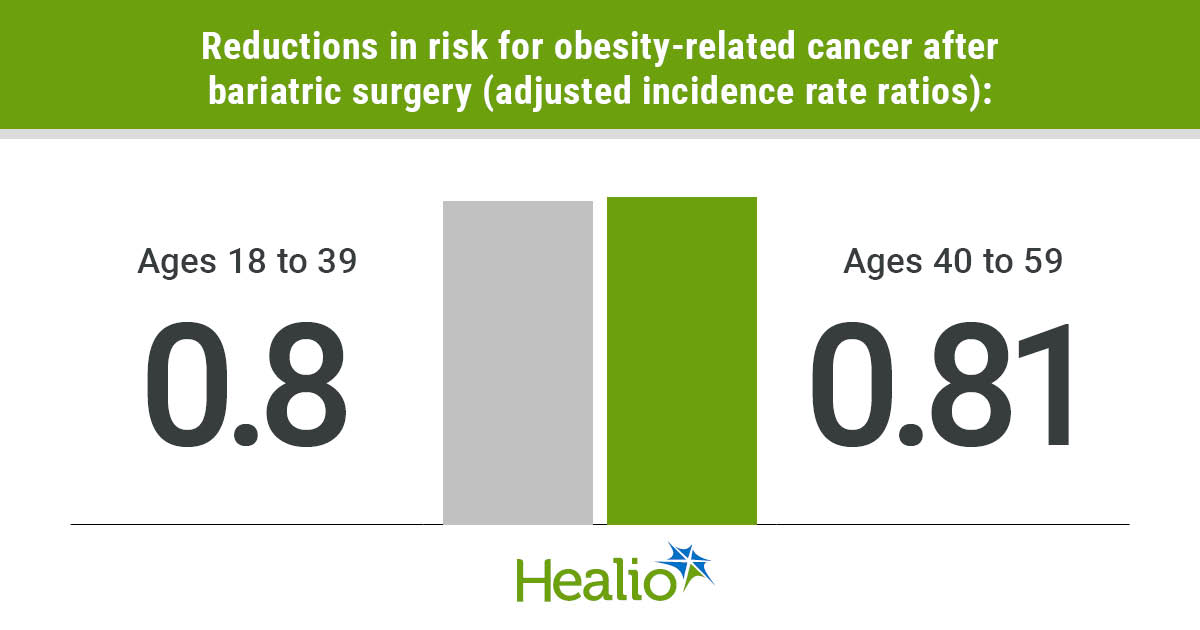
The magnitude of benefit remained consistent between individuals aged 18 to 39 years (aIRR = 0.8; 95% CI, 0.72-0.88) at the time of surgery and those aged 40 to 59 (aIRR = 0.81; 95% CI, 0.78-0.86).
When researchers restricted analyses to cancers that affect both sexes, results showed similar risk reductions among men and women.
Results showed the strongest inverse associations between bariatric surgery and incidence for liver cancer (aIRR = 0.49; 95% CI, 0.34-0.7), endometrial cancer (aIRR = 0.51; 95% CI, 0.45-0.59) and ovarian cancer (aIRR = 0.73; 95% CI, 0.6-0.87).
However, results showed what Radkiewicz described as a “surprisingly” elevated pancreatic cancer risk among individuals who underwent bariatric surgery, with the association most pronounced among younger adults (aIRR = 2.21; 95% CI, 1.44-3.39).
“Any potential underlying mechanisms remain unclear, and the observed association should be interpreted with caution, Radkiewicz said. “This finding needs to be replicated in other cohorts before any conclusions can be drawn.”
Long-term oncologic benefits
The researchers acknowledged study limitations, including the potential for residual or unmeasured confounding due to its observational design and the possibility that follow-up may not have been sufficient to capture long-latency cancers.
Investigators also lacked information about BMI — precluding adjustment for obesity severity — and potentially confounding lifestyle factors, such as smoking, diet, physical activity or alcohol consumption.
However, the findings suggest that bariatric surgery confers long-term oncologic benefits to men and women regardless of age and underscore how effective obesity treatment can contribute to long-term health, researchers concluded.
The researchers will continue to use the NordOSCo cohort, which is continuously updated and also includes data from Norway and Iceland, for additional research. The expanded cohort will further increase study power and facilitate investigations of a broad range of health outcomes related to obesity and bariatric surgery, including cancer risk, Radkiewicz said.
For more information:
Cecilia Radkiewicz, MD, PhD, can be reached at cecilia.radkiewicz@ki.se.
Sources/Disclosures
Source:
Radkiewicz C, et al. JAMA Surg. 2026;doi:10.1001/jamasurg.2026.4798.
References:
Disclosures:
Nordic Cancer Union, Region Stockholm, Swedish Cancer Society and Swedish Society of Medicine supported the study. Radkiewicz reports an unrestricted research grant from Amgen, as well as advisory board roles with NeoGAP, Pierre Fabre and Takeda. The other authors report no relevant financial disclosures.

Ask a clinical question and tap into Healio AI’s knowledge base.
- PubMed, enrolling/recruiting trials, guidelines
- Clinical Guidance, Healio CME, FDA news
- Healio’s exclusive daily news coverage of clinical data