
November 05, 2026
6 min read

Key takeaways:
- People living with diabetes have increased risk for hepatitis B virus.
- Vaccination and screening are key to HBV prevention and early detection.

Susan Weiner
In this Diabetes in Real Life column, Susan Weiner, MS, RDN, CDN, CDCES, FADCES, talks with Arpan Mohanty, MD, MSc, about why hepatitis B warrants greater attention in diabetes care and what to know about vaccination, screening and more.
Weiner: What is the clinical guidance for hepatitis vaccination for people living with diabetes?

Mohanty: The American Diabetes Association recommends hepatitis B virus vaccination for all adults with diabetes younger than 60 years. For those aged 60 years or older, vaccination should be considered based on individual risk factors, such as exposure risk, living situation and other health conditions, consistent with Advisory Committee on Immunization Practices guidance.
Weiner: What populations are at increased risk?
Mohanty: Adults with type 1 or type 2 diabetes have a higher risk for HBV. Among adults aged 19 to 59 years, the risk for acute infection is about twice that of people without diabetes. Diabetes may impair immune responses, reducing the likelihood of HBV clearance and increasing the risk for chronic infection. Risk may be especially high in long-term care settings or when blood glucose monitoring equipment is shared or not properly disinfected. In addition, vaccination is particularly important for people with diabetes, as they are more likely to develop metabolic dysfunction-associated steatotic liver disease (MASLD), which can lead to metabolic dysfunction-associated steatohepatitis (MASH), cirrhosis or liver cancer. Preventing HBV with vaccination helps protect a liver that may already be vulnerable.
Weiner: Describe the overlap of chronic kidney disease, diabetes, hypertension, inflammation and coordinated cardiometabolic management for people living with diabetes and hepatitis.
Mohanty: In patients with diabetes, hepatitis or liver inflammation most commonly results from viral infection, alcohol-associated liver disease or MASH, the inflammatory form of MASLD. MASLD and MASH frequently coexist with obesity, hypertension, dyslipidemia and CKD and should be viewed within the broader cardiovascular-kidney-metabolic (CKM) framework.
These conditions share common drivers, including insulin resistance, excess adiposity, endothelial dysfunction and chronic systemic inflammation. The relationship between MASLD and type 2 diabetes is bidirectional: Type 2 diabetes increases the risk for MASLD progression while MASLD may worsen insulin resistance and glycemic control. Consequently, MASLD, particularly when fibrosis is present, is associated not only with liver-related outcomes, including cirrhosis and hepatocellular carcinoma, but also with a higher risk for major adverse cardiovascular events.
Management should therefore be coordinated, rather than organ-specific. Therapies selected to improve glycemic control and protect the heart and kidneys may also reduce liver fat or injury while newer liver-directed treatments can slow or potentially reverse fibrosis in patients with MASH. Viral hepatitis also warrants prompt treatment. Hepatitis C virus cure may improve glycemic control and is associated with reduced kidney and CV complications. A coordinated CKM-liver strategy can therefore address shared risk factors while improving outcomes across the liver, heart and kidneys.
Weiner: Dialysis populations have historically experienced higher rates of HBV exposure. What enhanced infection control measures and monitoring situations should be implemented?
Mohanty: Patients receiving hemodialysis remain at increased risk for HBV and HCV because of frequent blood exposure, shared treatment environments and impaired immune function, which increases susceptibility to infection and reduces vaccine responsiveness. Prevention should begin before admission to an outpatient dialysis unit.
The CDC recommends baseline testing with hepatitis B surface antigen (HBsAg), antibody to hepatitis B surface antigen (anti-HBs) and antibody to hepatitis B core antigen (anti-HBc) for all patients starting hemodialysis. Susceptible patients should be vaccinated as early as possible, ideally before dialysis begins. For patients vaccinated after dialysis initiation, higher-dose regimens are recommended, followed by anti-HBs testing 1 to 2 months after series completion. Patients who do not achieve protective immunity should receive a second vaccine series. Ongoing HBV surveillance should be guided by immune status. Patients who remain susceptible should undergo monthly HBsAg testing, whereas vaccine responders should have anti-HBs levels checked annually and be revaccinated if titers fall below 10 IU/L. Patients with immunity from prior infection generally do not require additional routine HBV testing. In addition, patients should also be screened for HCV at dialysis initiation and every 6 months thereafter. Screening for viral hepatitis is also important when transferring to another dialysis center or changing treatment type, after a blood exposure, and whenever a new HBV case is identified in the unit.
Infection control within the dialysis unit is equally important. Standard precautions, meticulous hand hygiene, appropriate use of personal protective equipment, safe medication and injection practices, disinfection of dialysis stations and shared equipment, and maintenance of water quality should be consistently enforced. Patients who test positive for HbsAg should be promptly isolated and dialyzed using dedicated equipment, with unit-specific exposure protocols implemented to reduce transmission.
Weiner: How can hepatitis be prevented, detected and treated in the diabetes population? Which members of the healthcare team should support these efforts?
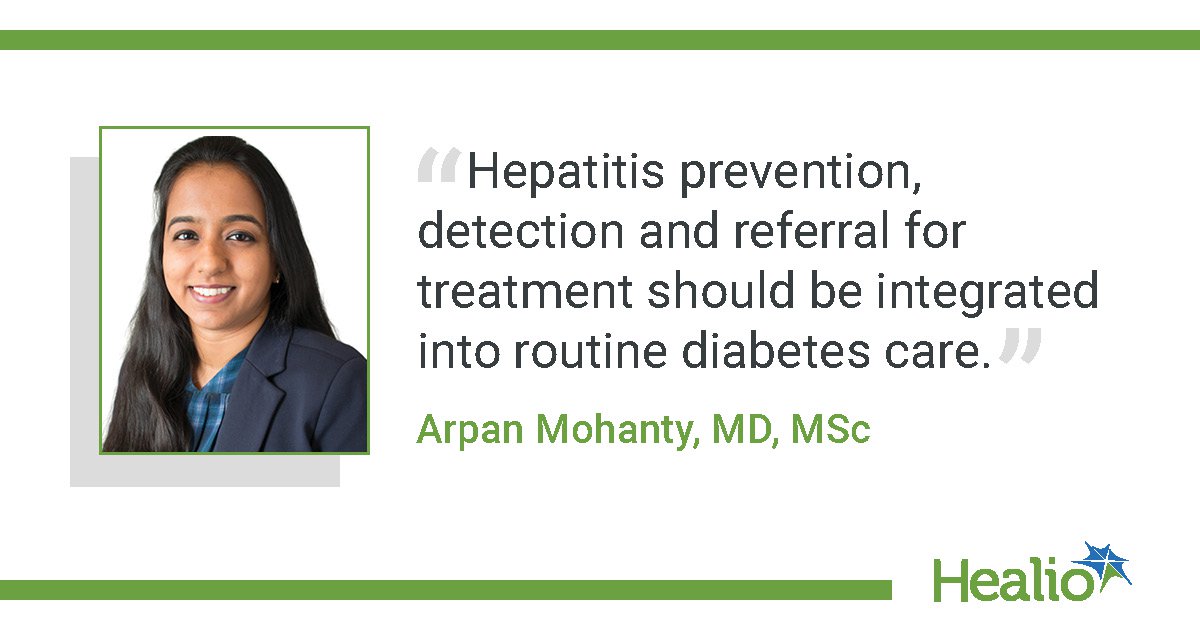
Mohanty: Hepatitis prevention, detection and referral for treatment should be integrated into routine diabetes care. The key steps are to assess vaccination status, complete recommended screening and ensure timely follow-up of positive results. Prevention begins with HBV vaccination. The ADA Standards of Care recommend vaccination for adults with diabetes aged younger than 60 years and individualized vaccination for those aged 60 years or older. Vaccine response may be reduced by older age, obesity, CKD, immunosuppression and diabetes itself. The two-dose CpG-adjuvanted vaccine (Heplisav-B, Dynavax) provides higher seroprotection and a shorter completion interval than conventional three-dose regimens. Postvaccination serologic testing is important when confirmation of immunity is clinically necessary, including for patients receiving hemodialysis, immunocompromised individuals and healthcare personnel.
Detection has been simplified by universal adult screening. All adults should undergo HBV screening at least once with HbsAg, anti-HBs and total anti-HBc, as well as one-time HCV antibody testing with reflex RNA testing. Repeat testing is indicated for those with ongoing risk. In diabetes care, the operational priority is to confirm that screening has been completed, document the results and establish a reliable follow-up pathway.
Patients with positive results should be referred promptly. Chronic HBV can be effectively suppressed, and HCV is curable in most patients, including those with advanced CKD. HCV cure may also improve glycemic control and reduce kidney and CV complications. Antiviral selection and monitoring may intersect with renal function, lipid management and glucose-lowering therapy.
The optimal model for hepatitis prevention and treatment often requires coordinated, interprofessional care, which depends on the clinical context and institutional resources. Primary care clinicians and endocrinologists can assess vaccination and screening status and initiate referrals while nurses, medical assistant and pharmacists can use standing orders, administer vaccines and track series completion. Diabetes care and education specialists can reinforce the relevance of hepatitis to diabetes outcomes; nephrology and dialysis teams can oversee dialysis-specific surveillance and infection control; and hepatology or infectious disease specialists can screen for hepatitis, manage confirmed infection and advanced liver disease. Each institution should establish a clear coordination point, assign responsibility for each step and embed hepatitis care within the diabetes pathway to prevent incomplete vaccination, missed results and unclosed referrals.
Weiner: How can we improve prevention, detection and treatment in underserved and at-risk communities?
Mohanty: Improving hepatitis prevention and care in underserved communities requires embedding services in the settings where people with diabetes already receive care, including primary care, endocrinology, pharmacies, dialysis units and diabetes education programs. Each setting should first identify its implementation gaps, such as low vaccination rates, incomplete screening or loss to follow-up, assess their magnitude and local causes, and tailor interventions accordingly.
Strategies to improve vaccination and screening include standing vaccination orders, opt-out testing and electronic health record prompts, which can reduce missed opportunities and help address disparities. Testing should also be available beyond traditional clinics through community health centers, mobile programs, shelters, correctional facilities, syringe-service programs and other settings that reach people with limited access to care.
Treatment access can be expanded through telehealth and task-shifting. Primary care clinicians, nurse practitioners and other trained nonspecialists can treat uncomplicated HCV with specialist support, allowing hepatology resources to focus on patients with cirrhosis, complex coinfection or treatment failure. Telehealth and Project ECHO (Extension for Community Healthcare Outcomes)-type models can extend expertise to rural and safety-net settings, although telephone-based options may be needed for patients with limited internet access.
Finally, improving outcomes requires addressing barriers that commonly interrupt care, including transportation, insurance coverage, medication costs, housing instability, limited health literacy and stigma. Community health workers, peer navigators, social workers and culturally and linguistically tailored education can help patients move from screening to treatment without being lost to follow-up. The most effective approach is a coordinated, context-specific system that combines easier access, automated workflows, community partnerships and clear ownership of follow-up.
Weiner: Is there current research available on other hepatitis treatments?
Mohanty: Research in MASH treatment is advancing rapidly, an especially important development for people with type 2 diabetes who are at high risk for MASLD/MASH and resultant progressive liver fibrosis. Resmetirom (Rezdiffra, Madrigal Pharmaceuticals), a thyroid hormone receptor-beta agonist, and semaglutide (Wegovy, Novo Nordisk), a GLP-1 receptor agonist, are now FDA-approved for adults with noncirrhotic MASH and moderate to advanced fibrosis, in conjunction with lifestyle modification. Incretin-based therapies remain particularly relevant to diabetes care. Phase 2 trials of tirzepatide (Mounjaro/Zepbound, Eli Lilly) and survodutide (Boehringer Ingelheim) have shown improvements in MASH, weight and cardiometabolic risk. Fibroblast growth factor 21, or FGF21, analogs, including efruxifermin (Novo Nordisk) and pegozafermin (Roche), have also shown promising effects on liver fibrosis and metabolic parameters and are now being evaluated in phase 3 trials. These advances also reinforce the importance of identifying fibrosis early so eligible patients can benefit from approved therapies or clinical trials.
For more information:
Arpan Mohanty, MD, MSc, is a hepatologist at Boston Medical Center and assistant professor of medicine at Boston University Chobanian & Avedisian School of Medicine. Mohanty can be reached at endocrinology@healio.com.
Susan Weiner, MS, RDN, CDN, CDCES, FADCES, is a registered dietitian, author, nutrition expert and media spokesperson who translates nutrition science into practical strategies for daily life. She is coauthor of The Complete Diabetes Organizer and Diabetes: 365 Tips for Living Well and serves as the Healio | Endocrine Today Diabetes in Real Life column editor. She can be reached at susan@susanweinernutrition.com; Instagram @susanweinernutrition; X @susangweiner.
Sources/Disclosures
Source:
Expert Submission
Disclosures:
Mohanty reports receiving research grant support paid to the institution from the American Diabetes Association, American Heart Association and the Robert A. Winn Career Development Award; consultant fees in the past 2 years from Boehringer Ingelheim, Madrigal, Medpace and Takeda; and serving as site principal investigator for industry-sponsored clinical trials funded by Atea Pharmaceuticals, Bausch Health, Inventiva, Kowa, Madrigal, Meridian Biosciences, Novo Nordisk and Takeda. Weiner reports no relevant financial disclosures.

Ask a clinical question and tap into Healio AI’s knowledge base.
- PubMed, enrolling/recruiting trials, guidelines
- Clinical Guidance, Healio CME, FDA news
- Healio’s exclusive daily news coverage of clinical data