November 10, 2026
2 min read

Key takeaways:
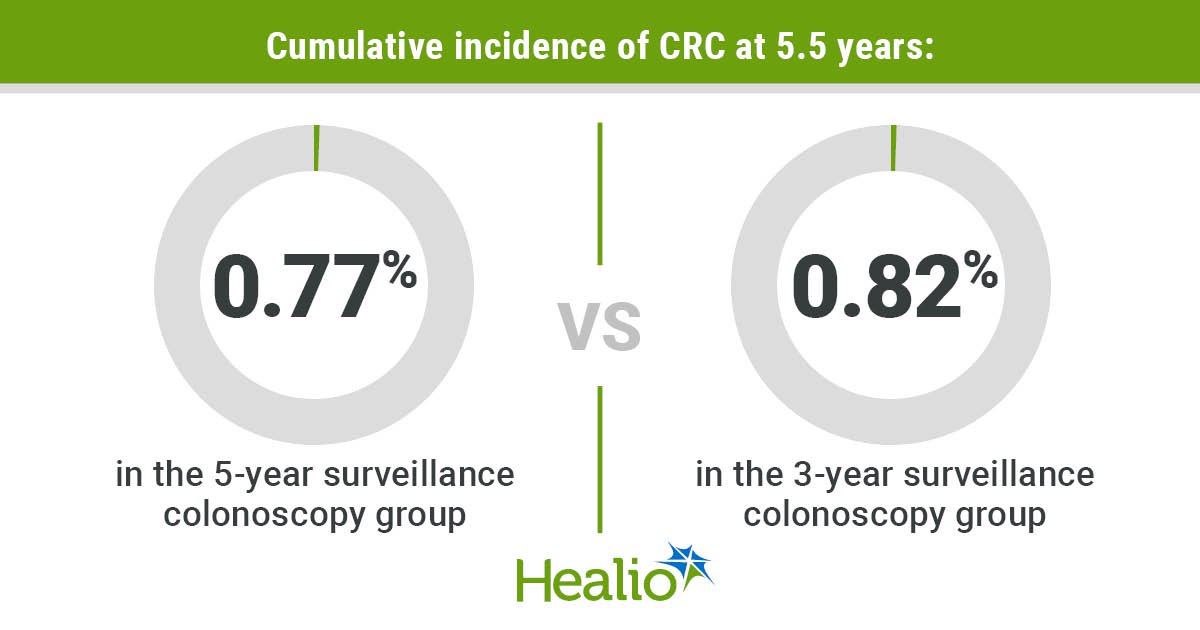
- Incidence of colorectal cancer at 5.5 years was 0.77% in the 5-year surveillance colonoscopy group vs. 0.82% in the 3-year group.
- CRC mortality and stage at diagnosis also were similar between groups.
Incidence of colorectal cancer appeared similar regardless of whether patients underwent surveillance colonoscopy at 3 or 5 years after high-risk adenoma removal, according to interim results of an ongoing, 10-year noninferiority study.
Although current guidelines advise colonoscopy 3 years after polyp removal in high-risk patients, limited data support this recommendation. Extending surveillance intervals could ease both patient and healthcare system burden while also reducing costs, researchers wrote.

Jover R, et al. N Engl J Med. 2026;doi:10.1056/NEJMoa2603816.

Rodrigo Jover
“Endoscopy units are overwhelmed with surveillance colonoscopies after positive results of CRC screening,” Rodrigo Jover, MD, PhD, of Hospital General Universitario Dr. Balmis in Alicante, Spain, told Healio. “Our study investigates the possibility of de-escalating a frequent indication for colonoscopy.”
Jover and colleagues randomly assigned 10,799 patients with high-risk adenomas to undergo surveillance colonoscopy at 5 and 10 years after polyp removal (n = 5,398; mean age, 62.6 years; 65.1% men) or at 3, 5 and 10 years (n = 5,401; mean age, 62.2 years; 65.3% men). All had at least one adenoma with a 10 mm diameter or greater, high-grade dysplasia or villous growth, or between three and 10 adenomas of any kind.
Participants were recruited from 49 endoscopy centers in Spain, Norway, Denmark, Poland, the Netherlands, Sweden, Portugal and Austria between April 2015 and March 2020. More than half (52%) of those enrolled were from Spain.
Cumulative incidence of CRC at 10 years served as the primary endpoint, for which the researchers selected a noninferiority margin of 0.7 percentage points. Secondary endpoints included CRC mortality and stage at diagnosis.
Interim analysis at 5.5 years showed a 0.77% incidence of CRC in the 5-year group and a 0.82% incidence in the 3-year group, a difference of –0.05 percentage points. The upper boundary of the 99.12% confidence interval reached 0.68, matching the predetermined criterion for noninferiority.
Based on these data, “surveillance interval could be probably extended until 5 years after excision of advanced adenomas,” Jover said.
The researchers observed no significant differences in early- or late-stage CRC diagnosis between groups, nor in deaths related to CRC (n = 2 in 3-year group; n = 3 in 5-year group).
Jover highlighted several related areas where additional research might be valuable.
“There are several questions that are not yet answered,” he told Healio. “On the topic of surveillance, for instance, we will investigate which are the real risk factors for development of new lesions after excision of advanced polyps and which patients will take advantage of repeat colonoscopy.”
For more information:
Rodrigo Jover, MD, PhD, can be reached at gastroenterology@healio.com.

Ask a clinical question and tap into Healio AI’s knowledge base.
- PubMed, enrolling/recruiting trials, guidelines
- Clinical Guidance, Healio CME, FDA news
- Healio’s exclusive daily news coverage of clinical data