November 10, 2026
3 min read

Key takeaways:
- Medicaid expansion was significantly association with improved colorectal cancer survival.
- Hispanic patients derived the most benefit.
States with Medicaid expansion had significantly lower colorectal cancer mortality than those without Medicaid expansion.
An evaluation of more than 650,000 patients showed individuals of all races and stages of disease benefited from Medicaid expansion, although Hispanic patients and those with stage IV colorectal cancer had the greatest improvements in survival.

Data derived from Akinyemi O, et al. JAMA Netw Open. 2026;doi:10.1001/jamanetworkopen.2026.34827.

Oluwasegun Akinyemi
“Medicaid expansion in the United States has become a partisan issue,” Oluwasegun Akinyemi, MD, PhD, MSc, health services researcher at Clive O. Callender, MD, Outcomes Research Center at Howard University College of Medicine, told Healio.
“Health is not supposed to be a partisan issue. This policy has been associated with reduction in mortality across all the cancers that we have studied. Male, female, Black, white, Hispanic — everyone benefits from this policy, irrespective of their political background.”
‘Everywhere we look’
American Cancer Society estimated 55,230 individuals would die of colorectal cancer this year, the second most of any malignancy, according to its Cancer Statistics 2026 report.
Prior research has associated insurance and socioeconomic status with stage at diagnosis and survival, according to study background.
In 2014, provisions of the Patient Protection and Affordable Care Act (ACA) permitted states to expand Medicaid eligibility to adults with incomes up to 138% of the federal poverty level and, overall, 40 states and the District of Columbia have adopted this expansion, according to health policy nonprofit KFF.
Medicaid expansion has been associated with a variety of improved cancer outcomes. Healio previously reported women with breast cancer who lived in expansion states had significantly better overall and 5-year survival.
Akinyemi and colleagues also have published data showing improved survival in lung and cervical cancer.
“Everywhere we look, Medicaid expansion was associated with significant improvement in survival,” Akinyemi said. “It was just natural for us to also look at colorectal cancer.”
Researchers used the National Cancer Database, which has data on roughly 70% of all newly diagnosed malignancies in the U.S., to investigate.
They evaluated 658,593 adults aged 40 to 64 years (mean age, 54.9 years; standard deviation, 6.3; 55.7% men) diagnosed with colorectal cancer between 2006 and 2021.
The cohort included 316,097 patients diagnosed before Medicaid expansion (pre-ACA) and 342,496 diagnosed after (post-ACA).
Overall mortality served as the primary endpoint.
‘All benefit’
Compared with non-expansion states, expansion states had significantly lower rates of uninsured patients (post-ACA: 2.4% vs. 9.7%) and higher Medicaid coverage rates (19% vs. 9.5%; P < .001).
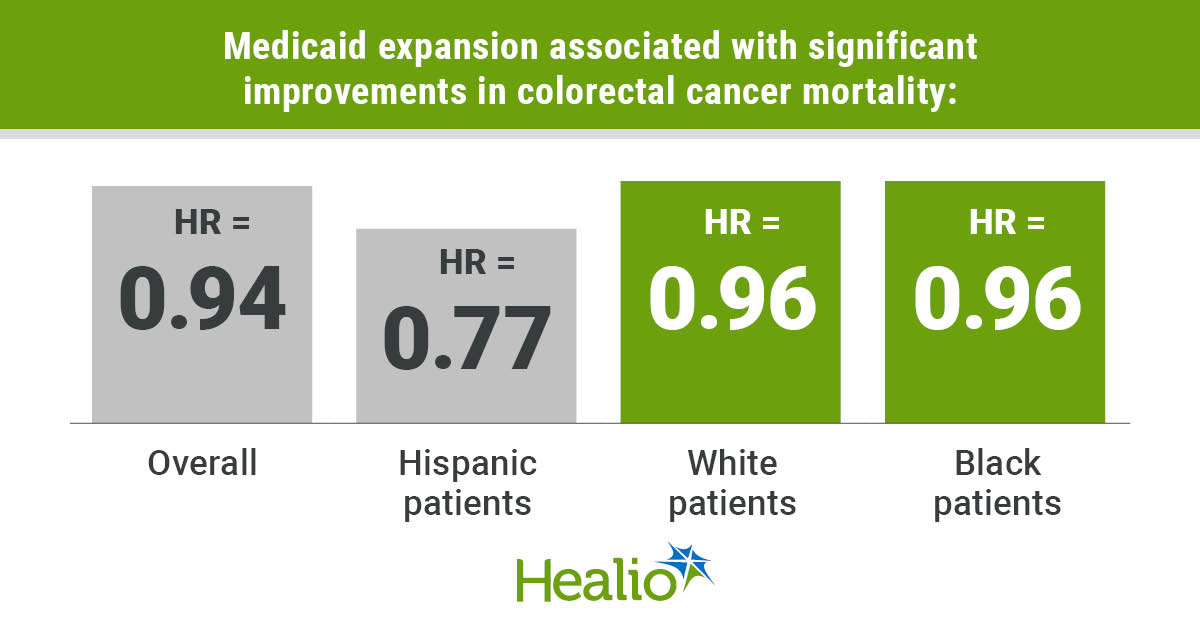
In the post-ACA period, expansion states had significantly lower overall mortality than non-expansion states (HR = 0.94; 95% CI, 0.93-0.95), which corresponded to a 6.3% lower risk for death.
Hispanic patients derived the most mortality benefit with a 22.6% lower risk for death (HR = 0.77; 95% CI, 0.75-0.8). Researchers observed smaller but significant mortality improvements among Black (HR = 0.96; 95% CI, 0.93-0.99) and white (HR = 0.96; 95% CI, 0.94-0.97) patients.
“[Hispanic patients] benefited more, but all benefit from this policy,” Akinyemi said.
Individuals with stage IV disease had the greatest mortality benefit, with an 11.6% lower risk for death (HR = 0.88; 95% CI, 0.83-0.94), compared with those with stage I (HR = 0.95; 95% CI, 0.92-0.97), stage II (HR = 0.97; 95% CI, 0.94-0.99) and stage III (HR = 0.95; 95% CI, 0.93-0.97) malignancies.
“Expansion is not only making sure that more people are diagnosed at an early stage of the disease, but the policy also works for individuals who have advanced stage disease,” Akinyemi said. “These individuals need complex, expensive and ongoing care. Gaps in coverage can interrupt this. Medicaid expansion helps these individuals and improves survival.”
The probability of an early-stage diagnosis increased 2.13 percentage points with Medicaid expansion (P < .001).
Additionally, the likelihood of surgical treatment increased 1.54 percentage points (P < .001), and any treatment rose 0.68 percentage points (P < .001). Conversely, the probability of immunotherapy decreased 1.62 percentage points (P < .001) and chemotherapy fell 1.3 percentage points (P < .001).
Researchers acknowledged study limitations, including its observational design.
Akinyemi noted future investigations should evaluate why certain racial and ethnic groups have greater benefits.
“The focus for the next studies is to explore how those differences in benefits can be reduced such that we close those survival gaps and ensure that there’s equity,” he said.
Despite those differences, Akinyemi emphasized expansion “works” and should be protected in the future.
“Any partisan gutting of this policy or removal of its funding will be followed by worse health outcomes overall,” he said.
For more information:
Oluwasegun Akinyemi, MD, PhD, MSc, can be reached at oluwasegun.akinyemi@howard.edu.

Ask a clinical question and tap into Healio AI’s knowledge base.
- PubMed, enrolling/recruiting trials, guidelines
- Clinical Guidance, Healio CME, FDA news
- Healio’s exclusive daily news coverage of clinical data