November 13, 2026
2 min read
Key takeaways:
- A larger proportion of those receiving oral budesonide vs. dupilumab had incident asthma.
- The budesonide group had a greater number of asthma diagnoses during follow-up vs. the dupilumab group.
PHOENIX — Significantly fewer children with eosinophilic esophagitis receiving dupilumab developed incident asthma than those receiving budesonide, according to findings presented here.

Kayla Steinberger
“Pediatric patients who have allergic diseases are prone to more,” Kayla Steinberger, MD, PhD, resident physician in pediatrics at West Virginia University, told Healio. “We should consider treating patients holistically and ensure patients have access to the most appropriate treatment.”

Data derived from Steinberger K. R052: Early dupilumab treatment for pediatric eosinophilic esophagitis is associated with reduced incident asthma. Presented at: ACAAI Annual Scientific Meeting; Nov. 12-16, 2026; Phoenix.
In a retrospective cohort study presented at the American College of Allergy, Asthma & Immunology Annual Scientific Meeting, Steinberger evaluated children aged 6 years or younger with eosinophilic esophagitis receiving either dupilumab (Dupixent; Sanofi, Regeneron) or oral budesonide in the TriNetX Research Network from 2016 to 2026 to determine if the incidence of asthma differs by treatment.
“Despite strong evidence that childhood allergic illnesses are driven by type 2 inflammation, the type 2 inflammation inhibitor, dupilumab, is not approved for asthma in children until 6 years old,” Steinberger said. “However, it is approved for other allergic diseases such as eczema and eosinophilic esophagitis (an allergic disease of the food tube) in infants.
“I wanted to see if children treated with dupilumab early in life, before its approval for asthma, had lower risk of an asthma diagnosis,” she continued.
Steinberger used propensity scores to match the two groups based on baseline demographics (age, sex) and atopic dermatitis, and this yielded 344 patients in the dupilumab group and 401 patients in the budesonide group.
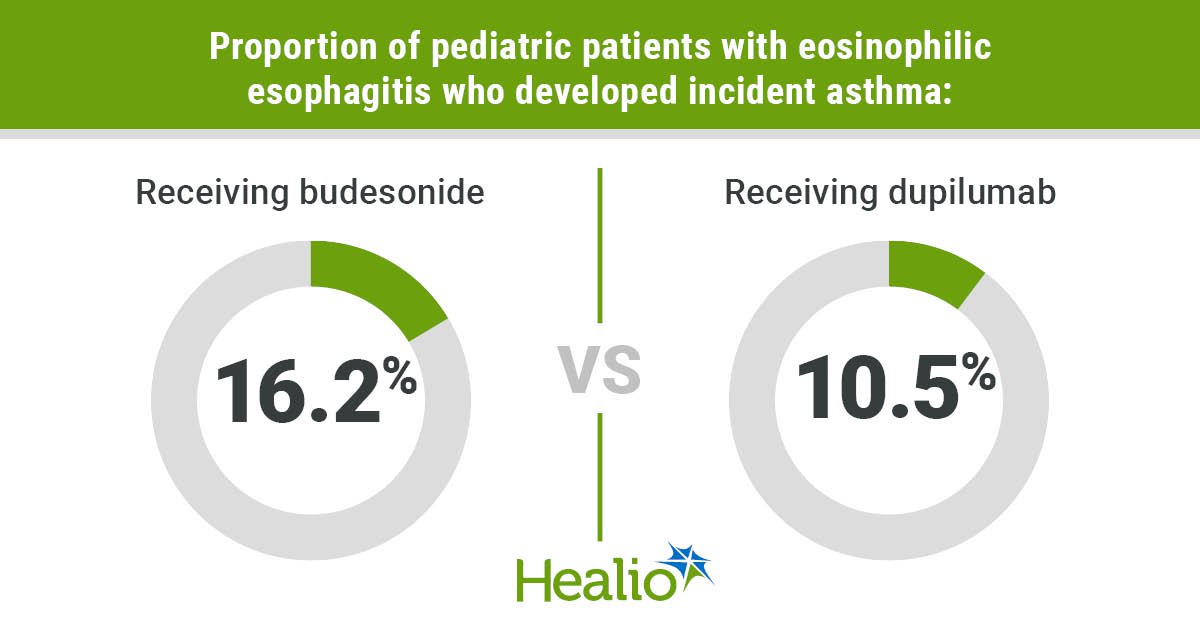
A significantly larger proportion of those receiving oral budesonide vs. dupilumab had incident asthma (16.2% vs. 10.5%; risk difference, 5.7%; P = .022), which corresponded to a higher risk for incident asthma (risk ratio = 1.55; 95% CI, 1.06-2.27).
Steinberger also found that the budesonide group had a greater number of asthma diagnoses during follow-up vs. the dupilumab group (mean, 0.743 vs. 0.369 events per patient; P = .028).
“I hypothesized that new asthma incidence would be lower because dupilumab would be treating the underlying pathway that would lead to asthma, something oral budesonide would not theoretically do,” she told Healio.
“I was, however, surprised that the number of asthma diagnoses per person was also lower in dupilumab treated patients compared to budesonide, as this number represents each time ‘asthma’ was billed for in medical visits (meaning one patient can have multiple ‘asthma’ diagnoses),” she said.
Moving forward, Steinberger said stronger longitudinal prospective studies are needed.
For more information:
Kayla Steinberger, MD, PhD, can be reached at kaylajsteinberger@gmail.com.
Sources/Disclosures
Source:
Steinberger K. R052: Early dupilumab treatment for pediatric eosinophilic esophagitis is associated with reduced incident asthma. Presented at: ACAAI Annual Scientific Meeting; Nov. 12-16, 2026; Phoenix.
Reference:
Disclosures:
Steinberger reports no relevant financial disclosures.

Ask a clinical question and tap into Healio AI’s knowledge base.
- PubMed, enrolling/recruiting trials, guidelines
- Clinical Guidance, Healio CME, FDA news
- Healio’s exclusive daily news coverage of clinical data