
November 18, 2026
4 min read

Key takeaways:
- A common age cutoff for germline genetic testing of solid tumors would have missed nearly three-quarters of people with pathogenic variants.
- The findings support universal testing for people with cancer.
Use of a commonly used age-based cutoff for genetic testing among individuals with solid tumors resulted in a considerable proportion of inherited gene variants going undetected, according to study findings.
An analysis of nearly 40,000 people with a variety of cancer types showed restricting germline genetic sequencing to those aged younger than 50 years would have missed nearly three-quarters of individuals who harbored pathogenic variants.

Data derived from Stadler ZK, et al. Cancer Discov. 2026;doi:10.1158/2159-8290.CD-26-0971.
This equates to a “missed opportunity” to obtain valuable information that could have profound implications for patients and their family members, according to lead author Zsofia K. Stadler, MD, chief of the clinical genetics service and gastrointestinal medical oncologist at Memorial Sloan Kettering Cancer Center.

Zsofia K. Stadler
“I have always thought that we should be moving toward universal testing for patients with cancer,” Stadler told Healio. “These findings prove to us that this is the right move and should be the next step.”
‘Somewhat arbitrary’
Prior research showed early-onset cancers tend to be more enriched for inherited genetic alterations.
People with inherited genetic conditions linked to higher lifetime cancer risk — such as Lynch syndrome or hereditary breast ovarian cancer syndrome — also tend to be diagnosed at younger ages.
Consequently, when genetic testing started “in earnest” about 25 years ago, age became part of the criteria to identify the population likely to derive the most benefit, Stadler said.
“Over the years, the pool of individuals eligible for testing for cancer risk genes has expanded tremendously, but criteria still vary by cancer type,” she said.
For example, genetic testing is recommended for everyone with ovarian cancer or pancreatic cancer. In other malignancies, testing decisions differ by age, family history, ancestry or tumor phenotype.
Stadler and colleagues aimed to investigate whether an age 50 cutoff — which she described as a commonly used “gatekeeper” for genetic testing — remains relevant across cancer types, including those that typically present at older ages.
The researchers performed germline sequencing on 39,184 unselected individuals with one of 32 solid tumor types, using the MSK-IMPACT assay to screen for 94 germline pathogenic variants.
Investigators determined mean age at diagnosis for each cancer type, then used standard deviations to stratify people with each malignancy into three groups based on age at onset (average, early or late).
One in six (16.3%) patients harbored at least one germline pathogenic variant.
Results showed inverse correlation between pathogenic variant prevalence and age at diagnosis, with higher prevalence among individuals with early-onset tumors (18.4%) than average-onset (15.6%) or late-onset tumors (12.3%; P < .001 for comparison).
Testing identified high- or moderate-penetrance pathogenic variants in about one in 10 patients (9.7%). These variants accounted for a greater proportion of enrichment in early-onset cancers (12.4%) than average-onset (8.9%) or late-onset cancers (5.1%; P < .001 for comparison).
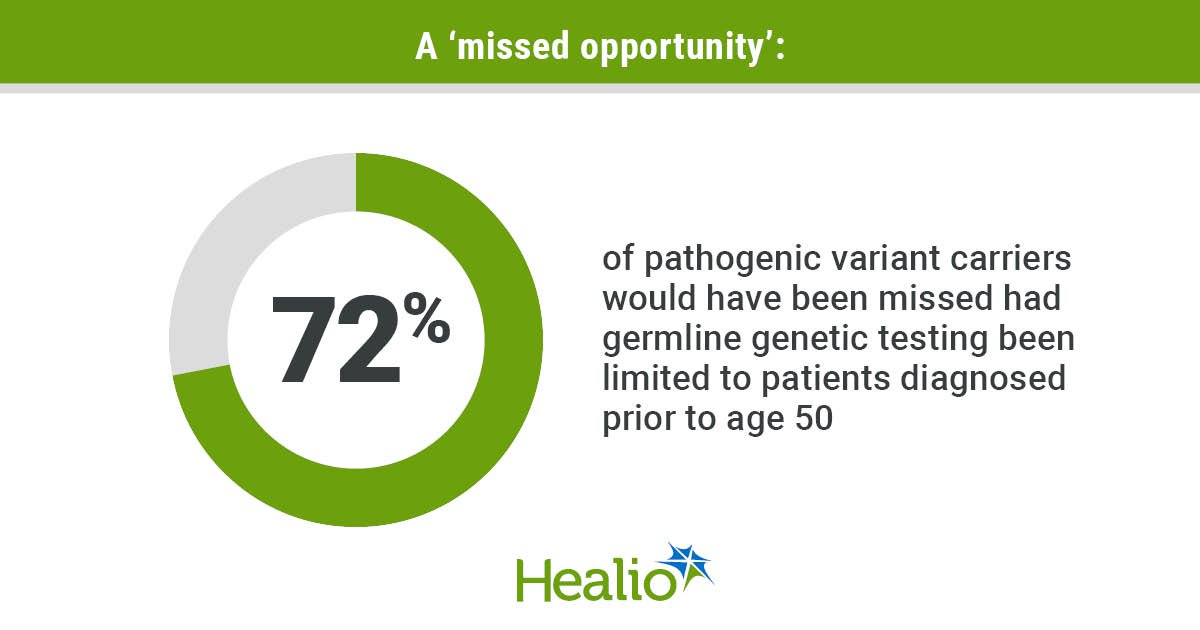
Had hereditary cancer testing been limited to patients diagnosed prior to age 50, about 4,600 pathogenic variant carriers — accounting for 72% of all people with variants — would have been missed.
“Our results confirm that early-onset cancers, regardless of type, are enriched for inherited genetic alterations,” Stadler said. “However, the vast majority of people don’t get cancer before age 50. This much larger sample size, and the burden of hereditary risk among average- or late-onset cases, suggests that the age 50 cutoff probably is somewhat arbitrary.”
Multiple benefits
Moving from conventional age-based criteria toward universal germline genetic testing could yield three distinct benefits, Stadler said.
First, the findings have “therapeutic implications,” Stadler said. For example, detection of BRCA variants can identify people with ovarian cancer or breast cancer who may benefit from treatment with PARP inhibitors.
Second, genetic testing can inform decision-making during survivorship.
A woman who survives breast cancer but does not know she harbors a BRCA1 variant may subsequently develop — and die of — ovarian cancer. In contrast, identification of a BRCA1 mutation may prompt a person to undergo salpingo-oophorectomy — removal of the ovaries and fallopian tubes — to reduce risk for that secondary malignancy.
“Many more people are surviving cancer but, if they are at higher risk for a new malignancy, we need to know that so we can optimize early detection — and possibly prevention,” Stadler said.
Third, people found to harbor inherited variants often inform first-degree relatives, who typically have a 50% chance for carrying the same gene mutation.
“One test doesn’t just help the patient at hand,” Stadler said. “If it leads to cascade testing of at-risk relatives, it can have an impact on entire families.”
The researchers acknowledged study limitations. Its single-institution design and a cohort comprised primarily of Caucasian and Ashkenazi Jewish individuals could limit generalizability of the findings to more diverse populations, Stadler said, though she noted the results remained consistent among individuals of non-European ancestry. The cohort also included overrepresentation of people with pancreatic cancer and underrepresentation of people with lung cancer.
Guidelines from professional societies such as National Comprehensive Cancer Network and ASCO — which greatly influence insurance coverage decisions — likely would need to be updated to endorse universal germline genetic testing for people with cancer for the approach to become broadly adopted, Stadler said.
“I certainly hope that happens,” Stadler said. “The criteria we use to guide testing for some cancer types are so incredibly complex for healthcare professionals that the guideline itself becomes a barrier to testing. Hopefully our data will help move the needle toward universal germline genetic testing. With genetic testing being more accessible and less expensive than it used to be, we now need to get away from such strict criteria and put the infrastructure in place to identify and take care of these high-risk patients.”
For more information:
Zsofia K. Stadler, MD, can be reached at stadlerz@mskcc.org.
Sources/Disclosures
Source:
Stadler ZK, et al. Cancer Discov. 2026;doi:10.1158/2159-8290.CD-26-0971.
Reference:
Disclosures:
Stadler reports intellectual property rights in SOPHiA Genetics. She serves as editor in chief for JCO Precision Oncology and section editor for UpToDate. She also reports an immediate family member is cofounder, chief medical officer and president of Blue Gen Therapeutics Foundation and serves as a consultant in ophthalmology for Beacon Therapeutics, Eli Lilly & Co. and Regeneron Pharmaceuticals Inc. Please see the study for all other authors’ relevant financial disclosures. NIH and Memorial Sloan Kettering Cancer Center funded this study.

Ask a clinical question and tap into Healio AI’s knowledge base.
- PubMed, enrolling/recruiting trials, guidelines
- Clinical Guidance, Healio CME, FDA news
- Healio’s exclusive daily news coverage of clinical data