November 20, 2026
4 min read

Key takeaways:
- Doctors need to become proficient enough with AI to critically assess their outputs, not just accept them.
- Patients should be informed of how AI is being used in their care.
ORLANDO — Familiarity with AI is increasingly necessary in the clinic, and doctors need to be able to discuss their use of AI with patients in an informed way, according to speakers at AIMed26.
“AI is … already part of healthcare, whether we’re fully prepared for it or not,” Orvil F. Martínez, MD, CEO of Advance Medical Research Center and director of the AI Coalition of Puerto Rico, told Healio, adding, “AI literacy is quickly becoming part of clinical competency.”

It is a trend “that certainly is not going away,” Rafael J. Grossmann, MD, MSHS, FACS, general, trauma and acute care surgeon at Portsmouth Regional Hospital in New Hampshire, told Healio.
“It’s only going to become more and more influential in every aspect of care as medicine evolves,” he said.
At AIMed26, Grossmann and Martínez spoke about clinical AI adoption in a session called “AI Is Already Treating Your Patients,” alongside Michael Becker, PhD, MSN, RN, associate principal at Press Ganey, and Gopal K. Chopra, MD, MBA, Dip. Anatomy ASANZ, FRACS, founding general partner at Validare Capital.
Healio spoke with Grossmann and Martínez for more of their thoughts on the future and current state of AI in healthcare.
Healio: What are your main takeaways from this panel?
Grossmann: AI is here to stay, and we really need to explore the use of AI in direct patient care. It is important that every player in this game — the clinicians, the nurses, the APPs, the patients and their families, the regulators and the administrators — take a very active role in becoming proficient in AI. You cannot stay on the sidelines of this.
Martínez: We need to understand how these tools arrive at their conclusions. If an AI system identifies a potential diagnosis, I want to know what information contributed to that assessment and whether the evidence is reliable enough to influence my clinical judgment.
We also need to recognize that healthcare is not the same everywhere. A system developed and validated in one population may not perform equally well in another.
And finally, we cannot forget the human side of medicine. AI should make us better physicians, not distance us from our patients.
Healio: What responsibility do clinicians have to understand AI tools?
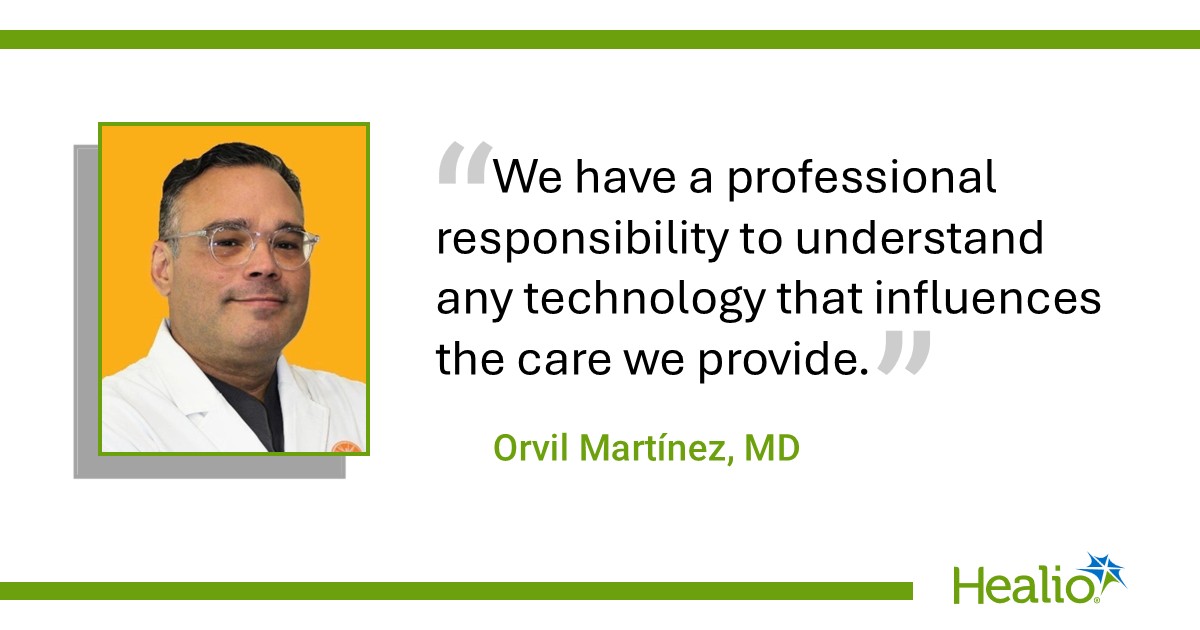
Martínez: We have a professional responsibility to understand any technology that influences the care we provide. That doesn’t mean every physician needs to become a programmer or data scientist. But we should understand what an AI system is designed to do, where its limitations are and when we should question its recommendations.
AI can produce answers that sound extremely convincing, even when they’re incorrect. That creates a new challenge for clinicians. We need to develop the ability to evaluate these outputs critically rather than simply accepting them because they come from sophisticated technology.
Healio: Where has AI delivered the most value for clinicians so far, and where has it fallen short?
Martínez: I see some of the greatest immediate benefits in reducing administrative work and helping clinicians recognize patterns that might otherwise be missed.
But we need to be careful not to confuse technological performance with actual clinical value. A tool can perform extremely well in a research environment and still struggle when introduced into everyday medical practice.
Another concern is whether these technologies work equally well across different populations. Many AI systems are developed using datasets that don’t adequately represent Hispanic, Caribbean or other underserved communities.
The goal isn’t simply to bring more AI into healthcare. It’s to make sure the technology actually improves outcomes for the patients we’re treating.
Healio: What should patients be told about the use of AI in their healthcare? How should practitioners discuss it?
Martínez: Patients deserve transparency, but we also need to communicate in a way they can easily understand. We don’t need to overwhelm patients with technical explanations about algorithms or machine learning. We should explain how the technology is being used in their care, what role the physician plays and how their medical information is being protected.
For example, I might tell a patient, “We’re using an AI tool to help us review your medical information and identify things that may deserve additional attention. But I’ll evaluate those findings alongside your medical history, examination and other clinical information before making a recommendation.” That kind of conversation can build trust.
Ultimately, patients should feel that AI is helping their physician understand them better, not replacing the personal attention they deserve.
Grossmann: If you’re going to get an X-ray, an X-ray is going to be read most likely by an AI algorithm. I don’t think it’s that important that the patient knows about that with a lot of detail. But, I think if we’re saying, “I’m going to have an AI robotic assistant help me do surgery on your tumor,” I think that requires a bit more discussion than just, “Sign here.”
When I have patients sign informed consent forms, that involves informed decision-making by the patient, the family and everyone involved, explaining the basics, the normal, the abnormal, the alternatives, the risks and benefits and so forth. I think that with AI, we need to do the same thing.
Healio: What lessons have healthcare organizations learned about AI so far?
Martínez: One of the biggest lessons is that implementing AI is much more complicated than purchasing software. You can have an impressive algorithm, but if it doesn’t fit into the daily workflow of a physician, nurse or healthcare administrator, its value will be limited. Healthcare organizations are beginning to realize that successful adoption requires education, leadership, clear policies and continuous evaluation.
Some healthcare professionals are excited about AI, while others are concerned about making mistakes, losing autonomy or eventually being replaced. Those concerns shouldn’t be dismissed. We need to address them through education and by involving healthcare professionals in the implementation process.
In my view, the biggest challenge in healthcare AI is no longer just developing the technology. It’s preparing people and healthcare systems to use it effectively and responsibly.
For more information:
Rafael J. Grossmann, MD, MSHS, FACS, can be reached at rgrossz@gmail.com or X @ZGJR. Orvil Martínez, MD, can be reached at orvil@advanceresearchpr.com.
Sources/Disclosures
Source:
Becker M, et al. AI is already treating your patients. Presented at: AIMed26; Nov. 11-13, 2026; Orlando.
Disclosures:
Grossmann and Martínez report no relevant financial disclosures.

Ask a clinical question and tap into Healio AI’s knowledge base.
- PubMed, enrolling/recruiting trials, guidelines
- Clinical Guidance, Healio CME, FDA news
- Healio’s exclusive daily news coverage of clinical data