
 Column
Orthopedics Today Commentary
Orthopedics Today Commentary
The challenges of health care have led many physicians to consider changing their professional environment. The first impulse is to modify the current situation, but systemic and institutional inertia may prevent any meaningful change.
Questions arise and these concerns may be briefly silenced by strong clinical outcomes, patient gratitude or the rewards of mentoring fellows and residents who value your guidance. However, for an increasing number of physicians at every stage of a career, the introspective voices may be growing louder, leading one to question if status quo is still acceptable or if it is time to change course.

These questions are not signs of weakness, loss of resilience or ingratitude. They reflect professional clarity and alignment with priorities and, increasingly, survival. Burnout rates among physicians have risen sharply during the past decade. The corporatization of medicine, loss of clinical autonomy, escalating administrative burdens and a sustained erosion of the patient-physician relationship have contributed.
For younger physicians, disillusionment can arrive before a strong foundation is established. For mid-career physicians, recognizing that a current environment cannot fulfill their long-term vision can feel paralyzing. For senior physicians, early retirement becomes an increasingly appealing alternative.
Not a failure
Changing course is not failure. When approached with clarity, evidence and intention, it is often the most courageous and consequential professional decision a physician can make.
The most effective way to consider a career change begins long before a moment of crisis. Every physician should develop a personal vision and mission statement that integrates professional and family priorities. This can be a dynamic document that articulates your professional vision, how you want to prioritize your time, and what matters most to your family. Ideally grounded in enduring principles, it can be refined as life stages, relationships and family circumstances change.
When this foundation exists, decisions become measurable. You can honestly ask if your current environment is moving you toward or away from stated values. When the answer is consistently away, the stages of change have already begun whether recognized or not.
Stages of change
The Transtheoretical Model of behavior change provides a validated framework for understanding how physicians navigate professional transitions. It identifies six stages: precontemplation, contemplation, preparation, action, maintenance and termination. Every major career pivot aligns with this model.
In the precontemplation stage, a physician has not yet recognized a problem. Performance remains high, external recognition is strong and dissatisfaction is rationalized as temporary. Sentinel events that move a physician into contemplation include leadership transitions, gradual erosion of input in institutional decisions, diminished autonomy and a growing dissonance between personal values and organizational expectations.
Moral distress deserves particular attention. It is not frustration or a lack of resilience. It is a documented psychological red flag arising from a persistent mismatch between a physician’s clinical values and system demands. If unaddressed, it predicts emotional exhaustion, depersonalization and departure from the organization on the organization’s terms rather than the physician’s own terms.
In contemplation, the physician gathers information, strengthens networks and relationships, and consults legal and financial experts. If change is pursued, then action leads to the transition, followed by maintenance, the critical post-transition stabilization period, and finally termination, which marks full integration into a new environment. The central lesson is not to wait for a crisis. When multiple red flags converge, preparation should begin on the physician’s terms.
Structured introspection is the most powerful instrument in any career decision. The strongest predictor of a successful transition is clarity about one’s vision. Ask whether you are building the skills, relationships and reputation that reflect who you want to be in a decade. Without a vision, decisions default to reactivity. Equally important is a structured evaluation of the trade-offs of staying vs. changing.
Life stage
Career mobility is profoundly shaped by life stages. In the early years, mobility is the highest and the cost of redirecting is lowest. A physician who discovers that a clinical environment does not align with their vision should act early and decisively, before a mature practice and referral base are established and contractual obligations mount. Clarity about what you do not want is as valuable as clarity about what you do.
In mid-career, mobility carries real cost. A mature referral network, established relationships with hospitals and ASCs, and ties to your community and school-aged children are powerful anchors. Transitions must be carefully planned, as referral bases are rarely transplanted and financial costs are measurable. However, cost does not mean wrong.
In late career, the risk calculus shifts. Children are leaving home, financial security is more established and one’s professional reputation has matured. However, it is important to recognize that relocating to a different region offers limited portability of a mature referral network. Among professional peers, reputation is more transferable, and leadership roles and industry partnerships become more attainable. A deliberate move now may be viable and lead to long-term satisfaction.
Case for change
Structural forces reshaping medicine, including declining reimbursements, health care system consolidation and administrative responsibilities, are not transient. They are intensifying. The steady increase in burnout and the recognition of misaligned values are stronger predictors of dissatisfaction than income, confirming that physicians who protect their careers effectively take these signals seriously and honestly evaluate how the signals align with their personal vision.
When physicians leave, it is rarely because of failure. It is because staying would have required them to become a different doctor than the one they aspired to be.
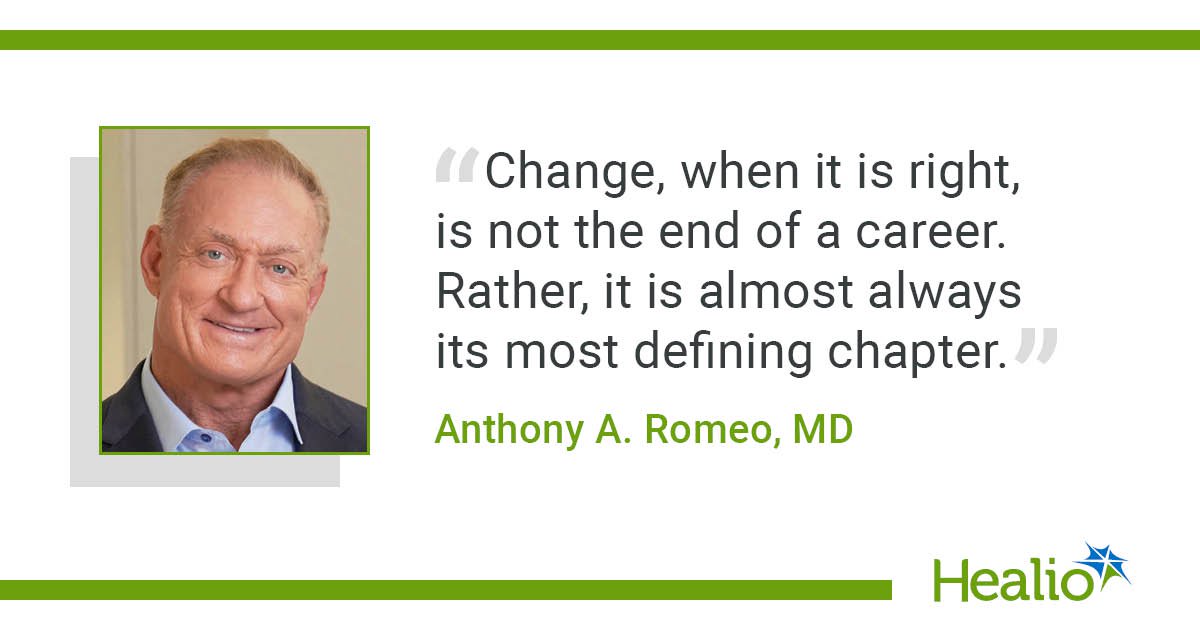
Change, when it is right, is not the end of a career. Rather, it is almost always its most defining chapter. It is never too early or never too late to reassess your course.
For more information:
Anthony A. Romeo, MD, is the Chief Medical Editor of Healio | Orthopedics Today. He can be reached at Healio, 6900 Grove Road, Thorofare, NJ 08086; email: orthopedics@healio.com.
Orthopedics Today Commentary

Sources/Disclosures
Source:
Expert Submission
Reference:
Disclosures:
Romeo reports receiving royalties from, being on the speakers bureau and a consultant for, and doing contracted research for Arthrex.

Ask a clinical question and tap into Healio AI’s knowledge base.
- PubMed, enrolling/recruiting trials, guidelines
- Clinical Guidance, Healio CME, FDA news
- Healio’s exclusive daily news coverage of clinical data