
Key takeaways:
- Peptides are often marketed for tissue repair, inflammation, gut health and injury recovery.
- Although it is a promising area of medical research, there are real risks to using peptides without safeguards.
There is a version of this story that ends well.
A class of molecules with genuine biological potential, freed from bureaucratic delay, reaches patients who need them, backed by solid science and honest clinical data. That version requires patience, rigor and transparency.

What we have instead is something messier: a multi-billion-dollar market, a gray zone of unregulated suppliers, a regulatory system under political pressure, and real people spending real money on compounds that, for most of them, will produce nothing at all. For some, the cost will be far greater than their credit card statement.
Let me be clear about what peptides actually are before we talk about what the wellness industry has turned them into. Peptides are short chains of amino acids, the same building blocks that make up the proteins running virtually every function in your body. Your body already makes millions of them. They regulate hormones, signal immune responses and help coordinate tissue repair. Some of the most transformative drugs in modern medicine are peptides. Insulin is a peptide. So is semaglutide, the active ingredient in Ozempic (Novo Nordisk) and Wegovy (Novo Nordisk), which has genuinely reshaped how we treat obesity and diabetes. The science of peptides is real, serious and worth pursuing.
That legitimate foundation is precisely what the hype machine is exploiting.
How we got here
The acceleration runs parallel to the GLP-1 moment. Ozempic’s rise as a cultural phenomenon did something unintentional: it handed the broader peptide space a coat of credibility it has not earned. If one peptide can produce such dramatic results, the thinking goes, what else might be possible? Influencers, biohackers and longevity entrepreneurs are rushing to fill the gap between that question and a real scientific answer. Compounds with names that sound like NASA spacecraft, BPC-157, TB-500, ipamorelin and MOTS-c, appear in TikTok testimonials, Reddit threads and targeted Instagram ads daily. The social media environment rewards the most enthusiastic claims, not the most careful ones.
According to independent market analysis, consumer searches for “cost of peptide therapy” have surged by 300% between April 2025 and April 2026 alone, which is not a sign of casual curiosity so much as a purchasing funnel moving at speed. The global peptide supplements market, currently valued at over $4 billion, is projected to nearly triple by 2035. Behind those numbers are patients, not clinical trial participants. People paying out of pocket, often without a physician’s guidance, for compounds whose effects in humans remain largely unknown.
The culture around peptide use is particularly visible in Silicon Valley, where a certain brand of techno-optimism is colliding with a deep distrust of regulatory institutions in real time. The argument goes roughly like this: the FDA moves too slowly, drug companies won’t fund trials for compounds they can’t patent, and a community of smart, data-minded individuals can run their own experiments. It is a seductive argument, and also a dangerously incomplete one.
What the evidence actually says
Take BPC-157, arguably the most hyped compound in the current peptide boom. It is marketed everywhere for tissue repair, inflammation, gut health and injury recovery. The preclinical literature is genuinely interesting, with animal studies showing regenerative properties that make theoretical sense. As of early 2026, however, only three published human studies exist, all of them small pilot studies with no placebo controls. The largest human trial ever attempted, a phase 1 study with 42 volunteers, was canceled in 2016 and never published results, leaving fewer than 30 people studied in any formal published human research on this compound. The FDA places BPC-157 on its list of bulk drug substances that may present significant safety risks, citing insufficient evidence alongside concerns about cancer promotion, liver toxicity and immune reactions. The compound is also banned by international sports authorities as a doping substance, none of which has stopped it from becoming one of the most widely-injected, gray-market compounds in the country.
The absence of human data is not a technicality; it is the whole point. When you take a compound that has only been tested in rodents and inject it into yourself, you are not being a citizen scientist, you are serving as a trial participant with no institutional review board, no dosing protocol, no adverse event monitoring and limited to no follow-up. The dose that helps in a rat study may be ineffective or harmful in a human, and a compound that reduces inflammation in one tissue can, in theory, accelerate growth in another, including precancerous tissue.
We do not know the long-term organ effects, the interaction profiles or what people are actually buying. That last point matters more than most people realize. Much of what is sold online arrives labeled “for research use only,” a legal fiction that does nothing to protect the person injecting it. A 2024 study published in Journal of Medical Internet Research that tested peptides purchased from illegal online pharmacies found endotoxins present in every sample tested, with purity rates measured as low as 7.7% to 14.37% against a labeled claim of 99%, and active ingredient content exceeding labeled amounts by nearly 40% in some cases.
The regulatory moment we are in
The federal government is considering changes to how these compounds are regulated right now. Health Secretary Robert F. Kennedy Jr., a vocal advocate for peptide access, previewed action on the Joe Rogan podcast earlier this year. In April, the FDA announced it will convene an advisory panel in July to evaluate whether several popular peptides, including BPC-157, should be added to a list of substances that compounding pharmacies can legally produce. The Associated Press reported that the FDA also plans to remove these compounds from a more restrictive list reserved for high-risk unapproved drugs in the interim.
The framing around this change matters enormously. Allowing compounding pharmacies to produce these peptides does not change their status as unapproved drugs, does not mean clinical trials have been conducted, and does not mean the FDA has evaluated them for safety or efficacy in humans. It means that patients could access them through a licensed pharmacy rather than a gray-market website, which does represent a genuine, if limited, reduction in contamination risk worth acknowledging. The deeper concern, captured precisely by a former FDA official quoted by the Associated Press, is that if there is now a less rigorous path to market, companies will have little incentive to invest in the full approval process, trading a functional if slow vetting system for a permanent state of mass uncontrolled experimentation on the American public.
The real cost
The best-case scenario for most people currently buying peptides from influencer-linked retailers or gray-market websites is that nothing happens. They spend hundreds or thousands of dollars on compounds with no proven benefit, receive no discernible effect, and eventually move on. That is the optimistic outcome and, I suspect, the most common one. The worst-case scenarios are not hypothetical. At a longevity conference in Las Vegas in the summer of 2025, two women were hospitalized in critical condition after receiving peptide injections at a provider’s booth — a documented, public incident that drew expert scrutiny and underscored the real consequences of injecting unvetted compounds outside any clinical framework. The psychological harm of chasing optimization through injections of unproven compounds, particularly for people managing chronic pain, body image concerns or underlying health conditions, also deserves far more attention than it currently receives in this conversation.
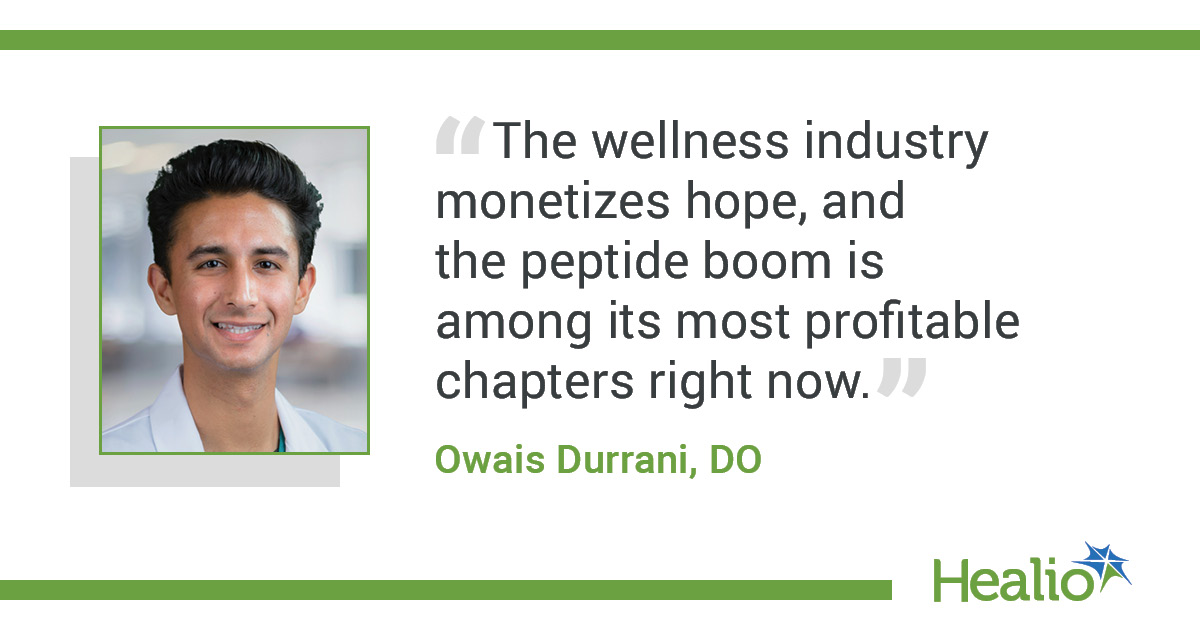
There is a structural harm that is harder to quantify as well. Every dollar spent on an unproven peptide stack is a dollar not spent on an evidence-based intervention, and every hour a patient spends researching compounds on Reddit or through an AI chatbot is time not spent having a real conversation with a physician. The wellness industry monetizes hope, and the peptide boom is among its most profitable chapters right now.
What we should actually do
The path forward is not to ban curiosity or dismiss the underlying science. Peptides represent a genuinely promising area of medicine, and the legitimate therapeutic landscape, anchored by FDA-approved drugs with real clinical data, will continue to grow. The broader peptide therapeutics market is projected to nearly double over the next decade, driven by approved drugs that went through the rigorous process of being tested in humans.
What we need is proportionality. Patients deserve honest information about what these compounds are and are not. Physicians who prescribe them should be transparent that they are operating at the frontier of experimental medicine, not offering validated therapy. Regulators, whatever decisions they make in July, should insist on post-market surveillance and adverse event reporting so that we can at least learn systematically from what is already happening at scale. The ecosystem of influencers, longevity entrepreneurs and platform algorithms amplifying unproven claims needs to be held to a much higher standard of disclosure, with financial relationships to product sellers made explicit rather than buried in a discount code.
The success of GLP-1 drugs did not come from bypassing the approval process. It came from decades of rigorous science followed by clinical trials that proved, in humans, that these drugs work and that their benefits outweigh their risks. That process is worth protecting, not because regulators are infallible, but because patients deserve more than a promising animal study and a referral link.
The hype around peptides is not going away. The question is whether we let it run unchecked or build the evidence base that would allow us to separate what works from what does not. One of those paths produces medicine. The other produces a very profitable gray market, with harm waiting at the end.
For more information:
Owais Durrani, DO, is an emergency medicine physician. He can be reached at owaisdurrani@gmail.com and on LinkedIn, Instagram, YouTube and X.
Sources/Disclosures
Source:
Expert Submission
References:
- Ashraf AR, et al. J Med Internet Res. 2024;doi:10.2196/65440.
- BPC-157: A prohibited peptide and an unapproved drug found in health and wellness products. https://www.opss.org/article/bpc-157-prohibited-peptide-and-unapproved-drug-found-health-and-wellness-products. Published April 29, 2025. Accessed May 8, 2026.
- BPC-157 human clinical trials (2025-2026): Complete status & results. https://peptide-db.com/guides/bpc-157-human-trials. Published Dec. 27, 2025. Accessed May 8, 2026.
- Certain bulk drug substances for use in compounding that may present significant safety risks. https://www.fda.gov/drugs/human-drug-compounding/certain-bulk-drug-substances-use-compounding-may-present-significant-safety-risks. Accessed May 8, 2026.
- Current state of the peptide market and where it’s headed in telehealth. https://openloophealth.com/blog/current-state-of-peptide-market-2026. Published April 15, 2026. Accessed May 8, 2026.
- FDA to weigh easing limits on unproven peptides favored by RFK Jr. and MAHA supporters. https://www.pbs.org/newshour/health/fda-to-weigh-easing-limits-on-unproven-peptides-favored-by-rfk-jr-and-maha-supporters. Published April 15, 2026. Accessed May 8, 2026.
- McGuire FP, et al. Curr Rev Musculoskelet Med. 2025;doi:10.1007/s12178-025-09990-7.
- Peptide supplements market analysis: Size, share and forecast outlook 2025 to 2035. https://www.futuremarketinsights.com/reports/peptide-supplements-market. Published July 8, 2025. Accessed May 8, 2026.
- Peptide therapeutics market (2026-2033). https://www.grandviewresearch.com/industry-analysis/peptide-therapeutics-market. Accessed May 8, 2026.
- Two people almost died at RAADfest. We went to the experts. https://lifespan.io/two-people-almost-died-at-raadfest-we-went-to-the-experts/. Published Sept. 2, 2025. Accessed May 8, 2026.
Disclosures:
Durrani reports no relevant financial disclosures.

Ask a clinical question and tap into Healio AI’s knowledge base.
- PubMed, enrolling/recruiting trials, guidelines
- Clinical Guidance, Healio CME, FDA news
- Healio’s exclusive daily news coverage of clinical data