Key takeaways:
- Pediatric patients/parents were asked how often they/their child experienced 12 EoE-related symptoms and were referred to GI if symptoms were concerning for EoE.
- Eight patients received a new EoE diagnosis.
Through a symptom-based screening approach, 8% to 13.9% of pediatric patients with asthma who were seen in an academic pediatric asthma/allergy clinic had eosinophilic esophagitis, according to study results.
These results were published in The Journal of Allergy and Clinical Immunology: In Practice.

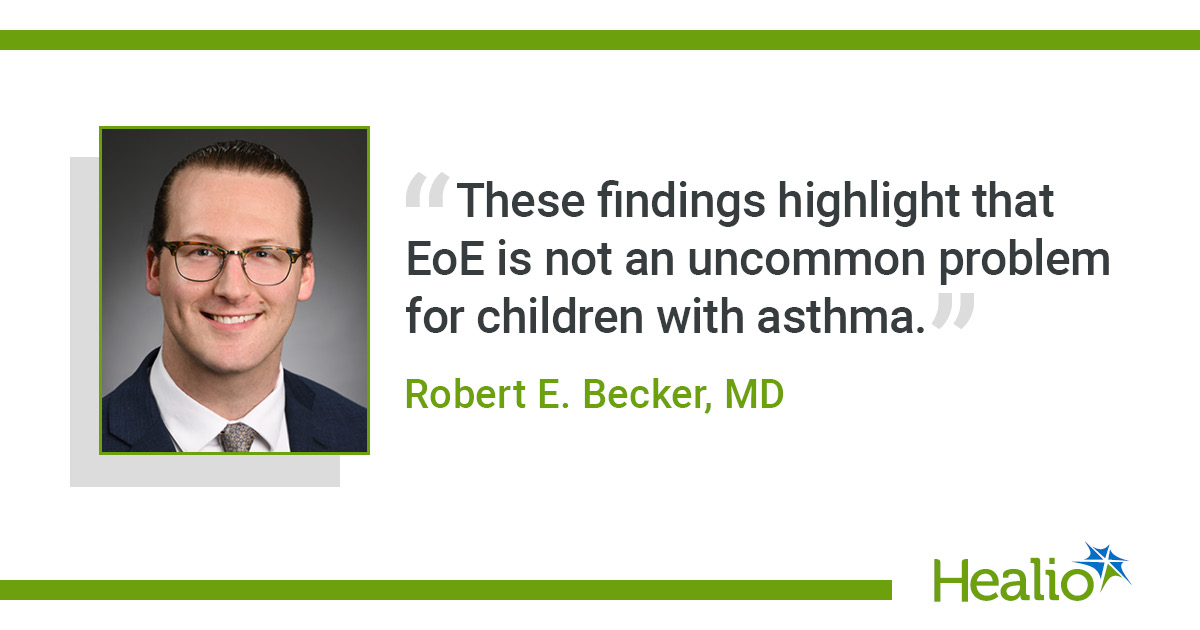
“These findings highlight that EoE is not an uncommon problem for children with asthma, and there may be a role for screening children with asthma for symptoms of EoE proactively,” Robert E. Becker, MD, pediatric gastroenterologist at Children’s Hospital of Wisconsin and assistant professor of pediatric gastroenterology at the Medical College of Wisconsin, told Healio.
In this study, Becker and colleagues assessed 189 pediatric patients (median age, 8.6 years; 58.7% boys; 39.2% Black/African American; 29.1% white; 16.4% Hispanic/“Latinx”) with asthma to determine how prevalent EoE is in this population via a modified Pediatric Eosinophilic Esophagitis Symptom Severity v2.0 (PEESSv2.0) questionnaire given in a tertiary care pediatric asthma/allergy clinic to screen for disease.
“This study was the brainchild of Dr. Diana Lerner, one of the manuscript’s senior authors,” Becker said. “It is not unusual for patients to have symptoms for years prior to being diagnosed with EoE, so we wondered to what extent EoE was undiagnosed among children and adolescents with asthma.”
The parents of patients aged 3 to 6 years completed the survey, whereas patients aged 7 to 17 years completed the questionnaire. The study outlined that the questionnaire asked patients/parents how often they/their child experienced 12 EoE-related symptoms: chest pain, heartburn, stomach aches, trouble swallowing, food gets stuck, need fluids to swallow, vomiting, nausea, food comes back up, eats less than others, needs more time to eat and avoids difficult foods.
Seventy-two of the 189 subjects (38%) were referred to gastroenterology by the allergists because of symptoms deemed concerning for EoE. Eight patients received a new EoE diagnosis.
In the studied population, 8% (95% CI, 5.1%-11.7%) was the total confirmed EoE prevalence, “assuming there were no undiagnosed cases of EoE among non-participants or patients lost to follow-up,” the authors wrote.
After accounting for patients who declined participation or were lost to follow-up, researchers projected a prevalence of 13.9% (95% CI, 10.1%-18.4%).
“We found that about 10% of children and teenagers seen in this setting (tertiary care pediatric asthma/allergy clinic) have EoE,” Becker told Healio. “We generally know that kids with asthma and allergies have increased risk for EoE, but there have not previously been estimates of this prevalence based on proactive screening.”
When compared with those without EoE, those with EoE were similar in age, sex, race, BMI z scores, asthma severity and number of comorbidities.
Lastly, researchers reported a significant link between vomiting at screening and an EoE diagnosis, as a larger proportion of those with vs. without EoE reported this symptom (37.5% vs. 1.7%; P = .001). No other individual screening symptoms reached significance.
“In the future, it will be important to know the prevalence of EoE in other clinical settings and to inch toward better understanding of how, when, why and for whom we may screen for symptoms of EoE,” Becker told Healio.
For more information:
Robert E. Becker, MD, can be reached at rbecker@mcw.edu.

Ask a clinical question and tap into Healio AI’s knowledge base.
- PubMed, enrolling/recruiting trials, guidelines
- Clinical Guidance, Healio CME, FDA news
- Healio’s exclusive daily news coverage of clinical data